Displaying items by tag: Percy Herbert
Carry on Jack
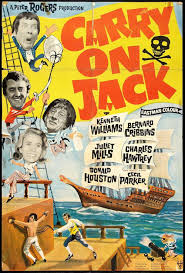
CARRY ON JACK
UK, 1964, 91 minutes, Colour.
Kenneth Williams, Charles Hawtrey, Bernard Cribbins, Juliet Mills, Donald Houston, Percy Herbert, Jim Dale, Patrick Cargill, Cecil Parker, Ed Devereaux, Peter Gilmore, George Woodbridge, Anton Rodgers.
Directed by Gerald Thomas.
This Carry on comedy came immediately after Carry on Cleo. One of the three Carry on films of 1964.
The film has a naval theme, even starting with the death of Nelson and the episode of “Kiss me, Hardy”. It is the first film completely written by Talbot Rothwell who was to continue the series into the 80s. He took over from Norman Hudis.
The first comment to be made is to note the absence of Sid James, Joan Sims, Kenneth Connor, Hattie Jacques. Since most of the action is at sea, no major roles for Joan Sims or Hattie Jacques. The main serious role is taken by Donald Houston, a serious actor rather than a comedian, but it might have been taken up by Sid James but with much more irony than the straightforward anger of Houston. Bernard Cribbins has the central role which is very much a variation on a lot of the characters played by Kenneth Connnor.
But, Kenneth Williams and Charles Hawtrey are there, William is the captain of the ship, initially seasick, allegedly Captain Fearless, anything but. Charles Hawtrey has a better role but much the same shtick as a cesspool cleaner press-ganged onto the ship. They have plenty to do in the latter part of the film when the four central characters experience a mutiny and are put to see in a boat.
Bernard Cribbins does very well as the put-upon midshipman, his uniform ‘s and sword stolen by Juliet Mills who wants to stow away to meet her lover in Spain. And, there are many character actors as usual, Percy Herbert as the tough officer, Jim Dale as carriage courier, Patrick Cargill as a Spanish Governor, Ed Devereaux as a pirate and Cecil Parker as the lord admirable.
Something of a little parody of Mutiny on the Bounty and H.M.S.Defiant (and the film using some of their sets). Carry on with the lighter touch.
Carry on Cowboy
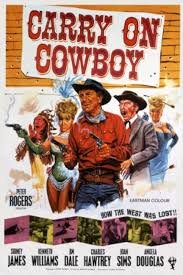
CARRY ON COWBOY
UK, 1965, 93 minutes, Colour.
Sidney James, Kenneth Williams, Jim Dale, Charles Hawtrey, Joan Sims, Angela Douglas, Bernard Bresslaw, Peter Butterworth, Percy Herbert, Jon Pertwee.
Directed by Gerald Thomas.
One of the advantages for this episode in the Carry on a series is that audiences are so familiar with westerns. And, underlying the Carry on humour here, there is a basic plot that could have been in any of the westerns over the decades, a gunfighter, the mayor, the sheriff, the saloon, the Madame, the gamblers, the singers, cattle rustling, the new marshall, the confrontations and the shootout. All very familiar, but generally always welcome with audiences.
So, how does the British cast handle being characters in a Western? And, their accents? Sid James is the gunfighter, with a roving eye and a leer. But, most interestingly, there is Kenneth Williams doing his usual shtick but with a huge moustache and with a heavy American accent (which he said was based on the American director, Hal Roach). And, Joan Sims does her bit as the madame, while Angela Douglas, to appear in several Carry on films, is Annie Oakley.
There is a lot of play on names like Marshall P. Knut. And a joke with Charles Hawtrey being the Indian chief, glasses, British accent and his usual comic style, Big Heap and the large Bernard Bresslaw as Little Heap (looking back one hopes the comedy overcomes any racial offensiveness).
So, the usual jokes and puns, the innuendo, a lot of physical comedy and pratfalls, and variations on the familiar American Western conventions.
And, in retrospect, as with most of the Carry on films, many bloggers saying it is the best and some saying it is the worst. (This reviewer was favourable.)
Cracksman, The
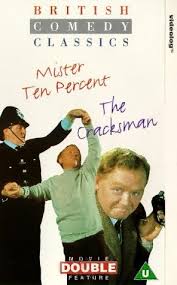
THE CRACKSMAN
UK, 1963, 112 minutes, Colour.
Charlie Drake, George Sanders, Dennis Price, Nyree Dawn Porter, Eddie Byrne, Finlay Currie, Percy Herbert, Geoffrey Keen, Patrick Cargill, Norman Bird, Ronnie Barker.
Directed by Peter Graham Scott.
Despite the notable cast, and the big Cinemascope and colour treatment, this is a comedy that is very much of its time, indication of British cinema in the early 1960s, but not the kind of comedy that lasts.
It is a star vehicle for comedian, Charlie Drake, who had his major successes in television series in the late 1950s and early 1960s – and continued after his slate of films which did not bring him lasting cinema success. While popular at the time, he is very much an acquired taste.
Charlie Drake contributed to the writing of the screenplay, a star vehicle for himself, naivete personified, a completely ingenuous character. He is a locksmith, working in the London streets, content with himself and his ability for being able to unlock any lock, no matter how difficult. So, short in stature, roly-poly in size, naive as well as wisecracking, he is played on by quite a number of characters starting with Dennis Price who passes himself off as a wealthy man and is able to persuade the cracksman to enter a house to rob it. And the police arresting.
The scenario happens over and over again throughout the film, the cracksman being taken in, doing a range of jobs, back in prison where, in fact, he is rather admired – but also played on. (And, for fans of the two Ronnies, here is Ronnie Barker as a prisoner, prior to his television term as Fletcher in Porridge.)
Ultimately, when the cracksman is out of jail, he is used by two gangs for quite an elaborate robbery, one gang led by Eddie Byrne, the other, more suave, led by, of all people, George Sanders. Ultimately, the ingenuous cracksman who has fallen for an undercover policeman, Nyree Dawn Porter, is able to set the two gangs in a fight against each other.
The supporting cast is enjoyable, Patrick Cargill as a snobby guide in the Museum, Finlay Currie as a good old prisoner, Percy Herbert leading the gangs in prison, Geoffrey Keen as a magistrate.
Barnacle Bill/ All at Sea
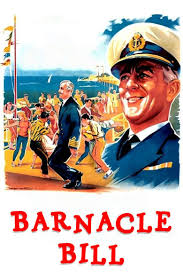
BARNACLE BILL/ALL AT SEA
UK, 1957, 87 minutes, Black-and-white.
Alec Guinness, Irene Brown, Percy Herbert, Maurice Denham, Victor Maddern, Donald Pleasance, Warren Mitchell, Lionel Jeffries, Jackie Collins, Miles Malleson, Allan Cuthbertson, Charles Lloyd Pack, George Rose, Richard Wattis, Eric Pohlmann, Joan Hickson.
Directed by Charles Frend.
Barnacle Bill/All at Sea was Alec Guinness’ last comedy film, immediately after his Oscar win in The Bridge on the River Kwai, 1957. And, it was the last of his Ealing comedies, his moving into more serious films into the 60s and 70s.
The film was written by T.E.B.Clark, author of many of the Ealing studios films, Passport to Pimlico, Lavender Hill Mob, films about individuals and their defying the authorities. It is the same here, Captain Ambrose, played by Guinness, has seafaring ancestors, even from the Stone Age, and/or visualised with Guinness playing each of them, but all suffering from seasickness and disasters. During World War II, in Ambrose tested vessels rather than going to see!
After the war, very seriously, he buys a pier on the coast, the ship Arabella, and turns it into the equivalent of the tourist ship. But, he runs foul of the local Council, leading to scenes of tourists enjoying the comforts of a sea voyage and some sabotage from the Council members.
It is brief, rather low-key, British comedy of the time, social commentary. And, looking at the cast, it is filled with quite a number of well-known British character actors of the period or who were to emerge successfully in coming decades in television series – Warren Mitchell, Donald Pleasance, Joan Hickson… And, yes, that is the Jackie Collins in the cast!
Direction was by Charles Frend, who directed many of the significant British films, especially the 1940s and 50s, including Scott of the Antarctic and The Cruel Sea.
- From Ealing studios in the 1950s? An Alec Guinness vehicle and his Ealing Studios films? The individual against the corporations?
- Ealing Studios comedy, the writer, the directors, British humour, situations, character actors? Musical score?
- The title, given the alternate All at Sea?
- The introduction to Captain Ambrose, a celebrity, the honours, his manner, perfectly straightforward sometimes mischievous humour? The interviews, his reputation, at the pub, the rum cask, going to the bank, his money account, the staff, listening to his story, at the end, the celebrity mood?
- Captain Ambrose’s story? His ancestors, from the Stone Age, Francis Drake, the Later Sea Captain, World War I – and Alec Guinness playing all roles? Seasickness and the way that it was manifested, the comic tragedies?
- Captain Ambrose and his war career, seasick, the audience thinking he was at dea, but his career in demonstrating seasickness in various vessels?
- His decision to buy the Arabella, the pier? Very serious, spending his money? The initial encounter with Mrs Barrington and her accusations? Going to the pier, the staff, seriously setting up the ship and the crew? The first officer and reliance on him? The performance, the Houdini -like character, the Captain tying him up in a bag, unable to get out?
- Captain Ambrose vision for the pier, looking at the slot machines, the police, getting the young expert, his knowing how to win with skill? The machines being allowed? The youngsters, the rock ‘n’ roll atmosphere, taunting Captain Ambrose, coming to the concert, the talent not turning up? Playing the piano, dancing, the ripping up of the seats, providing the dance area, the youngsters enjoying it?
- The plan to turn the Arabella into a cruise ship, holidays, yet at the pier? The work, the volunteers, the transformation? The dining area, the pool, all the luxuries?
- The Mayor, his visits and discussions, the Council meetings, his henchmen, legal advice, Mrs Barrington? Corruption? The decision to improve the seafront, threatening Mrs Barrington’s dressing cabins, upset, the encounter with Captain Ambrose, his taking them, installing, her supporting him, her transformation, drinking the rum?
- The crowds, coming aboard, the atmosphere of the luxury ship? The staff? Captain happily moving amongst his guests? The young lovers always hiding in boats et cetera?
- The Council, their plans, the confrontations, the turncoat, swimming underwater engaging the depths, seen by the drinking Captain? Looking at the radar? Reality, his being Captain, interrogated?
- The Council and the plan, sending out the boat, underwater, the Captain, facing his seasickness, Mrs Barrington’s cure, corset and earplugs? Going out, the confrontation, the four in the cage, trying to escape, Captain Ambrose and the machinery, capturing the Council?
- The legal issues, the cruise ship and the foreign government and the permits? Sawing the connection so as not to pay shore taxes?
- Small British comedies of the 1950s, the humour, still entertaining even if they look dated?
