Displaying items by tag: Donald Houston
Carry on Jack
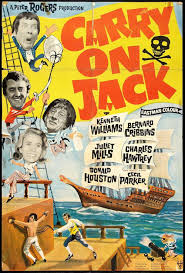
CARRY ON JACK
UK, 1964, 91 minutes, Colour.
Kenneth Williams, Charles Hawtrey, Bernard Cribbins, Juliet Mills, Donald Houston, Percy Herbert, Jim Dale, Patrick Cargill, Cecil Parker, Ed Devereaux, Peter Gilmore, George Woodbridge, Anton Rodgers.
Directed by Gerald Thomas.
This Carry on comedy came immediately after Carry on Cleo. One of the three Carry on films of 1964.
The film has a naval theme, even starting with the death of Nelson and the episode of “Kiss me, Hardy”. It is the first film completely written by Talbot Rothwell who was to continue the series into the 80s. He took over from Norman Hudis.
The first comment to be made is to note the absence of Sid James, Joan Sims, Kenneth Connor, Hattie Jacques. Since most of the action is at sea, no major roles for Joan Sims or Hattie Jacques. The main serious role is taken by Donald Houston, a serious actor rather than a comedian, but it might have been taken up by Sid James but with much more irony than the straightforward anger of Houston. Bernard Cribbins has the central role which is very much a variation on a lot of the characters played by Kenneth Connnor.
But, Kenneth Williams and Charles Hawtrey are there, William is the captain of the ship, initially seasick, allegedly Captain Fearless, anything but. Charles Hawtrey has a better role but much the same shtick as a cesspool cleaner press-ganged onto the ship. They have plenty to do in the latter part of the film when the four central characters experience a mutiny and are put to see in a boat.
Bernard Cribbins does very well as the put-upon midshipman, his uniform ‘s and sword stolen by Juliet Mills who wants to stow away to meet her lover in Spain. And, there are many character actors as usual, Percy Herbert as the tough officer, Jim Dale as carriage courier, Patrick Cargill as a Spanish Governor, Ed Devereaux as a pirate and Cecil Parker as the lord admirable.
Something of a little parody of Mutiny on the Bounty and H.M.S.Defiant (and the film using some of their sets). Carry on with the lighter touch.
Man Upstairs, The
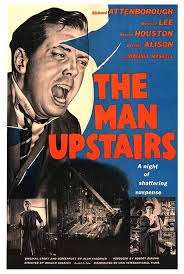
THE MAN UPSTAIRS
UK, 1958, 88 minutes, Black-and-white.
Richard Attenborough, Bernard Lee, Donald Houston, Dorothy Allison, Virginia Maskell, Kenneth Griffith, Patricia Jessel, Alfred Burke, Charles Houston, Maureen Connell, Walter Hudd.
Directed by Don Chaffey.
British 1950s psychological drama. There is an ensemble British cast led by Richard Attenborough, persuasive as a man who has been involved in an accident causing death which has taken its toll on him.
The action takes place over several hours in the early hours of the morning, the man upstairs waking, nightmares, upset, interacting with various members who live in the block of flats in London, attacking one, barricading himself in his room, the police arriving with strong, unsympathetic tactics (led by Bernard Lee), contrasting with the sympathetic wife and mother downstairs, Dorothy Alison, and different reactions from members of the household, especially the righteous Kenneth Griffith. Donald Huston plays a local counsellor who does get an opportunity to talk with the man upstairs but with little effect.
The action takes place within the block of flats, sometimes going outside to see the crowds, the police holding them back, the fire brigade arriving.
Some commentators have noted that this film came out just after the American 12 Angry Men, a drama in a room where members of the jury argue the different aspects of the case. Some bloggers have noted that they found the film tedious. Others, more sympathetic, will be interested in the character and experience of the man upstairs as well as the variety of responses to him.
- The title, the anonymity, the false name, the real name? Upstairs, the block of flats, the upstairs room, the stairs, the window, looking out to the street? Black and white photography?
- The British ensemble cast and its effectiveness?
- The situation, John Wilson/Peter Watson, waking, upset, in his room, there for three weeks, his bewildered reactions, the early hours of the morning? The encounter with the artist and his not helping? The encounter with Mr Pollen, hitting him and the reaction? The friendship with Mrs Barnes, helping her son with his homework? The continued trauma and bewilderment?
- The arrival of Helen, Mrs Barnes calling her, the story of the past, the accident, her brother’s death, the court case, the man’s outburst, his having a record?
- The gathering of those in the block, the harsh landlady, Dolly herself up, with Mr Pollen, the drinking, her harsh attitudes, cynical touches? The contrast with the elderly lady, frightened in her bed, brought downstairs? The artist, his work, his girlfriend present, trying to conceal her presence? Mr Pollen, fussy, civil defence, calling the police, backing the police? Mr Barnes arriving home after work? The range of people, the drama of their points of view, conflicts, final reactions, Mrs Barnes urging them all to go upstairs, Mr Pollen holding out, the going up the stairs?
- The arrival of the police, police attitudes, Thompson, his straightforward attitudes, harsh, unsympathetic to mental illness, doing his job? Intervening, the police going upstairs, the man pushing the policeman and his falling over the railing, to hospital? Thompson aggravated? The role of the other police, standing guard, guns, the arrival of the superintendent, the range of discussions, his decisions, Thompson disagreeing?
- Sanderson, his role in the borough, wanting to talk, Thompson’s lack of sympathy, the superintendent allowing him up, his attempts to talk, knocking, going in, the man’s reactions? Support with Mrs Barnes? The discussions with the superintendent?
- The fire brigade, the police, the teargas issue and its use?
- The light, into the room, the man upset, the suitcase on the window ledge, his pushing it over? The gun and the threats? With Sanderson and overcoming him?
- Mrs Barnes, urging, agreements and disagreements, the decision to go upstairs, her leadership, the meeting with the police? Her being allowed to go up, knocking, talking, the three minutes time limit, the man eventually coming out?
- The man, let downstairs, led away?
- The film of the 1950s, the role of the police, the role of mental illness, treatment, sympathy, harsh attitudes?
