Displaying items by tag: Cecil Parker
I Believe in You
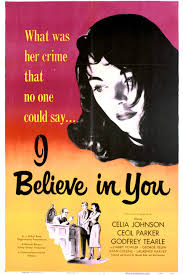
I BELIEVE IN YOU
UK, 1952, 95 minutes, Black-and-white.
Cecil Parker, Celia Johnson, Harry Fowler, Joan Collins, George Relph, Godfrey Tearle, Ernest Jay, Laurence Harvey, Ursula Howells, Sidney James, Katie Johnson, Ada Reeve, Brenda de Banzie, Gladys Henson.
Directed by Michael Relph, Basil Dearden.
This is a serious British film of the early 1950s, the team of Michael Relph and Basil Dearden, making a number of serious films together, then Basil Dearden directing on his own with such significant films as Victim and Khartoum.
Cecil Parker had established himself as a serious character actor and leads the cast here, a retiree, wanting to do something better with his life, becoming a parole officer, having to adapt his manner and even his clothing to the ordinary types that he encountered, yet able to get the trust of several, guide them, supervise, be challenged, make mistakes. He provides a voice-over for the action.
There is a very strong supporting cast led by Celia Johnson, best known for her Oscar-nominated performance in David Lean’s version of Noel Coward’s Blithe Spirit. There is a young Laurence Harvey as a surly criminal. And Joan Collins in her fourth film, making an impression – and, within two or three years, starring in Hollywood films. There is Sidney James working in an office, Katie Johnson, the famous old lady from the Ladykillers, an early role for Brenda de Banzie.
Not necessarily a film that contemporary audiences want to watch, but a worthy film and a reminder of past issues in British society.
- A serious piece of British filmmaking in the 1950s? Ordinary people, ordinary life, crime, the courts, parole officers?
- The perspective on Britain in the early 1950s, post-war, ordinary life, families, crime, courts, prisons? The role of the parole officer, supervision, counselling and help?
- Black-and-white photography, streets, homes, offices, courts, authentic feel? The musical score?
- Mr Phipps, the voice-over, Cecil Parker and his screen presence, his career, retirement, wanting to do something better, becoming a parole officer, the encounters with the other members of the staff, the friendship with Matty, the sympathy, challenging him? His quiet life at home? At the office, the interactions with the police? The range of clients, in the court, giving evidence, commissioned to check on those accused, issues of accommodation, investigating family backgrounds, the details of his interactions and friendship with Charlie, with Norma, with the old lady and the paintings from her past, the old lady and the dog being poisoned, the mother of the boy with limited intelligence…? Friendly, criticised? The confrontation with the magistrate? Reaching out to Charlie, encouraging him, the accommodation, Charlie and the crime, his intervening, the bashing, in court? Decision to retire? Talking to Matty? Staying, the magistrate bending a little under Mr Phipps’ influence?
- Matty, war widow, her work, personality, with those accused of crime, interactions with Norma, discipline, the alcoholic? The pregnant woman? Interactions with Mr Phipps, blunt, apologetic, going home for the drink? Encouraging him?
- The elderly parole officer, his health, his clients, collapse, continuing his work, encouraging Mr Phipps and handing over his clients?
- The local staff, the police, those at the desk, the busyness of the work in the office?
- Charlie, his age, crime, difficulties with his parents, accommodation, with Mr Phipps, the gradual bonding, the issue of not living in a hostel, the relationship with Norma, her background, flirtatious, the past with Jordie, imprisonment, getting out, the plans with Charlie, the pressure from Jordie, her plea to Charlie, his reaction? But the happy ending, supported by Mr Phipps?
- The elderly ladies, the lady who had posed for the paintings? The old lady and the neighbouring poisoners? The mothers? The severe fathers?
- Jordie, sullen, prison, his gang, the robbery, caught?
- Comparisons between past parole officers and later parole officers, supervision, prisons, in a world of supervision and technology?
Carry on Jack
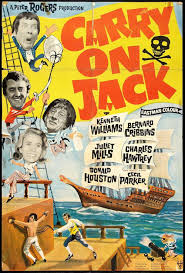
CARRY ON JACK
UK, 1964, 91 minutes, Colour.
Kenneth Williams, Charles Hawtrey, Bernard Cribbins, Juliet Mills, Donald Houston, Percy Herbert, Jim Dale, Patrick Cargill, Cecil Parker, Ed Devereaux, Peter Gilmore, George Woodbridge, Anton Rodgers.
Directed by Gerald Thomas.
This Carry on comedy came immediately after Carry on Cleo. One of the three Carry on films of 1964.
The film has a naval theme, even starting with the death of Nelson and the episode of “Kiss me, Hardy”. It is the first film completely written by Talbot Rothwell who was to continue the series into the 80s. He took over from Norman Hudis.
The first comment to be made is to note the absence of Sid James, Joan Sims, Kenneth Connor, Hattie Jacques. Since most of the action is at sea, no major roles for Joan Sims or Hattie Jacques. The main serious role is taken by Donald Houston, a serious actor rather than a comedian, but it might have been taken up by Sid James but with much more irony than the straightforward anger of Houston. Bernard Cribbins has the central role which is very much a variation on a lot of the characters played by Kenneth Connnor.
But, Kenneth Williams and Charles Hawtrey are there, William is the captain of the ship, initially seasick, allegedly Captain Fearless, anything but. Charles Hawtrey has a better role but much the same shtick as a cesspool cleaner press-ganged onto the ship. They have plenty to do in the latter part of the film when the four central characters experience a mutiny and are put to see in a boat.
Bernard Cribbins does very well as the put-upon midshipman, his uniform ‘s and sword stolen by Juliet Mills who wants to stow away to meet her lover in Spain. And, there are many character actors as usual, Percy Herbert as the tough officer, Jim Dale as carriage courier, Patrick Cargill as a Spanish Governor, Ed Devereaux as a pirate and Cecil Parker as the lord admirable.
Something of a little parody of Mutiny on the Bounty and H.M.S.Defiant (and the film using some of their sets). Carry on with the lighter touch.
For Better, For Worse
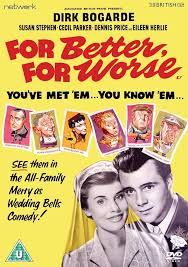
FOR BETTER, FOR WORSE
UK, 1954, 85 minutes, Colour.
Dirk Bogarde, Susan Stephen, Cecil Parker, Eileen Herlie, Athene Seyler, Dennis Price, Pia Teri, James Hayter, Thora Hird, George Woodbridge, Charles Victor, Sidney James, Robin Bailey.
Directed by J. Lee Thompson.
British domestic story from the mid-1950s – and, on the evidence of this film, it would seem a long time ago.
It was something of a prestige film at its time, written and directed by J. Lee Thompson who was to go on to international success with many films, especially The Guns of Navarone and a number of Charles Bronson thrillers. At this time Dirk Bogarde was emerging as a comedian, after many thrillers, especially with Doctor in the House. Susan Stephen was a regular star of this period. Cecil Parker was a very popular character actor – and there are so many more character actors in the supporting roles in this film which makes it so much more enjoyable as we recognise them.
Dirk Bogarde, playing 10 years younger than he actually was, earnestly wants to marry Susan Stephen. The film opens as they watch a romance on screen, then a proposal, then the meeting with her mother, Eileen Herlie, who becomes almost immediately sympathetic, and then the meeting with her father, Cecil Parker, demanding but far less pompously aristocratic than in many of his roles.
There is the issue of getting a job which he eventually does with the government but is it enough to live on? And what about a house? They go to a one-room flat, managed by Dennis Price, there are arguments for and against but their placing the deposit.
One of the main sections, especially for some comedy, has Susan Stephen preparing a dinner for her parents – and the elderly neighbour who is always coming in to use the phone, interfering, but ultimately nice; the local cleaner, played by Thora Hird, who is helpful in preparing the dinner; James Hayter as the plumber who is at the end of an attack by the husband. The other big scene is the arrival of so much furniture, with Charles Victor and George Woodbridge as the sympathetic carriers – and then a glimpse of Sidney James, not so sympathetic.
If this appeals, with its mid-1950s British style, beliefs about the working husband, the wife staying at home…, Then this may be an appealing pastime. (And, for distribution in the US, as with many British the time, very strange title changes – and this one was called, of all things, Cocktails in the Kitchen.)
On the Fiddle
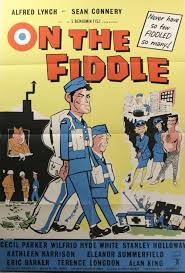
ON THE FIDDLE
UK, 1961, 89 minutes, Black-and-white.
Alfred Lynch, Sean Connery, Victor Madden, Eric Barker, Cecil Parker, Wilfrid Hyde White, John Le Mesurier, Graham Stark, Patsy Rowlands, Eleanor Summerfield, Miriam Karlin, Bill Owen, Barbara Windsor, Beatrix Lehmann.
Directed by Cyril Frankel.
The title indicates the activities of something of a rogue. And that is certainly the case here with the character and performance by comedian Alfred Lynch.
This film has a war setting, looking something like those war films from the 1940s and 1950s – but then veering into comedy, touches of parody and satire, very much the type of English comedy for the broad audience at the end of the 1950s, the early 1960s – especially remembering that this was the period of the emerging of the Carry On series.
The first part of the film shows Lynch as Horace, hanging around with all kinds of scams, and using all kind of patter to insinuate himself into the various situations – but, arrested, pretending that he was lining up for enlisting, means that his patter has landed him in the RAF.
Most of the film is a series of cons, with the supremely confident Horace, able to take charge of all kinds of situations. But, he immediately makes a friend, Peddlar, played by comparative newcomer, Sean Connery, a year before he was to be James Bond in Dr No. Peddlar is not the brightest, admires Horace, plays along with all kinds of situations, but does question Horace’s moral stances.
There is a lot of sending up of RAF officers, especially allowing themselves to be tripped so often. And, there is an interesting episode with a butcher, the meat for the RAF, attach a romantic interlude, the butcher and his wife played by Stanley Holloway and Kathleen Harrison, comedy veterans, an appearance by Wilfrid Hyde White is a quietly muttering innkeeper. And the young Barbara Windsor turns up at the end of the film.
And, while Cecil Parker has top billing, he does not appear as the flustered commander until almost the end of the film.
The Royal Navy provided cooperation, allowing the producers to film in Chatham Dockyard, and aboard HMS Jaguar and HMS Chaplet.
Perhaps this war film was a little dated by 1960 and its perspective on remembering World War II. Which means then that the targets of satire are not fresh in the cinema audience’s mind in the 21st-century but, allowing for these aspects, it is a chance to see several British comedians in action – and, course, the young Sean Connery.
