Displaying items by tag: Peter Graham Scott
Headless Ghost, The
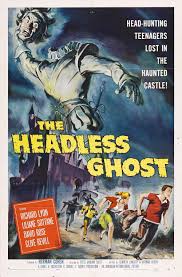
THE HEADLESS GHOST
UK, 1959, 65 minutes, Black-and-white.
Richard Lyon, Lilian Sottane, David Rose, Clive Revill, Jack Allen, Alexander Archdale.
Directed by Peter Graham Scott.
Versatility in the title! This is a small, almost negligible film. American money was put into the British production, Horrors of the Black Museum and the supporting feature was required. This film, quickly written, filmed over two weeks, then became the second half of this British/American program in cinemas.
The basic plot is rather silly, three American tourists in England, visiting a castle as tourists (one referring to castles as old stones surrounded by a ditch!). The three actors in the lead are not persuasive as performers, stilted, sometimes awkward. They do the tour, hear the stories, especially narrated by the current ancestor, looking at the portraits, deciding to hide out overnight to get information for an article.
The film comes more alive with the appearance of Clive Revill, coming down from the painting, Revill giving a class in acting, enjoying his character and the revelations. Especially about the headless ghost and the need for him to recover his head and everybody live in peace.
There is a scene of a banquet, all ghosts enjoying themselves, the headless ghost present.
Complications, the owner and his assistant hearing noises, calling the police, the three Americans discovered, the arrival of the headless ghost, recovering his head, going back into the painting…
It could be a useful exercise for aspiring directors and actors to watch the film sequence by sequence and have discussions as to how they might have filmed each sequence differently and more effectively.
Mister Ten Per Cent
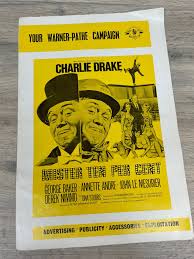
MR TEN PER CENT
UK, 1967, 84 minutes, Colour.
Charlie Drake, Derek Nimmo, Wanda Ventham, John Le Mesurier, Anthony Nichols, Noel Dyson, John Laurie, George Baker, Una Stubbs.
Directed by Peter Graham Scott.
Dear oh dear!
The diminutive comedian, Charlie Drake, was very popular on British television in the 1960s. He also made four films, slight comedies, not particularly well received by critics or the public, The Cracksman being the most successful.
This, his final starring role, is for diehards only, his complete fans. Yet he continued to have a successful career on television and was appearing in supporting roles in various films for the next 30 years.
In retrospect, many audiences will find his performance highly contrived, often very silly, trying too hard.
The film opens with his explaining Swan Lake while working on a building site, pairing with a policeman. Later, with an eye on the portrait of Oscar Wilde, he fancies himself as a dramatist, posh accent though mixing vocabulary, and later will fancy himself advising on how he his play should be produced. But, the play is highly dramatic, comes across as farcical. The unscrupulous entrepreneur, played by John Le Mesurier, decides to profit by investing in a commercial failure. His chosen director is played by Derek Nimmo, himself a very eccentric performer (most successful in television’s Oh Brother).
The would-be playwright interferes with the rehearsals, is taken in by a financier, does not realise how he is being used – but, eventually, ousted from the play, tries to sabotage the London performance, audiences flocking to see and laugh at the farcical play.
Only Charlie Drake’s fans will be persuaded by the last sequence, where the audience realises that he is sincere, hopeful, and applauds him.
The same theme was far more successfully handled by expert Mel Brooks the following year with his comedy classic, The Producers, with Zero Mostel and Gene Wilder (as well as the musical version in the 2000s with Nathan Lane and Matthew Broderick) – and we all remember the extraordinary song and dance routine, Springtime with Hitler!
Cracksman, The
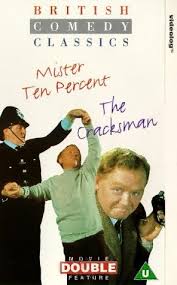
THE CRACKSMAN
UK, 1963, 112 minutes, Colour.
Charlie Drake, George Sanders, Dennis Price, Nyree Dawn Porter, Eddie Byrne, Finlay Currie, Percy Herbert, Geoffrey Keen, Patrick Cargill, Norman Bird, Ronnie Barker.
Directed by Peter Graham Scott.
Despite the notable cast, and the big Cinemascope and colour treatment, this is a comedy that is very much of its time, indication of British cinema in the early 1960s, but not the kind of comedy that lasts.
It is a star vehicle for comedian, Charlie Drake, who had his major successes in television series in the late 1950s and early 1960s – and continued after his slate of films which did not bring him lasting cinema success. While popular at the time, he is very much an acquired taste.
Charlie Drake contributed to the writing of the screenplay, a star vehicle for himself, naivete personified, a completely ingenuous character. He is a locksmith, working in the London streets, content with himself and his ability for being able to unlock any lock, no matter how difficult. So, short in stature, roly-poly in size, naive as well as wisecracking, he is played on by quite a number of characters starting with Dennis Price who passes himself off as a wealthy man and is able to persuade the cracksman to enter a house to rob it. And the police arresting.
The scenario happens over and over again throughout the film, the cracksman being taken in, doing a range of jobs, back in prison where, in fact, he is rather admired – but also played on. (And, for fans of the two Ronnies, here is Ronnie Barker as a prisoner, prior to his television term as Fletcher in Porridge.)
Ultimately, when the cracksman is out of jail, he is used by two gangs for quite an elaborate robbery, one gang led by Eddie Byrne, the other, more suave, led by, of all people, George Sanders. Ultimately, the ingenuous cracksman who has fallen for an undercover policeman, Nyree Dawn Porter, is able to set the two gangs in a fight against each other.
The supporting cast is enjoyable, Patrick Cargill as a snobby guide in the Museum, Finlay Currie as a good old prisoner, Percy Herbert leading the gangs in prison, Geoffrey Keen as a magistrate.
