Displaying items by tag: Dennis Price
Horror of Frankenstein
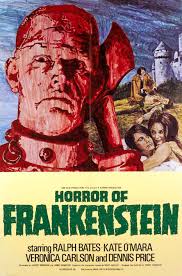
HORRORS OF FRANKENSTEIN
UK, 1970, 95 minutes, Colour.
Ralph Bates, Kate O'Mara, Graham James, Dennis Price, David Prowse, Jon Finch, Bernard Archard, James Hayter, Joan Rice, Veronica Carlson, James Cossins.
Directed by Jimmy Sangster.
In the 1950s, Hammer Studios began a series of films focusing on Frankenstein, Curse of…, Evil of… And Dr Frankenstein was played by Peter Cushing. He does not appear in this film, from 1970, the writer of the first two films, Jimmy Sangster, writer of other horror films, coming again to this theme and directing the film.
Dr Frankenstein, younger, is played by Ralph Bates, arrogant, narcissistic, cruel, killing the opposition, a ladies’ man… And the film capitalising on the more explicit presentations of sexuality and nudity that emerged during the 1960s.
Mary Shelley’s original stories are echoed but the film takes the narrative beyond her original novel.
For fans of the horror films from Hammer Studios – but it does not have the inspiration and quality, style and tone of the original two films.
- The work of Mary Shelley? 18 century? Science and fantasy? Scientist playing God? Creation of creatures, monsters? This variation on characters created by Mary Shelley?
- The setting, Germany/Austria, castles, the forests, costumes and decor? The interiors of the Frankenstein Council? The laboratory?
- The interpretation of Victor Frankenstein, Ralph Bates’ presence and performance, style? Seen in class, drawing, reminded of the teacher, the punishment and Victor’s refusal, his challenging of the teacher, overcoming him? His friendship with William? The presence of the women in the class and the attraction to Victor? The graduation and his return home, with William?
- The scene with his father, his father, sexual liaison with Alice, his demands on his son, refusal for his education? Victor, the gun, altering it, hunting, his father’s death? The funeral? His inheritance?
- The character of Victor Frankenstein here, young, obsessed, narcissistic, obsessive, sociopathic, science, his aims, playing God, creation, but a creator more like Satan than God? His behaviour in the Castle, his reliance on Alice, sexual, criticising her cooking, bringing in Stephan? His continued work with William and William support?
- Employing the gravedigger, having the arm and stealing it from the University, the various body parts, the number of deaths, his drawing of the human body and numbering its parts, filling in the parts?
- Elizabeth, her father, the encounter with the highway men, William wanting to help, Victor and his shrewdness, the rescue, shooting the highway man? Henry, police, past friendship, the investigations?
- The meal with Elizabeth and her father, poisoning him, his death, the gravedigger getting his skull, the brain, the scratch and the deterioration, preserving the brain?
- The doctor, his concern about Victor, his visit, his being electrocuted? The gravedigger, his money, greed, putting him in the that? The unscrupulous deaths?
- Elizabeth, her property, coming to the Castle, in love with Viktor, his being willing to have a recipe housekeeper?
- The experiments with William, William and his suspicions, critique, deciding to leave, Victor killing him?
- The final creation of the creature, the experiments with the animals, electric power bringing them to life, the turtle? The appearance of the creature, giant, not speaking? Victor and his controlling him?
- The creature, out in the countryside, the little girl, the deaths, Henry and the police investigation, Stephane and his being blamed? Imprisoned? Victor’s callous this interest in everything, his lies, covering? The attack on Elizabeth, her testimony, Henry arriving?
- Victor and his sessions with the creature, the police search of the house, Victor and his hiding the creature – in the bath? The little girl playing, turning the taps, the acid, the destruction of the creature, the skeleton?
- Leaving Victor for further experimentation?
Rebel, The
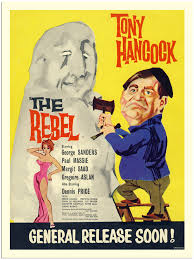
THE REBEL
UK, 1961, 105 minutes, Colour.
Tony Hancock, George Sanders, Paul Massie, Margit Saad, Gregoire Aslan, Dennis Price, Irene Handl, John Le Mesurier, Liz Fraser, Mervyn Johns, Peter Bull, Nanette Newman, Oliver Reed.
Directed by Robert Day.
British comedian Tony Hancock was extremely popular on radio and television, especially during the 1950s. This was his main feature film – appearing in small roles in a few films during the 1960s. Certainly, alcohol and drug problems, depression, he committed suicide in Sydney in 1968 at the age of 44. However, he is still considered highly in the history of British comedy.
The screenplay was written by the team of Ray Eagleton and Simpson, writers for his radio programs as well as television. And he keeps his own name as his character, I don’t identify with the ups and downs of his experience, the target of satire while creating satiric comment 1960s society – and especially art pretensions (many French existentialist style).
The film begins amusingly with Hancock on a railway station, she did to get a seat on the crowded train with all the men in balls and suits, and newspapers, uniformly going to work and routines office. Comedy with the boss, John the measure. At home, Hancock has a huge sculptor, complains his landlady, I really handle, then his decision to free and go to Paris as an artist.
He listens into a group of artists, especially Paul Massie (and a glimpse of Oliver Reed) in a cafe, is invited to share an apartment, and begins his art. In the meantime, Paul Massie, not confidence in himself, has produced quite a number of paintings. There are a whole lot of Sion meetings, pretentious looking artists (especially a cameo by Dennis Price) and women, looking the same, black hair, white asked. And, they listen to Hancock who has the gift of the gap and who is feted, especially taken up by an aristocratic agent, a typical George Sanders role, who mistakes Paul Massie’s paintings for those of Hancock who does try to intervene but then goes and lives the celebrated life.
So, a lot of situation comedy, especially on the yacht millionaire and his glamorous wife who pursues Hancock.
Ultimately, Hancock sets at the moment of truth, and admitting that the poor work was his own but the good work was that of the artist. Goes back to the landlady and resumes his sculpture.
An example of British comedy in the 1960s, the work of Tony Hancock, still amusing in its satire and his impersonations and gift of the gap, but still rather dated.
Cracksman, The
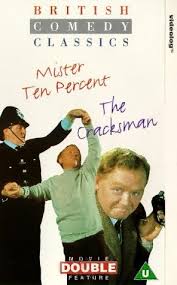
THE CRACKSMAN
UK, 1963, 112 minutes, Colour.
Charlie Drake, George Sanders, Dennis Price, Nyree Dawn Porter, Eddie Byrne, Finlay Currie, Percy Herbert, Geoffrey Keen, Patrick Cargill, Norman Bird, Ronnie Barker.
Directed by Peter Graham Scott.
Despite the notable cast, and the big Cinemascope and colour treatment, this is a comedy that is very much of its time, indication of British cinema in the early 1960s, but not the kind of comedy that lasts.
It is a star vehicle for comedian, Charlie Drake, who had his major successes in television series in the late 1950s and early 1960s – and continued after his slate of films which did not bring him lasting cinema success. While popular at the time, he is very much an acquired taste.
Charlie Drake contributed to the writing of the screenplay, a star vehicle for himself, naivete personified, a completely ingenuous character. He is a locksmith, working in the London streets, content with himself and his ability for being able to unlock any lock, no matter how difficult. So, short in stature, roly-poly in size, naive as well as wisecracking, he is played on by quite a number of characters starting with Dennis Price who passes himself off as a wealthy man and is able to persuade the cracksman to enter a house to rob it. And the police arresting.
The scenario happens over and over again throughout the film, the cracksman being taken in, doing a range of jobs, back in prison where, in fact, he is rather admired – but also played on. (And, for fans of the two Ronnies, here is Ronnie Barker as a prisoner, prior to his television term as Fletcher in Porridge.)
Ultimately, when the cracksman is out of jail, he is used by two gangs for quite an elaborate robbery, one gang led by Eddie Byrne, the other, more suave, led by, of all people, George Sanders. Ultimately, the ingenuous cracksman who has fallen for an undercover policeman, Nyree Dawn Porter, is able to set the two gangs in a fight against each other.
The supporting cast is enjoyable, Patrick Cargill as a snobby guide in the Museum, Finlay Currie as a good old prisoner, Percy Herbert leading the gangs in prison, Geoffrey Keen as a magistrate.
