Displaying items by tag: George Woodbridge
Nurse on Wheels
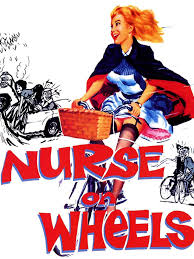
NURSE ON WHEELS
UK, 1963, 85 minutes, Black-and-white.
Juliet Mills, Ronald Lewis, Joan Sims, Noel Purcell, Esma Cannon, Raymond Huntley, Athene Seyler, Norman Rossington, Ronald Howard, Joan Hickson, Renee Houston, Jim Dale, George Woodbridge.
Directed by Gerald Thomas.
A pleasant, old-fashioned British comedy. It was directed by Gerald Thomas taking some time off from making Carry on films. It was written by Norman Hudis who had written the early Carry on films but was giving way to Talbot Rothwell. And, it is very much geared towards the widest audience, only a little innuendo and a spoilt flirtation sequence.
Juliet Mills, in her early 20s, plays a district nurse, new to the district, under suspicion by the patients of the previous nurse, sometimes rude to her, offhand. She is strong-minded, rides a bike, has a driving lesson – and a later driving escapade which proves that she is far better on her bicycle. Ultimately, of course, her patients relent and she is accepted. There is also a romance with Ronald Lewis as a local farmer, sometimes curt, especially to a young man and his pregnant wife who want to park on his land, but, of course, a final reconciliation.
The film is striking for the number of character actors who take the roles generally of the locals, suspicious, hard, gradually relenting. And, there are at least half a dozen regulars from the Carry on films, Joan Sims with a very straightforward role as the vicar’s daughter, Raymond Huntley is the vicar, Jim Dale as the husband, and Joan Hickson as a housekeeper. And, especially, Esma Cannon as the nurses pleasantly dithery as the nurse’s mother.
There is a jaunty theme playing every time the nurse appears on her bike and then more frequently, possibly too often!
Life in English country towns in the early 1960s, the NHS, the district nurse, local doctors, and a variety of local characters.
Carry on Jack
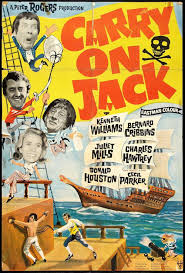
CARRY ON JACK
UK, 1964, 91 minutes, Colour.
Kenneth Williams, Charles Hawtrey, Bernard Cribbins, Juliet Mills, Donald Houston, Percy Herbert, Jim Dale, Patrick Cargill, Cecil Parker, Ed Devereaux, Peter Gilmore, George Woodbridge, Anton Rodgers.
Directed by Gerald Thomas.
This Carry on comedy came immediately after Carry on Cleo. One of the three Carry on films of 1964.
The film has a naval theme, even starting with the death of Nelson and the episode of “Kiss me, Hardy”. It is the first film completely written by Talbot Rothwell who was to continue the series into the 80s. He took over from Norman Hudis.
The first comment to be made is to note the absence of Sid James, Joan Sims, Kenneth Connor, Hattie Jacques. Since most of the action is at sea, no major roles for Joan Sims or Hattie Jacques. The main serious role is taken by Donald Houston, a serious actor rather than a comedian, but it might have been taken up by Sid James but with much more irony than the straightforward anger of Houston. Bernard Cribbins has the central role which is very much a variation on a lot of the characters played by Kenneth Connnor.
But, Kenneth Williams and Charles Hawtrey are there, William is the captain of the ship, initially seasick, allegedly Captain Fearless, anything but. Charles Hawtrey has a better role but much the same shtick as a cesspool cleaner press-ganged onto the ship. They have plenty to do in the latter part of the film when the four central characters experience a mutiny and are put to see in a boat.
Bernard Cribbins does very well as the put-upon midshipman, his uniform ‘s and sword stolen by Juliet Mills who wants to stow away to meet her lover in Spain. And, there are many character actors as usual, Percy Herbert as the tough officer, Jim Dale as carriage courier, Patrick Cargill as a Spanish Governor, Ed Devereaux as a pirate and Cecil Parker as the lord admirable.
Something of a little parody of Mutiny on the Bounty and H.M.S.Defiant (and the film using some of their sets). Carry on with the lighter touch.
For Better, For Worse
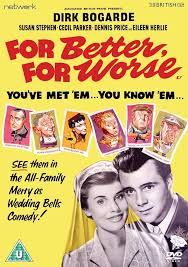
FOR BETTER, FOR WORSE
UK, 1954, 85 minutes, Colour.
Dirk Bogarde, Susan Stephen, Cecil Parker, Eileen Herlie, Athene Seyler, Dennis Price, Pia Teri, James Hayter, Thora Hird, George Woodbridge, Charles Victor, Sidney James, Robin Bailey.
Directed by J. Lee Thompson.
British domestic story from the mid-1950s – and, on the evidence of this film, it would seem a long time ago.
It was something of a prestige film at its time, written and directed by J. Lee Thompson who was to go on to international success with many films, especially The Guns of Navarone and a number of Charles Bronson thrillers. At this time Dirk Bogarde was emerging as a comedian, after many thrillers, especially with Doctor in the House. Susan Stephen was a regular star of this period. Cecil Parker was a very popular character actor – and there are so many more character actors in the supporting roles in this film which makes it so much more enjoyable as we recognise them.
Dirk Bogarde, playing 10 years younger than he actually was, earnestly wants to marry Susan Stephen. The film opens as they watch a romance on screen, then a proposal, then the meeting with her mother, Eileen Herlie, who becomes almost immediately sympathetic, and then the meeting with her father, Cecil Parker, demanding but far less pompously aristocratic than in many of his roles.
There is the issue of getting a job which he eventually does with the government but is it enough to live on? And what about a house? They go to a one-room flat, managed by Dennis Price, there are arguments for and against but their placing the deposit.
One of the main sections, especially for some comedy, has Susan Stephen preparing a dinner for her parents – and the elderly neighbour who is always coming in to use the phone, interfering, but ultimately nice; the local cleaner, played by Thora Hird, who is helpful in preparing the dinner; James Hayter as the plumber who is at the end of an attack by the husband. The other big scene is the arrival of so much furniture, with Charles Victor and George Woodbridge as the sympathetic carriers – and then a glimpse of Sidney James, not so sympathetic.
If this appeals, with its mid-1950s British style, beliefs about the working husband, the wife staying at home…, Then this may be an appealing pastime. (And, for distribution in the US, as with many British the time, very strange title changes – and this one was called, of all things, Cocktails in the Kitchen.)
