Displaying items by tag: Patrick Cargill
Carry on Jack
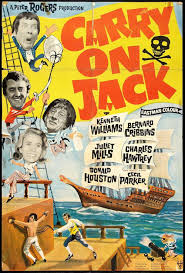
CARRY ON JACK
UK, 1964, 91 minutes, Colour.
Kenneth Williams, Charles Hawtrey, Bernard Cribbins, Juliet Mills, Donald Houston, Percy Herbert, Jim Dale, Patrick Cargill, Cecil Parker, Ed Devereaux, Peter Gilmore, George Woodbridge, Anton Rodgers.
Directed by Gerald Thomas.
This Carry on comedy came immediately after Carry on Cleo. One of the three Carry on films of 1964.
The film has a naval theme, even starting with the death of Nelson and the episode of “Kiss me, Hardy”. It is the first film completely written by Talbot Rothwell who was to continue the series into the 80s. He took over from Norman Hudis.
The first comment to be made is to note the absence of Sid James, Joan Sims, Kenneth Connor, Hattie Jacques. Since most of the action is at sea, no major roles for Joan Sims or Hattie Jacques. The main serious role is taken by Donald Houston, a serious actor rather than a comedian, but it might have been taken up by Sid James but with much more irony than the straightforward anger of Houston. Bernard Cribbins has the central role which is very much a variation on a lot of the characters played by Kenneth Connnor.
But, Kenneth Williams and Charles Hawtrey are there, William is the captain of the ship, initially seasick, allegedly Captain Fearless, anything but. Charles Hawtrey has a better role but much the same shtick as a cesspool cleaner press-ganged onto the ship. They have plenty to do in the latter part of the film when the four central characters experience a mutiny and are put to see in a boat.
Bernard Cribbins does very well as the put-upon midshipman, his uniform ‘s and sword stolen by Juliet Mills who wants to stow away to meet her lover in Spain. And, there are many character actors as usual, Percy Herbert as the tough officer, Jim Dale as carriage courier, Patrick Cargill as a Spanish Governor, Ed Devereaux as a pirate and Cecil Parker as the lord admirable.
Something of a little parody of Mutiny on the Bounty and H.M.S.Defiant (and the film using some of their sets). Carry on with the lighter touch.
Up Pompeii
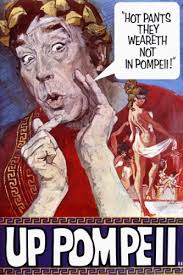
UP POMPEII
UK, 1971, 90 minutes, Colour.
Frankie Howerd, Patrick Cargill, Bill Fraser, Michael Hordern, Barbara Murray, Lance Percival, Adrian Foster, Bernard Bresslaw, Roy Hudd, Lally Bowers, Kenneth Cranham.
Directed by Bob Kellett.
Comedian, Frankie Howerd, popular on British radio and television, had a successful television series, 14 episodes, in the late 1960s, Up Pompeii. And here is a version made for the cinema screen, with Talbot Rothwell, writer of the Carry on films, having a credit for idea.
The basic idea is humorous enough, Frankie Howard as a slave in Pompeii the year of its destruction, A.D. 79 – but, for film purposes, the Emperor is Nero who reigned 15 years earlier!
Frankie Howerd’s style of comedy was to confide in the audience, looking straight to camera and the audience, plenty of remarks, reminding everyone that this is a film, anticipating action and jokes. The idea here is that there is conspiracy against Nero amongst senators and military of Pompeii. Howerd’s Lurcio works for Ludicrus Sextus (the film’s names of characters rivalling those of the Asterix films), the pompous senator, played with the right kind of satire by Michael Hordern. There is his wife and her ambitions, his young son and his sexuality problems, a clash with a Roman sergeant in the marketplace and the focus on a scroll with a list of conspirators.
Anything could happen – and does.
However, the writers and the cast have drawn on an enormous catalogue of sex jokes. And most of them are here, some very obvious, some familiar – touch of innuendo (though the screenplay is too obvious for innuendo). Some are signalled, Frankie Howard drawing attention to them and reacting sometimes with prudery.
And, looking back, it may be surprising to find such an amount of nudity in British comedy at the beginning of the 1970s – reticence is not the order of the day here.
So, once again, an opportunity to see and gain something of an awareness of popular British comedy in the early 1970s – but, so much depends on whether audiences are fans of Frankie Howerd himself and this kind of style. He then made The Chastity Belt and the World War II farce, Up the Front in the same style.
Cracksman, The
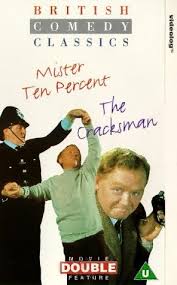
THE CRACKSMAN
UK, 1963, 112 minutes, Colour.
Charlie Drake, George Sanders, Dennis Price, Nyree Dawn Porter, Eddie Byrne, Finlay Currie, Percy Herbert, Geoffrey Keen, Patrick Cargill, Norman Bird, Ronnie Barker.
Directed by Peter Graham Scott.
Despite the notable cast, and the big Cinemascope and colour treatment, this is a comedy that is very much of its time, indication of British cinema in the early 1960s, but not the kind of comedy that lasts.
It is a star vehicle for comedian, Charlie Drake, who had his major successes in television series in the late 1950s and early 1960s – and continued after his slate of films which did not bring him lasting cinema success. While popular at the time, he is very much an acquired taste.
Charlie Drake contributed to the writing of the screenplay, a star vehicle for himself, naivete personified, a completely ingenuous character. He is a locksmith, working in the London streets, content with himself and his ability for being able to unlock any lock, no matter how difficult. So, short in stature, roly-poly in size, naive as well as wisecracking, he is played on by quite a number of characters starting with Dennis Price who passes himself off as a wealthy man and is able to persuade the cracksman to enter a house to rob it. And the police arresting.
The scenario happens over and over again throughout the film, the cracksman being taken in, doing a range of jobs, back in prison where, in fact, he is rather admired – but also played on. (And, for fans of the two Ronnies, here is Ronnie Barker as a prisoner, prior to his television term as Fletcher in Porridge.)
Ultimately, when the cracksman is out of jail, he is used by two gangs for quite an elaborate robbery, one gang led by Eddie Byrne, the other, more suave, led by, of all people, George Sanders. Ultimately, the ingenuous cracksman who has fallen for an undercover policeman, Nyree Dawn Porter, is able to set the two gangs in a fight against each other.
The supporting cast is enjoyable, Patrick Cargill as a snobby guide in the Museum, Finlay Currie as a good old prisoner, Percy Herbert leading the gangs in prison, Geoffrey Keen as a magistrate.
