Displaying items by tag: Lionel Jeffries
Revenge of Frankenstein, The
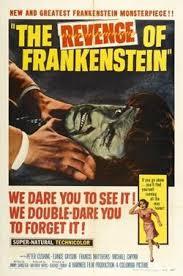
THE REVENGE OF FRANKENSTEIN
UK, 1958, 90 minutes, Colour.
Peter Cushing, Francis Matthews, Eunice Gayson, Michael Gwynn, Lionel Jeffries, Charles Lloyd Pack, George Woodbridge, Michael Ripper.
Directed by Terrence Fisher.
Mary Shelley must be amazed at the vast number of Frankenstein films. And they continue.
However, in the mid-1950s, Hammer Studios began a series of horror films based on classics, especially Frankenstein and Bram Stoker’s Dracula. The first was The Curse of Frankenstein, featuring Peter Cushing as the Baron. While there were some of the horror tropes, especially the end, the film was really made as drama, well cast, well acted, dramatising the elements of Mary Shelley’s perspective but, going beyond it, Frankenstein and the consequences of his actions.
Then, almost immediately, this sequel. And the same comment about drama and the horror tropes. Now, Frankenstein is about to be executed for his experiments, a scene at the gallows, struggle – and, his friends helping him, substituting the assistant priest in the coffin.
The bulk of the film has Frankenstein in the city, calling himself Dr Stein, treating all the fashionable inhabitants who flock to him, but also working in the poor ward. The local Council of doctors are not impressed – except for the young one, played by Francis Matthews, who knows who Dr Stein is and wants to learn from him, collaborating in a reworking of constructing the body of a new creature, wanting to transfer the brain of the crippled Karl who works in the laboratory.
So, the emphasis on drama, Peter Cushing full of dignity, clearly articulate, arrogant in his self-confidence, and the eager young assistant, details of the poor ward, the experiment, and, as expected, some dire consequences.
Six years later, there was a third Peter Cushing/Frankenstein film, Evil of Frankenstein.
- The second in the Hammer Studios trilogy of Frankenstein? The original curse of Frankenstein, the next film, Evil of Frankenstein? The continuation of the story beyond Mary Shelley?
- Hammer Studios, the 1950s, taking up the classic horror stories, emphasising the drama and the characters rather than the horror aspects? Keeping the horror aspects until the end?
- The situation, Frankenstein and his experiments, the arrest, condemnation to death, the opening and the gallows, Frankenstein being led to the gallows, the priest, Karl in attendance, the executioners? The focus on the gallows, the sounds of the commotion, Frankenstein’s escape?
- The cemetery, the two men, the salary, digging up graves, drinking, the lazy digger eating, opening the coffin, finding the priest? Frankenstein, the digger and his heart attack?
- Three years later, Dr Victor Stein in Carlsbruck, his practice, the waiting room full, the women, his work in the poor ward, the many men, his work, charity work?
- The town council of doctors, the meeting, denunciations of Dr Stein? The decision about the delegation, their arrival, being made to wait with the poor patients?
- Peter Cushing as Dr Frankenstein, presence, dignified manner, speaking clearly, dignity? Yet the ruthlessness of his experiments? Commitment to science? His treatment of the committee?
- Dr Kleve, age, earnest, his practice, education, devotion to science, his request of Frankenstein, and the interrogation, Frankenstain showing him the laboratories, the extent of his experiments, fire, the eyes moving, the hand reaching out, the brain? The revelation of the perfect body made up of parts? (And the parts coming from the men in the ward?)
- Karl, hunches, his brain, working with the doctor, the promise of a new body with his own brain?
- Margaret, her position in the town, wanting to work? Dr Stein’s reaction, ousting her? Her later visits? The worker, his confiding the truth in her? Her meeting Karl? Later encounter with Karl, trying to help, his reliance on her? At the musical recital, Karl coming, the crisis?
- The worker in the ward, his relationship with Dr Stein, helping, yet shrewd, having the key, informing Margaret?
- The experiment, taking Karl’s brain, into the new body? Karl’s body – and his discovering it, burning it? Karl, the new awareness, appearance, being bound, the treatment by the doctors? His dissatisfaction, the background of the chimpanzee and Otto and the exchange of brain?
- Dr Kleve and his helping Karl, Margaret, loosening the bonds, his getting away? The clear brain, the monstrous brain, his attack on the young girl? The police stopping the doctors, the interrogation?
- The doctors, going to the recital, the search for Karl, his going berserk?
- The reaction of the doctors, the condemnation of Dr Stein, exposing him and his response? His going into the ward, the condemnation, despising him, the attack, his death, Dr Kleve and the rescue?
- Dr Stein and his recovery, London, Dr Frank and a new life?
Barnacle Bill/ All at Sea
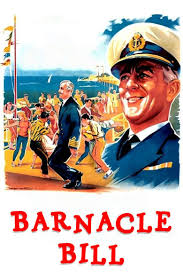
BARNACLE BILL/ALL AT SEA
UK, 1957, 87 minutes, Black-and-white.
Alec Guinness, Irene Brown, Percy Herbert, Maurice Denham, Victor Maddern, Donald Pleasance, Warren Mitchell, Lionel Jeffries, Jackie Collins, Miles Malleson, Allan Cuthbertson, Charles Lloyd Pack, George Rose, Richard Wattis, Eric Pohlmann, Joan Hickson.
Directed by Charles Frend.
Barnacle Bill/All at Sea was Alec Guinness’ last comedy film, immediately after his Oscar win in The Bridge on the River Kwai, 1957. And, it was the last of his Ealing comedies, his moving into more serious films into the 60s and 70s.
The film was written by T.E.B.Clark, author of many of the Ealing studios films, Passport to Pimlico, Lavender Hill Mob, films about individuals and their defying the authorities. It is the same here, Captain Ambrose, played by Guinness, has seafaring ancestors, even from the Stone Age, and/or visualised with Guinness playing each of them, but all suffering from seasickness and disasters. During World War II, in Ambrose tested vessels rather than going to see!
After the war, very seriously, he buys a pier on the coast, the ship Arabella, and turns it into the equivalent of the tourist ship. But, he runs foul of the local Council, leading to scenes of tourists enjoying the comforts of a sea voyage and some sabotage from the Council members.
It is brief, rather low-key, British comedy of the time, social commentary. And, looking at the cast, it is filled with quite a number of well-known British character actors of the period or who were to emerge successfully in coming decades in television series – Warren Mitchell, Donald Pleasance, Joan Hickson… And, yes, that is the Jackie Collins in the cast!
Direction was by Charles Frend, who directed many of the significant British films, especially the 1940s and 50s, including Scott of the Antarctic and The Cruel Sea.
- From Ealing studios in the 1950s? An Alec Guinness vehicle and his Ealing Studios films? The individual against the corporations?
- Ealing Studios comedy, the writer, the directors, British humour, situations, character actors? Musical score?
- The title, given the alternate All at Sea?
- The introduction to Captain Ambrose, a celebrity, the honours, his manner, perfectly straightforward sometimes mischievous humour? The interviews, his reputation, at the pub, the rum cask, going to the bank, his money account, the staff, listening to his story, at the end, the celebrity mood?
- Captain Ambrose’s story? His ancestors, from the Stone Age, Francis Drake, the Later Sea Captain, World War I – and Alec Guinness playing all roles? Seasickness and the way that it was manifested, the comic tragedies?
- Captain Ambrose and his war career, seasick, the audience thinking he was at dea, but his career in demonstrating seasickness in various vessels?
- His decision to buy the Arabella, the pier? Very serious, spending his money? The initial encounter with Mrs Barrington and her accusations? Going to the pier, the staff, seriously setting up the ship and the crew? The first officer and reliance on him? The performance, the Houdini -like character, the Captain tying him up in a bag, unable to get out?
- Captain Ambrose vision for the pier, looking at the slot machines, the police, getting the young expert, his knowing how to win with skill? The machines being allowed? The youngsters, the rock ‘n’ roll atmosphere, taunting Captain Ambrose, coming to the concert, the talent not turning up? Playing the piano, dancing, the ripping up of the seats, providing the dance area, the youngsters enjoying it?
- The plan to turn the Arabella into a cruise ship, holidays, yet at the pier? The work, the volunteers, the transformation? The dining area, the pool, all the luxuries?
- The Mayor, his visits and discussions, the Council meetings, his henchmen, legal advice, Mrs Barrington? Corruption? The decision to improve the seafront, threatening Mrs Barrington’s dressing cabins, upset, the encounter with Captain Ambrose, his taking them, installing, her supporting him, her transformation, drinking the rum?
- The crowds, coming aboard, the atmosphere of the luxury ship? The staff? Captain happily moving amongst his guests? The young lovers always hiding in boats et cetera?
- The Council, their plans, the confrontations, the turncoat, swimming underwater engaging the depths, seen by the drinking Captain? Looking at the radar? Reality, his being Captain, interrogated?
- The Council and the plan, sending out the boat, underwater, the Captain, facing his seasickness, Mrs Barrington’s cure, corset and earplugs? Going out, the confrontation, the four in the cage, trying to escape, Captain Ambrose and the machinery, capturing the Council?
- The legal issues, the cruise ship and the foreign government and the permits? Sawing the connection so as not to pay shore taxes?
- Small British comedies of the 1950s, the humour, still entertaining even if they look dated?
