Displaying items by tag: Richard Wattis
Carry on Spying
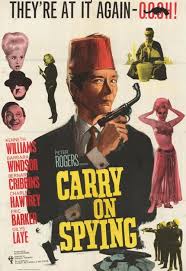
CARRY ON SPYING
UK, 1964, 87 minutes, Black-and-white.
Kenneth Williams, Barbara Windsor, Bernard Cribbins, Charles Hawtrey, Eric Barker, Dilys Laye, Jim Dale, Richard Wattis, Eric Pohlmann, Victor Maddern, Judith Furse, John Bluthal.
Directed by Gerald Thomas.
With James Bond film, Dr No, 1962, followed by From Russia With Love, it was probably inevitable that the Carry on series would move into the world of espionage and British agents. And so it was.
This episode was released at the same time as Carry on Cleo. The series had moved colour but this episode returns to black-and-white. And key members of the team are absent, Sid James, Joan Sims, Hattie Jacques, Kenneth Connnor. But, Bernard Cribbins had been the Kenneth Connor type character in Carry on Jack and does the same here. But, this was the first Carry on film for Barbara Windsor and she certainly makes a big impression, sense of comedy and fun, but also showing that the female characters, while definitely for the male gaze, have character and could contribute to the more serious aspects of the plot.
Not that there are very many more serious aspects. This is very basic Carry on material, really just an espionage farce, with some of the usual jokes and more than innuendo. The screenplay was written by Talbot Rothwell, who was becoming the regular writer, but he collaborates with Sid Colin, writer of many comedies with the Chastity Belt and Up The Front comedies to come.
OF course, it is all a parody of British espionage, four dimwitted agents, Eric Barker as the version of M, Richard Wattis as a kind of Q. And there are various villains, especially led by Eric Pohlman, the in the number of British films at the time.
The impact depends on the presence of Kenneth Williams, not quite his usual role, in fact, giving up his posh accent for a rather flat one. But, a lot of the same shtick in the world of agents. Bernard Cribbins is genial but rather dumb. Charles Hawtrey is as always. And, Jim Dale is very enjoyable in a whole range of disguises as their contact. Dilys Laye sings songs and is ambiguous in her loyalties. Judith Furse is a variation on Blofeld. And, instead of SPECTRE, there is STENCH, Society for the Total Extinction of Non-Conforming Humans.
In and Algiers, an impossible number of extensive changes of costume and disguises. Some laughs, some nods to Bond and, explicitly with the zither music, The Third Man’s scene of Orson Welles emerging from the sewers. But, very basic British comedy.
Dentist on the Job
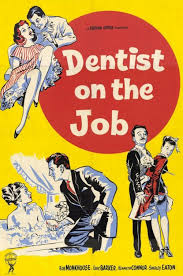
DENTIST ON THE JOB
UK, 1961, 88 minutes, Black-and-white.
Bob Monkhouse, Kenneth Connor, Shirley Eaton, Eric Barker, Richard Wattis, Ronnie Stevens, Reginald Beckwith, Graham Stark, Charles Hawtrey.
Directed by C.M. Pennington-Richards.
A star vehicle for Bob Monkhouse, popular film and television star. Good-looking, presentable, but playing characters who seem rather smugly satisfied with themselves.
This is a sequel to Dentist in the Chair. It was released in 1961, the years when the Carry on series was emerging. And, quite a number of Carry on stars appear, especially Kenneth Connor, in the central role, along with a cameo by Charles Hawtrey, and key roles by Eric Barker and Shirley Eaton. The other main character is played by Ronnie Stevens.
The film could have been called Carry on Dentist, Carry on Advertising, or, even, Carry on Toothpaste!
The film is about a campaign for a new toothpaste which is not doing very well, Richard Wattid the very prim executive, Reginald Beckwith one of the sales representatives. Because a dentist, qualified, will be taken off the register for promoting a product, Monkhouse and Stevens are tricked into signing up to promote this toothpaste. So, all the usual shenanigans, quite some ogling, lots of sexual innuendo.
However, Kenneth Connor, is an ex-convict has plenty of opportunities to do his impersonations, projects and, then American accent. Shirley Eaton obviously enjoys this kind of role. And, Eric Barker, has two roles, two cousins.
Lots of knockabout comedy, parody of filming commercials, and a completely impossible situation whereby the doctors prepare take to a recorded message substituted for one going into space which will advertise the toothpaste all over the universe! There is some comment on security but, a more security-conscious public will think that these episodes, because not to be taken too seriously, are absolutely impossible.
Along with the Carry on series and other small comedies, this was British comedy on screen in the early 1960s.
Take Me High
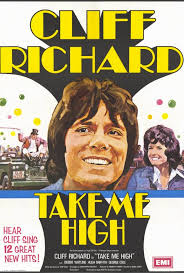
TAKE ME HIGH
UK, 1973, 91 minutes, Colour.
Cliff Richard, Debbie Watling, Hugh Griffith, George Cole, Anthony Andrews, Richard Wattis.
Directed by David Askey.
Not exactly a 21st century entertainment! Rather, of interest for more historical reasons.
This was the last main feature film for popular singer, Cliff Richard, emerging at the age of 19-20 as a singer, and actor in such films as espresso bongo, but then moving to some popular musicals. After Take Me High, his main screen presence was a long list of music videos.
Rather surprisingly in this film, he plays a merchant banker, in Birmingham, working with Anthony Andrews, surprising to see him so early, soon to be in The Scarlet Pimpernel and his key role in Brideshead Revisited. Cliff Richard is not entirely persuasive as this kind of banker, especially when the script asks him to be something of a mastermind in financial deals, one up and ship towards his partner. The deals are between Hugh Griffith, highly overacting at first, then agreeably punctures, remembering his Oscar for Ben Hur as well is his presence in Tom Jones. He is conservative, a Birmingham family traditions, contrast with George Cole as a more left-wing representative.
Debbie Watling plays a manager a restaurant who has financial problems with the company, links up with Cliff Richard, inventing the new hamburger, the Bromberg. Longtime comedian, Richard Wattis, has a role as the head of the banks in one of his final performances.
Filmed on location in Birmingham, the city, the canals, the streets and parades… It has a listed soundtrack of 15 songs. The credits focused close-up of Cliff Richard singing but many of the songs, most of them, directly son as background to the action.
A belated attempt to have Cliff Richard as a film star – but, he continued his long career, is a popular singer.
Barnacle Bill/ All at Sea
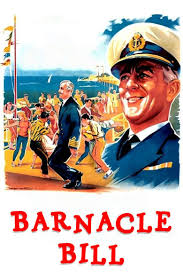
BARNACLE BILL/ALL AT SEA
UK, 1957, 87 minutes, Black-and-white.
Alec Guinness, Irene Brown, Percy Herbert, Maurice Denham, Victor Maddern, Donald Pleasance, Warren Mitchell, Lionel Jeffries, Jackie Collins, Miles Malleson, Allan Cuthbertson, Charles Lloyd Pack, George Rose, Richard Wattis, Eric Pohlmann, Joan Hickson.
Directed by Charles Frend.
Barnacle Bill/All at Sea was Alec Guinness’ last comedy film, immediately after his Oscar win in The Bridge on the River Kwai, 1957. And, it was the last of his Ealing comedies, his moving into more serious films into the 60s and 70s.
The film was written by T.E.B.Clark, author of many of the Ealing studios films, Passport to Pimlico, Lavender Hill Mob, films about individuals and their defying the authorities. It is the same here, Captain Ambrose, played by Guinness, has seafaring ancestors, even from the Stone Age, and/or visualised with Guinness playing each of them, but all suffering from seasickness and disasters. During World War II, in Ambrose tested vessels rather than going to see!
After the war, very seriously, he buys a pier on the coast, the ship Arabella, and turns it into the equivalent of the tourist ship. But, he runs foul of the local Council, leading to scenes of tourists enjoying the comforts of a sea voyage and some sabotage from the Council members.
It is brief, rather low-key, British comedy of the time, social commentary. And, looking at the cast, it is filled with quite a number of well-known British character actors of the period or who were to emerge successfully in coming decades in television series – Warren Mitchell, Donald Pleasance, Joan Hickson… And, yes, that is the Jackie Collins in the cast!
Direction was by Charles Frend, who directed many of the significant British films, especially the 1940s and 50s, including Scott of the Antarctic and The Cruel Sea.
- From Ealing studios in the 1950s? An Alec Guinness vehicle and his Ealing Studios films? The individual against the corporations?
- Ealing Studios comedy, the writer, the directors, British humour, situations, character actors? Musical score?
- The title, given the alternate All at Sea?
- The introduction to Captain Ambrose, a celebrity, the honours, his manner, perfectly straightforward sometimes mischievous humour? The interviews, his reputation, at the pub, the rum cask, going to the bank, his money account, the staff, listening to his story, at the end, the celebrity mood?
- Captain Ambrose’s story? His ancestors, from the Stone Age, Francis Drake, the Later Sea Captain, World War I – and Alec Guinness playing all roles? Seasickness and the way that it was manifested, the comic tragedies?
- Captain Ambrose and his war career, seasick, the audience thinking he was at dea, but his career in demonstrating seasickness in various vessels?
- His decision to buy the Arabella, the pier? Very serious, spending his money? The initial encounter with Mrs Barrington and her accusations? Going to the pier, the staff, seriously setting up the ship and the crew? The first officer and reliance on him? The performance, the Houdini -like character, the Captain tying him up in a bag, unable to get out?
- Captain Ambrose vision for the pier, looking at the slot machines, the police, getting the young expert, his knowing how to win with skill? The machines being allowed? The youngsters, the rock ‘n’ roll atmosphere, taunting Captain Ambrose, coming to the concert, the talent not turning up? Playing the piano, dancing, the ripping up of the seats, providing the dance area, the youngsters enjoying it?
- The plan to turn the Arabella into a cruise ship, holidays, yet at the pier? The work, the volunteers, the transformation? The dining area, the pool, all the luxuries?
- The Mayor, his visits and discussions, the Council meetings, his henchmen, legal advice, Mrs Barrington? Corruption? The decision to improve the seafront, threatening Mrs Barrington’s dressing cabins, upset, the encounter with Captain Ambrose, his taking them, installing, her supporting him, her transformation, drinking the rum?
- The crowds, coming aboard, the atmosphere of the luxury ship? The staff? Captain happily moving amongst his guests? The young lovers always hiding in boats et cetera?
- The Council, their plans, the confrontations, the turncoat, swimming underwater engaging the depths, seen by the drinking Captain? Looking at the radar? Reality, his being Captain, interrogated?
- The Council and the plan, sending out the boat, underwater, the Captain, facing his seasickness, Mrs Barrington’s cure, corset and earplugs? Going out, the confrontation, the four in the cage, trying to escape, Captain Ambrose and the machinery, capturing the Council?
- The legal issues, the cruise ship and the foreign government and the permits? Sawing the connection so as not to pay shore taxes?
- Small British comedies of the 1950s, the humour, still entertaining even if they look dated?
