Displaying items by tag: Angela Douglas
Carry on up the Khyber
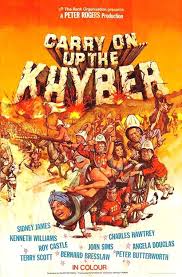
CARRY ON UP THE KHYBER
UK, 1968, 95 minutes, Colour.
Sidney James, Kenneth Williams, Charles Hawtrey, Roy Castle, Joan Sims, Bernard Bresslaw, Peter Butterworth, Terry Scott, Angela Douglas, Cardew Robinson, Julian Holloway, Peter Gilmore.
Directed by Gerald Thomas.
By 1968, the Carry on series had been popular for 10 years – and there were more than 10 years more to come.
For devotees of the series, this is considered one of the best, with some plot borrowed from the many stories of British presence in India, uprisings, British stiff upper lip… And plenty of the humour associated with the series.
For those who are beginning to dislike the series, put it down, it is considered one of the worst.
While the setup has its background of humour, Sid James as the British representative, Sir Ruff-Diamond, and Joan Sims as his pompously silly wife, various officials…, there are problems at the Khyber pass, Kenneth Williams as the local chief, doing his usual, Bernard Bresslaw with his name punning on Gunga din, wanting to oust the British.
Critics say that the basic premise is infantile. Rather, it is the kind of joking of young boys. The regiment protecting the past is the Foot and Mouth regiment, wearing kilts. And, the whole situation is whether somebody wears underpants or not, regulation say not, Charles Hwtrey doing his usual stick is found wearing underpants and a photo taken to be used with the locals to show they should not fear the British.
This joke continues throughout the film, poking fun at the British, especially the Sergeant Major played by Terry Scott.
There is a huge bombardment sequence at the end while the British sit at their table, enjoying their lavish meal, everything being shot up around them, including the orchestra who has been playing and, after their being shot at, getting up to continue playing, the only person noticing the damage is the fake religious preacher played by Peter Butterworth.
And, what is the strategy for finally defeating the uprising, the kilted men all lining up at the moment of ceasefire, raising their kilts and the Indians running for the hills.
Carry on Cowboy
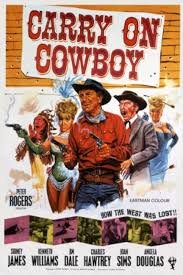
CARRY ON COWBOY
UK, 1965, 93 minutes, Colour.
Sidney James, Kenneth Williams, Jim Dale, Charles Hawtrey, Joan Sims, Angela Douglas, Bernard Bresslaw, Peter Butterworth, Percy Herbert, Jon Pertwee.
Directed by Gerald Thomas.
One of the advantages for this episode in the Carry on a series is that audiences are so familiar with westerns. And, underlying the Carry on humour here, there is a basic plot that could have been in any of the westerns over the decades, a gunfighter, the mayor, the sheriff, the saloon, the Madame, the gamblers, the singers, cattle rustling, the new marshall, the confrontations and the shootout. All very familiar, but generally always welcome with audiences.
So, how does the British cast handle being characters in a Western? And, their accents? Sid James is the gunfighter, with a roving eye and a leer. But, most interestingly, there is Kenneth Williams doing his usual shtick but with a huge moustache and with a heavy American accent (which he said was based on the American director, Hal Roach). And, Joan Sims does her bit as the madame, while Angela Douglas, to appear in several Carry on films, is Annie Oakley.
There is a lot of play on names like Marshall P. Knut. And a joke with Charles Hawtrey being the Indian chief, glasses, British accent and his usual comic style, Big Heap and the large Bernard Bresslaw as Little Heap (looking back one hopes the comedy overcomes any racial offensiveness).
So, the usual jokes and puns, the innuendo, a lot of physical comedy and pratfalls, and variations on the familiar American Western conventions.
And, in retrospect, as with most of the Carry on films, many bloggers saying it is the best and some saying it is the worst. (This reviewer was favourable.)
Some People
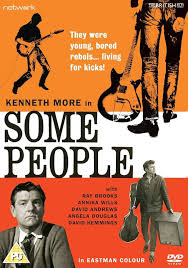
SOME PEOPLE
UK, 1962, 93 minutes, Colour.
Kenneth More, Ray Brooks, Annika Wills, David Andrews, Angela Douglas, David Hemmings, Harry H.Corbett, Cyril Luckham.
Directed by Clive Donner.
Some People is very much a film of its era, rather difficult to watch in later decades. However, it highlights some of the social changes in the UK in the early 1960s, the emergence of Teddy Boys, leading into the era of the Rockers.
The film was well received at the time, highlighting the social issues, especially amongst teenagers and young adults, as well as the possibilities for some kind of help or rehabilitation. It is the era of the Duke of Edinburgh awards for help with young people.
Quite a lot of the film shows four friends, Teddy boy types, riding their motorbikes, going through red lights, in the courts, told off by the magistrates, resentful, causing mischief. The leader is played by Ray Brooks, his later career was very much in television series, with David Andrews as the very surly and imposing type, Andrews acting for a while but then moving into film and television direction. Not so much in the limelight here, but the third member of the group is played by David Hemmings, Blow up soon to come and his much stronger career as actor and director.
The star of the film is Kenneth More, veteran, very popular in the 1950s with comedies like Genevieve and Doctor in the House as well as war films like Reach for the Sky.
He encounters the group as they move into a church, having been moved along by various authorities, and one of them talented pianist, playing. They encounter Kenneth More as the leader of the choir, much more tolerant of the youngsters, especially with his daughter and becomes involved with them, offering them opportunity for the church to be a place after choir practice for their music, developing a group, the talent in playing, the local girls talented with singing – and a number of songs with music by the very popular composer of British films of the time, Ron Grainer. Again, the songs are very much of the period of the early 1960s.
There is some background of the work in industry and aviation which Kenneth More is involved in – and some possibilities for the youngsters to get some jobs.
So, a journey back to the 1960s, the move away from polite and controlled stories in film (and in real life), the film not knowing what the rest of the 60s and changes would be like.
