Displaying items by tag: Geoffrey Keen
Cracksman, The
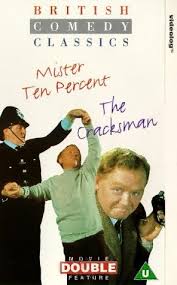
THE CRACKSMAN
UK, 1963, 112 minutes, Colour.
Charlie Drake, George Sanders, Dennis Price, Nyree Dawn Porter, Eddie Byrne, Finlay Currie, Percy Herbert, Geoffrey Keen, Patrick Cargill, Norman Bird, Ronnie Barker.
Directed by Peter Graham Scott.
Despite the notable cast, and the big Cinemascope and colour treatment, this is a comedy that is very much of its time, indication of British cinema in the early 1960s, but not the kind of comedy that lasts.
It is a star vehicle for comedian, Charlie Drake, who had his major successes in television series in the late 1950s and early 1960s – and continued after his slate of films which did not bring him lasting cinema success. While popular at the time, he is very much an acquired taste.
Charlie Drake contributed to the writing of the screenplay, a star vehicle for himself, naivete personified, a completely ingenuous character. He is a locksmith, working in the London streets, content with himself and his ability for being able to unlock any lock, no matter how difficult. So, short in stature, roly-poly in size, naive as well as wisecracking, he is played on by quite a number of characters starting with Dennis Price who passes himself off as a wealthy man and is able to persuade the cracksman to enter a house to rob it. And the police arresting.
The scenario happens over and over again throughout the film, the cracksman being taken in, doing a range of jobs, back in prison where, in fact, he is rather admired – but also played on. (And, for fans of the two Ronnies, here is Ronnie Barker as a prisoner, prior to his television term as Fletcher in Porridge.)
Ultimately, when the cracksman is out of jail, he is used by two gangs for quite an elaborate robbery, one gang led by Eddie Byrne, the other, more suave, led by, of all people, George Sanders. Ultimately, the ingenuous cracksman who has fallen for an undercover policeman, Nyree Dawn Porter, is able to set the two gangs in a fight against each other.
The supporting cast is enjoyable, Patrick Cargill as a snobby guide in the Museum, Finlay Currie as a good old prisoner, Percy Herbert leading the gangs in prison, Geoffrey Keen as a magistrate.
Horrors of the Black Museum
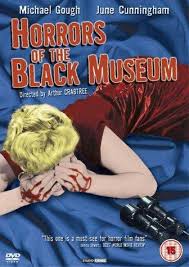
HORRORS OF THE BLACK MUSEUM
UK, 1959, 95 minutes, Colour.
Michael Gough, June Cunningham, Graham Curnow, Shirley Anne Field, Geoffrey Keen.
Directed by Arthur Crabtree.
With Hammer Studios moving into horror with Dracula and Frankenstein in the mid to late 1950s, there was a movement towards horror films in British production. Michael Powell’s Peeping Tom appeared in 1960.
While very dated, very, this film is part of that horror movement in the UK which was to flourish in the 1960s and 1970s. Surprisingly the Dir is Arthur Crabtree who had significant films in the 1940s and 1950s, especially at Gainsborough studios, starting with Madonna of the Seven Moons.
The star of the film is the younger Michael Gough, a blend of the charming and the sinister, in many films but becoming internationally known for his role in Penny worth in the Batman films of the 1980s and 1990s. Here he portrays a journalist and author, specialising in crime, always in contact with Scotland Yard, appearing at scenes of crimes, but with his own Blackcap Museum (Scotland Yard having its own such Museum) with all kinds of bizarre instruments and tableau is of crimes. He has an assistant who is completely under his control, played by Graham Curnow.
There is a series of gruesome murders, especially in the opening sequence with a glamorous young blonde looking through a pair of binoculars and her eyes being pierced. And there are several other murders throughout the film, including the elocution of the doctor, and the Revelation that the journalist is in control of situations, creating crimes, especially committed by his assistant, even on an outing at a fair with his girlfriend, played by Shirley and field.
Geoffrey keen is the leading Detective. June Cunningham has a long sequence interacting with Michael Gough and then going to a bar and dancing as if another Diana doors with dance movements like Rita Hayworth’s Gilda.
In a British pulp fiction kind of way, the film is interesting but, it is more of a curiosity of British filmmaking in the late 1950s.
