Displaying items by tag: Sid James
We Joined the Navy

WE JOINED THE NAVY
UK, 1962, 104 minutes, Colour.
Kenneth More, Lloyd Nolan, Joan O’Brien, Jeremy Lloyd, Dinsdale Landon, Derek Fowlds, Mischa Auer, John Le Mesurier, Lally Bowers, Laurence Naismith, Andrew Cruickshank, Walter Fitzgerald, Ronald Leigh-Hunt, Esma Cannon, Kenneth Griffith, Warren Mitchell, Graham Crowden, Cameos: Michael Bentine, Rodney Bewes, Dirk Bogarde, Sid James.
Directed by Wendy Toye.
British comedy at the beginning of the 1960s, broadening of humour, the period of the beginning of the Carry on series… And, glancing at the cast list, quite a number of names of popular British actors of the time and those who were emerging (and a couple of celebrity cameos, particularly Dirk Bogarde as Dr Simon Sparrow, his character in the Doctor series, where he played with Kenneth More). Sid James does a chuckling variation on his Carry on characters. Notable supporting performances from Kenneth Griffith and, especially, Warren Mitchell. And for fans of veteran actress, Esma Cannon, this is one that definitely should be seen, decked out in official royalty costume and with an accent!
There are several Americans in the cast because of the screenplay, notably Lloyd Nolan, first appearing in American films in the mid-1930s, a 50 years career, his last film Woody Allen’s Hannah and her Sisters.
Much of the screenplay now seems very corny. And there is a great deal of farce. There are interview sequences for inept candidates for the Navy. There are plenty of training sequences. But, with Kenneth More as the central character, always speaking out and being transferred to other jobs, put in command of three potential officers, Jeremy Lloyd (actor but later writer of such television series as Are You Being Served and ‘Ullo ‘Ullo), Dinsdale Landon and Derek Fowlds who came to prominence as the meek public servant in Yes, Minister and Yes, Prime Minister.
There are sequences in the Riviera, clashes between the Brits and the Yanks, more farce about romance for Kenneth More.
Finally, an intervention in an African revolution, Kenneth Griffiths, often so meek on screen, as a yelling and ranting revolutionary, veteran Mischa Auer as two characters leading the country, extremely eccentric.
This comedy has, some humour, but a great deal of silliness as well.
Carry on Regardless
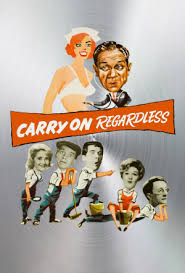
CARRY ON REGARDLESS
UK, 1961, 90 minutes, Black-and-white.
Sidney James, Kenneth Connor, Charles Hawtrey, Joan Sims, Kenneth Williams, Bill Owen, Liz Fraser, Terrence Longdon, Hattie Jacques, Esma Cannon, Sidney Tafler, Terrence Alexander, Stanley Unwin, Joan Hickson, Fenella Fielding, David Lodge.
Directed by Gerald Thomas.
The fifth film in the series, by now getting underway, and this film having most of the cast from the early films.
The screenplay was written by Norman Hudis who wrote the early screenplays before the transition to Talbot Rothwell who wrote most of the subsequent Carry on films. This one is very straightforward. Sidney James and Esma Cannon run the Helping Hand agency, ready to help out in any emergency. Meanwhile, at the labour exchange, there are a whole lot of characters looking for jobs and who descend on the agency – at one stage, in a scene at the agency, nine of the popular members of the cast are all assembled in the one room.
There is no plot as such. Rather, the film is a succession of farcical episodes, slapstick comedy, each of the new members of the agency going out on jobs and generally mucking them up. And, for a variation, in the last part of the film they go to a mixup of addresses, again with some disastrous results. And finally, their gobbledygook-speaking landlord, Stanley Unwin, interpreted by Kenneth Williams’ character who speaks 16 languages! indicates that he wants the premises renovated. Needless to say, they all help but create disasters, only to find that with all the mess that they have made, it will be all right because the landlord has decided to demolish the building.
Not so much innuendo in this particular version – though, Liz Fraser does offer an opportunity for some sex comedy. And, it is interesting to see Sid James in a fairly straightforward role. And, it is a pleasure to see most of the members of the staff as well as a number of supporting British character actors who appeared in a number of films in the series.
Carry on Constable
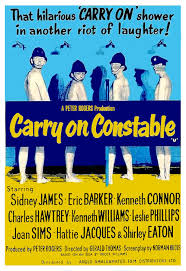
CARRY ON CONSTABLE
UK, 1960, 86 minutes, Black and white.
Sid James, Kenneth Williams, Eric Barker, Kenneth Connor, Charles Hawtrey, Leslie Phillips, Joan Sims, Hattie Jacques, Shirley Eaton, Cyril Chamberlain, Joan Hickson, Irene Handl, Esma Cannon, Terence Longden, Jill Adams, Victor Maddern.
Directed by Gerald Thomas.
One of the earliest of the Carry on series, two years after it began, the atmosphere of British filmmaking in 1960, popular comedy, the transition to the more permissive 1960s. In the retrospect of the later films, Carry on Constable seems comparatively innocent certainly some sexual references, some shower and bathroom scenes, some ogling by the male stars but, in comparison with later films, rather more of the light touch.
In fact, the film was written by the writer of the earlier Carry on films, Norman Hudis. Then there was a transition to Talbot Rothwell who scripted most of the Carry on films, more explicit with sexual themes, a great deal of innuendo.
This was the first Carry on film with Sid James, rather more straightforward role, sometimes sympathetic, but he was to develop into the chuckling lecherer during the 60s and 70s. But, it is pleasing to see so many of the regulars in this film, the two Kenneths and Charles Hawtrey, much more explicitly gay in this film than later, especially with the cross dressing of Kenneth Williams and Hawtrey, Hawtrey even passing passably for female.
Joan Sims and Hattie Jacques are happily present and there are a whole number of guest female stars, young like Shirley Eaton, three years before Goldfinger, and Jill Adams, and veterans like Esme Canon as a deaf old lady trying to cross the road, Irene Handl erupting about a misbehaving boy, and, especially, two scenes with Joan Hickson as an aristocratic alcoholic showing her as an excellent comedienne as well as dramatic actress, later Miss Marple.
Eric Barker, doing his usual shtick as a befuddled authority, is in charge of the police station and employing four new recruits, the two Kenneths, Charles Hawtrey and, appearing in several of the Carry on films, Leslie Phillips.
A whole lot of farcical situations in the office and a succession of muddled police activity with special sequences for each of the four, their own kind of comedy which was to develop during the success of films.
Popular and easy humour, easy to watch.
I Believe in You
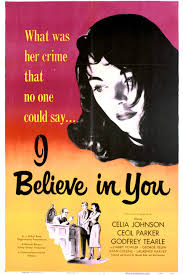
I BELIEVE IN YOU
UK, 1952, 95 minutes, Black-and-white.
Cecil Parker, Celia Johnson, Harry Fowler, Joan Collins, George Relph, Godfrey Tearle, Ernest Jay, Laurence Harvey, Ursula Howells, Sidney James, Katie Johnson, Ada Reeve, Brenda de Banzie, Gladys Henson.
Directed by Michael Relph, Basil Dearden.
This is a serious British film of the early 1950s, the team of Michael Relph and Basil Dearden, making a number of serious films together, then Basil Dearden directing on his own with such significant films as Victim and Khartoum.
Cecil Parker had established himself as a serious character actor and leads the cast here, a retiree, wanting to do something better with his life, becoming a parole officer, having to adapt his manner and even his clothing to the ordinary types that he encountered, yet able to get the trust of several, guide them, supervise, be challenged, make mistakes. He provides a voice-over for the action.
There is a very strong supporting cast led by Celia Johnson, best known for her Oscar-nominated performance in David Lean’s version of Noel Coward’s Blithe Spirit. There is a young Laurence Harvey as a surly criminal. And Joan Collins in her fourth film, making an impression – and, within two or three years, starring in Hollywood films. There is Sidney James working in an office, Katie Johnson, the famous old lady from the Ladykillers, an early role for Brenda de Banzie.
Not necessarily a film that contemporary audiences want to watch, but a worthy film and a reminder of past issues in British society.
- A serious piece of British filmmaking in the 1950s? Ordinary people, ordinary life, crime, the courts, parole officers?
- The perspective on Britain in the early 1950s, post-war, ordinary life, families, crime, courts, prisons? The role of the parole officer, supervision, counselling and help?
- Black-and-white photography, streets, homes, offices, courts, authentic feel? The musical score?
- Mr Phipps, the voice-over, Cecil Parker and his screen presence, his career, retirement, wanting to do something better, becoming a parole officer, the encounters with the other members of the staff, the friendship with Matty, the sympathy, challenging him? His quiet life at home? At the office, the interactions with the police? The range of clients, in the court, giving evidence, commissioned to check on those accused, issues of accommodation, investigating family backgrounds, the details of his interactions and friendship with Charlie, with Norma, with the old lady and the paintings from her past, the old lady and the dog being poisoned, the mother of the boy with limited intelligence…? Friendly, criticised? The confrontation with the magistrate? Reaching out to Charlie, encouraging him, the accommodation, Charlie and the crime, his intervening, the bashing, in court? Decision to retire? Talking to Matty? Staying, the magistrate bending a little under Mr Phipps’ influence?
- Matty, war widow, her work, personality, with those accused of crime, interactions with Norma, discipline, the alcoholic? The pregnant woman? Interactions with Mr Phipps, blunt, apologetic, going home for the drink? Encouraging him?
- The elderly parole officer, his health, his clients, collapse, continuing his work, encouraging Mr Phipps and handing over his clients?
- The local staff, the police, those at the desk, the busyness of the work in the office?
- Charlie, his age, crime, difficulties with his parents, accommodation, with Mr Phipps, the gradual bonding, the issue of not living in a hostel, the relationship with Norma, her background, flirtatious, the past with Jordie, imprisonment, getting out, the plans with Charlie, the pressure from Jordie, her plea to Charlie, his reaction? But the happy ending, supported by Mr Phipps?
- The elderly ladies, the lady who had posed for the paintings? The old lady and the neighbouring poisoners? The mothers? The severe fathers?
- Jordie, sullen, prison, his gang, the robbery, caught?
- Comparisons between past parole officers and later parole officers, supervision, prisons, in a world of supervision and technology?
Carry on Henry
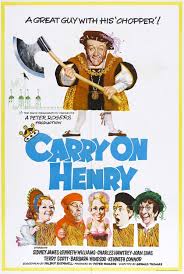
CARRY ON HENRY
UK, 1971, 89 minutes, Colour.
Sid James, Kenneth Williams, Charles Hawtrey, Joan Sims, Terry Scott, Barbara Windsor, Kenneth Connor, Julian Holloway, Peter Gilmore, William Mervyn, Bill Maynard.
Directed by Gerald Thomas.
Of all British Kings, Henry VIII would be the least to need the advice to Carry on! By 1971, Carry on films had a 13 year history, tapping a number of historical situations. Here is an invention that the king had two more wives than his six, chronicled by William Cobler, so a load of old cobblers as the introduction suggests, to the background of Greensleeves (and later Chanson D’Amour and variations on the Trumpet Voluntary).
Sid James continues as a chuckling lecherer as the king, with the same performance as always. Kenneth Williams performance is always the same, but he provides good comedy as Thomas Cromwell. Terry Scott hams it up as Cardinal Woolsey. And Kenneth Connor, shows that he can give quite a different performance in every film. And, many of the supporting cast are present again, especially Barbara Windsor as the possible Queen. But, dominating everything is Joan Sims as the princess from Normandy.
In fact, a lot of the central plot hinges on French love garlic, the Princess putting it into her mouth in the bedroom, the king repelled by garlic, and various Gallic/garlic jokes throughout the film.
A lot of shenanigans, quite some pageantry, Charles Hawtrey as the least likely gallant knight attending to the Queen.
With the subject of Henry VIII, the emphasis on sex is more prominent than usual, crude jokes, clever innuendo, and, of course, as with the king himself, the female members of the cast seen as sexual objects for male gaze and groping. How would they remake this film in the 21st-century!?
Carry on Matron
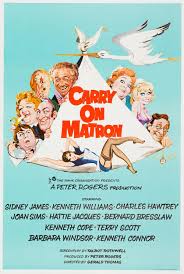
CARRY ON MATRON
UK, 1972, 88 minutes, Colour.
Hattie Jacques, Sidney James, Kenneth Williams, Kenneth Connor, Joan Sims, Bernard Bresslaw, Bill Maynard, Kenneth Cope, Barbara Windsor, Terry Scott, Charles Hawtrey, Patsy Rowlands.
Directed by Gerald Thomas.
Before this episode in the medical Carry on comedies, Nurse, Doctor, Doctor again. And, by this time, the Carry on films had been carrying on for 14 years. Most of the regular cast appear in this film.
There is a story of the hospital, Finisham, with wards named Bunn and Oven. And, there a place on the title at the opening, From Here to Maternity, Womb with a View…
Hattie Jacques, once again, is matron, sympathetic if dominating, but infatuated with the head of the hospital, Sir Bernard Cutting, once again Kenneth Williams doing his shtick, hypochondriac, fearing that he was having a sex change, pursued by the matron.
And there is something of a plot, Sid James leading a gang of crooks, including Bernard Briesslaw and Bill Maynard with Sid James’s son, Kenneth Cope, having to disguise himself as a trainee nurse, infiltrate the hospital and get the plans for where the contraceptive pills are stored so that the gang could steal them and sell them. So, lots of comedy with Cyril, the son, dressed as a nurse, sharing a room with Barbara Windsor, becoming a sensation in helping to deliver triplets in an ambulance! And, the intensity of the robbery, disguises, misadventures, and, ultimately, a gathering in some panic, everybody involved at the hospital.
Kenneth Connor, is able to create another character, a railway man waiting long hours for his pregnant wife to give birth, Joan Sims as the wife, seen continually eating hefty helpings and capitalising on the free meals. There is Terry Scott as a doctor with his eyes on the ladies. And Charles Hawtrey is able to do his shtick as a psychiatrist on the hospital staff, clashing with Kenneth Williams.
Lots of puns, lots of innuendo, some titillation, some slapstick, a typical Carry on comedy.
Carry on Screaming
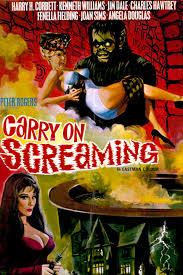
CARRY ON SCREAMING
UK, 1966, 97 minutes, Colour.
Harry H. Corbett, Fenella Fielding, Kenneth Williams, Jim Dale, Charles Hawtrey, Joan Sims, Angela Douglas, Bernard Bresslaw, Peter Butterworth, Jon Pertwee, Tom Clegg, Billy Cornelius, Frank Thornton.
Directed by Gerald Thomas.
With the growing propensity for the Carry on films to parody classic stories, it was inevitable that there would be a horror film. But, no Sid James, no Kenneth Connor.
By this stage, writer, Talbot Rothwell, was in his element. Basically, this story is a Frankenstein variation, Kenneth Williams enjoying himself with his repartee and shtick as a scientist, dead, but like his monsters, electrified into life. And, he has two monsters and a drink which can temporarily change heroes into monsters. And he is aided and abetted by the strong presence of Fenella Fielding as his sister, very much in the Morticia Addams look vein.
The rather unsympathetic hero is played by Harry H. Corbett, of Steptoe and Son. He could have been played by Kenneth Connor. And, there is Joan Sims as his harridqn wife, a parallel to her turn in Carry on Matron. And, just before the end, she has the final wink.
Jim Dale is the put-upon hero. Charles Hawtrey has a small role. But, regular, Peter Butterworth, has a more substantial turn in this film as Corbett’s assistant and having to dress as a woman as bait for the monsters. And Bernard Bresdlaw is the undead butler. Frank Thornton, anticipating Are You Being Served, his shop manager.
All the usual shenanigans – and the film has a high reputation amongst the Carry on series.
Carry on Camping
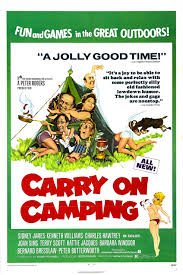
CARRY ON CAMPING
UK, 1969, 88 minutes, Colour.
Sid James, Kenneth Williams, Charles Hawtrey, Joan Sims, Terry Scott, Barbara Windsor, Hattie Jacques, Bernard Bresslaw, Julian Holloway, Dilys Laye, Peter Butterworth, Betty Marsden, Trisha Noble.
Directed by Gerald Thomas.
By this time, the Carry On series had been going for over a decade, with small black and white, it is to cover comedies and strong popularity, not only in the UK but overseas – but, not so much in the United States.
A great number of bloggers on the IMDb considered as one of the best of the Carry on series.
For this reviewer, it seemed one of the weakest. It is 1969, the film opens with an extensive coverage of a nudist film, something of a breakthrough for mainstream films in the late 1960s (not a feature of popular comedies from the US). It is take for granted that there will be sex jokes and references, innuendo, objects recycled, obvious is… And that is certainly the case here. However, this to be more of a leering turn their in many of the other films, Sid James being particularly ogling and leering here.
One of the advantages of the film is that so many of the regular cast are present. A very sympathetic presences, especially Joan Sims and Bernard Breslau (always putting his foot in it as since good friend). And, there is the young Barbara Windsor – exactly and inhibited presence on screen. Hattie Jacques is serious, even in a comedy and Kenneth Williams is always himself. Many might find Charles Hawtrey very irritating this time round and there are troubles between Terry Scott Betty Marston as his non-listening falling wife.
It would be interesting to see a feminist review of Carry on Camping and its presentation of the objectification of women, especially young women, this comedy presentation of the male gaze with Sid James’s line: what are the young women always there where I’m staring!
And, with the ending the people gathering for music Festival, remembering that 1969 was the year of Woodstock – although the oldies and regulars from the Carry on films are against the festival and oust everyone.
Carry on Cabby
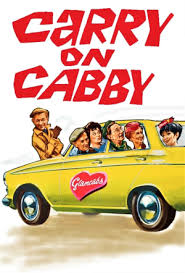
CARRY ON CABBY
UK, 1963, 91 minutes, Black-and-white.
Sidney James, Hattie Jacques, Kenneth Connor, Charles Hawtrey, Esma Cannon, Liz Fraser, Bill Owen, Milo O'Shea, Judith Furse, René Houston, Jim Dale, Amanda Barrie, Norman Chappell.
Directed by Gerald Thomas.
Not originally intended as a Carry on comedy. It was Called Me a Cab, written by Sid Green and Dick Hills, writers for the comedy team of Morecombe and Wise. But, with the popularity of the Carry on series, regular writer, Talbot Rothwell adapted it.
This means there are two different features for this Carry on comedy. There is far more plot and character development and interaction. And, the film relies far less on sexual references and jokes and innuendo. In fact, Sid James, apart from being a workaholic taxi driver and neglecting his wife, is quite respectable.
The film also acknowledges support from the taxi companies in London. And, with many variations on the theme, it shows how significant taxis can be.
Sid James loves driving taxis, worked with his partner, played in his usual way by Kenneth Connor (who does have to dress up as a female taxi driver at one stage). And Sid James is married to Hattie Jacques. The comment is that she thinks this is the best of her Carry on films – and, she is at her best, creating a character, a greater range of emotions than a stern matron! Charles Hawtrey does his usual simple-minded shtick. But, there is the advantage of Milo O’Shea as a taxidriver in an early role, veteran Esma Cannon, Liz Fraser, and introducing to the series, Jim Dale as a frantic father and Amanda Barrie.
When Sid James is caught up in taxi problems and neglects his wife’s anniversary celebrations, she decides to set up a rival company, not letting him know. She buys many taxis, gets glamorous drivers, is able to steal his clientele, with digs at ogling males. So, plenty of shenanigans. But, when the Glam firm is so successful, Sid James has to use his wits to bring down the company.
So, a lot of comedy, some slapstick, some tense situations, and the good idea of having some robbers hijack Hattie Jacques’s car and everybody then in on the act to track the robbers with the whole taxi fleet.
Enjoyable, British filmmaking in the 1960s, and the most PG rated of all the Carry on films!
Carry on up the Khyber
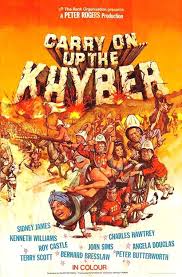
CARRY ON UP THE KHYBER
UK, 1968, 95 minutes, Colour.
Sidney James, Kenneth Williams, Charles Hawtrey, Roy Castle, Joan Sims, Bernard Bresslaw, Peter Butterworth, Terry Scott, Angela Douglas, Cardew Robinson, Julian Holloway, Peter Gilmore.
Directed by Gerald Thomas.
By 1968, the Carry on series had been popular for 10 years – and there were more than 10 years more to come.
For devotees of the series, this is considered one of the best, with some plot borrowed from the many stories of British presence in India, uprisings, British stiff upper lip… And plenty of the humour associated with the series.
For those who are beginning to dislike the series, put it down, it is considered one of the worst.
While the setup has its background of humour, Sid James as the British representative, Sir Ruff-Diamond, and Joan Sims as his pompously silly wife, various officials…, there are problems at the Khyber pass, Kenneth Williams as the local chief, doing his usual, Bernard Bresslaw with his name punning on Gunga din, wanting to oust the British.
Critics say that the basic premise is infantile. Rather, it is the kind of joking of young boys. The regiment protecting the past is the Foot and Mouth regiment, wearing kilts. And, the whole situation is whether somebody wears underpants or not, regulation say not, Charles Hwtrey doing his usual stick is found wearing underpants and a photo taken to be used with the locals to show they should not fear the British.
This joke continues throughout the film, poking fun at the British, especially the Sergeant Major played by Terry Scott.
There is a huge bombardment sequence at the end while the British sit at their table, enjoying their lavish meal, everything being shot up around them, including the orchestra who has been playing and, after their being shot at, getting up to continue playing, the only person noticing the damage is the fake religious preacher played by Peter Butterworth.
And, what is the strategy for finally defeating the uprising, the kilted men all lining up at the moment of ceasefire, raising their kilts and the Indians running for the hills.
