Displaying items by tag: Jim Dale
Nurse on Wheels
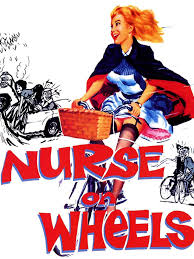
NURSE ON WHEELS
UK, 1963, 85 minutes, Black-and-white.
Juliet Mills, Ronald Lewis, Joan Sims, Noel Purcell, Esma Cannon, Raymond Huntley, Athene Seyler, Norman Rossington, Ronald Howard, Joan Hickson, Renee Houston, Jim Dale, George Woodbridge.
Directed by Gerald Thomas.
A pleasant, old-fashioned British comedy. It was directed by Gerald Thomas taking some time off from making Carry on films. It was written by Norman Hudis who had written the early Carry on films but was giving way to Talbot Rothwell. And, it is very much geared towards the widest audience, only a little innuendo and a spoilt flirtation sequence.
Juliet Mills, in her early 20s, plays a district nurse, new to the district, under suspicion by the patients of the previous nurse, sometimes rude to her, offhand. She is strong-minded, rides a bike, has a driving lesson – and a later driving escapade which proves that she is far better on her bicycle. Ultimately, of course, her patients relent and she is accepted. There is also a romance with Ronald Lewis as a local farmer, sometimes curt, especially to a young man and his pregnant wife who want to park on his land, but, of course, a final reconciliation.
The film is striking for the number of character actors who take the roles generally of the locals, suspicious, hard, gradually relenting. And, there are at least half a dozen regulars from the Carry on films, Joan Sims with a very straightforward role as the vicar’s daughter, Raymond Huntley is the vicar, Jim Dale as the husband, and Joan Hickson as a housekeeper. And, especially, Esma Cannon as the nurses pleasantly dithery as the nurse’s mother.
There is a jaunty theme playing every time the nurse appears on her bike and then more frequently, possibly too often!
Life in English country towns in the early 1960s, the NHS, the district nurse, local doctors, and a variety of local characters.
Carry on Spying
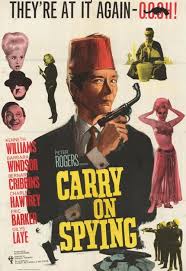
CARRY ON SPYING
UK, 1964, 87 minutes, Black-and-white.
Kenneth Williams, Barbara Windsor, Bernard Cribbins, Charles Hawtrey, Eric Barker, Dilys Laye, Jim Dale, Richard Wattis, Eric Pohlmann, Victor Maddern, Judith Furse, John Bluthal.
Directed by Gerald Thomas.
With James Bond film, Dr No, 1962, followed by From Russia With Love, it was probably inevitable that the Carry on series would move into the world of espionage and British agents. And so it was.
This episode was released at the same time as Carry on Cleo. The series had moved colour but this episode returns to black-and-white. And key members of the team are absent, Sid James, Joan Sims, Hattie Jacques, Kenneth Connnor. But, Bernard Cribbins had been the Kenneth Connor type character in Carry on Jack and does the same here. But, this was the first Carry on film for Barbara Windsor and she certainly makes a big impression, sense of comedy and fun, but also showing that the female characters, while definitely for the male gaze, have character and could contribute to the more serious aspects of the plot.
Not that there are very many more serious aspects. This is very basic Carry on material, really just an espionage farce, with some of the usual jokes and more than innuendo. The screenplay was written by Talbot Rothwell, who was becoming the regular writer, but he collaborates with Sid Colin, writer of many comedies with the Chastity Belt and Up The Front comedies to come.
OF course, it is all a parody of British espionage, four dimwitted agents, Eric Barker as the version of M, Richard Wattis as a kind of Q. And there are various villains, especially led by Eric Pohlman, the in the number of British films at the time.
The impact depends on the presence of Kenneth Williams, not quite his usual role, in fact, giving up his posh accent for a rather flat one. But, a lot of the same shtick in the world of agents. Bernard Cribbins is genial but rather dumb. Charles Hawtrey is as always. And, Jim Dale is very enjoyable in a whole range of disguises as their contact. Dilys Laye sings songs and is ambiguous in her loyalties. Judith Furse is a variation on Blofeld. And, instead of SPECTRE, there is STENCH, Society for the Total Extinction of Non-Conforming Humans.
In and Algiers, an impossible number of extensive changes of costume and disguises. Some laughs, some nods to Bond and, explicitly with the zither music, The Third Man’s scene of Orson Welles emerging from the sewers. But, very basic British comedy.
Carry on Screaming
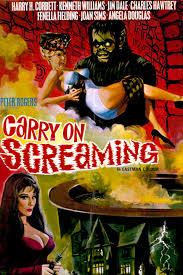
CARRY ON SCREAMING
UK, 1966, 97 minutes, Colour.
Harry H. Corbett, Fenella Fielding, Kenneth Williams, Jim Dale, Charles Hawtrey, Joan Sims, Angela Douglas, Bernard Bresslaw, Peter Butterworth, Jon Pertwee, Tom Clegg, Billy Cornelius, Frank Thornton.
Directed by Gerald Thomas.
With the growing propensity for the Carry on films to parody classic stories, it was inevitable that there would be a horror film. But, no Sid James, no Kenneth Connor.
By this stage, writer, Talbot Rothwell, was in his element. Basically, this story is a Frankenstein variation, Kenneth Williams enjoying himself with his repartee and shtick as a scientist, dead, but like his monsters, electrified into life. And, he has two monsters and a drink which can temporarily change heroes into monsters. And he is aided and abetted by the strong presence of Fenella Fielding as his sister, very much in the Morticia Addams look vein.
The rather unsympathetic hero is played by Harry H. Corbett, of Steptoe and Son. He could have been played by Kenneth Connor. And, there is Joan Sims as his harridqn wife, a parallel to her turn in Carry on Matron. And, just before the end, she has the final wink.
Jim Dale is the put-upon hero. Charles Hawtrey has a small role. But, regular, Peter Butterworth, has a more substantial turn in this film as Corbett’s assistant and having to dress as a woman as bait for the monsters. And Bernard Bresdlaw is the undead butler. Frank Thornton, anticipating Are You Being Served, his shop manager.
All the usual shenanigans – and the film has a high reputation amongst the Carry on series.
Carry on Cabby
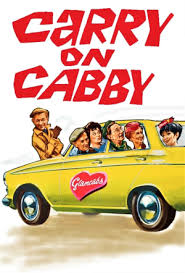
CARRY ON CABBY
UK, 1963, 91 minutes, Black-and-white.
Sidney James, Hattie Jacques, Kenneth Connor, Charles Hawtrey, Esma Cannon, Liz Fraser, Bill Owen, Milo O'Shea, Judith Furse, René Houston, Jim Dale, Amanda Barrie, Norman Chappell.
Directed by Gerald Thomas.
Not originally intended as a Carry on comedy. It was Called Me a Cab, written by Sid Green and Dick Hills, writers for the comedy team of Morecombe and Wise. But, with the popularity of the Carry on series, regular writer, Talbot Rothwell adapted it.
This means there are two different features for this Carry on comedy. There is far more plot and character development and interaction. And, the film relies far less on sexual references and jokes and innuendo. In fact, Sid James, apart from being a workaholic taxi driver and neglecting his wife, is quite respectable.
The film also acknowledges support from the taxi companies in London. And, with many variations on the theme, it shows how significant taxis can be.
Sid James loves driving taxis, worked with his partner, played in his usual way by Kenneth Connor (who does have to dress up as a female taxi driver at one stage). And Sid James is married to Hattie Jacques. The comment is that she thinks this is the best of her Carry on films – and, she is at her best, creating a character, a greater range of emotions than a stern matron! Charles Hawtrey does his usual simple-minded shtick. But, there is the advantage of Milo O’Shea as a taxidriver in an early role, veteran Esma Cannon, Liz Fraser, and introducing to the series, Jim Dale as a frantic father and Amanda Barrie.
When Sid James is caught up in taxi problems and neglects his wife’s anniversary celebrations, she decides to set up a rival company, not letting him know. She buys many taxis, gets glamorous drivers, is able to steal his clientele, with digs at ogling males. So, plenty of shenanigans. But, when the Glam firm is so successful, Sid James has to use his wits to bring down the company.
So, a lot of comedy, some slapstick, some tense situations, and the good idea of having some robbers hijack Hattie Jacques’s car and everybody then in on the act to track the robbers with the whole taxi fleet.
Enjoyable, British filmmaking in the 1960s, and the most PG rated of all the Carry on films!
Carry on Cowboy
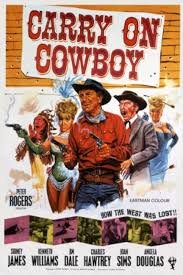
CARRY ON COWBOY
UK, 1965, 93 minutes, Colour.
Sidney James, Kenneth Williams, Jim Dale, Charles Hawtrey, Joan Sims, Angela Douglas, Bernard Bresslaw, Peter Butterworth, Percy Herbert, Jon Pertwee.
Directed by Gerald Thomas.
One of the advantages for this episode in the Carry on a series is that audiences are so familiar with westerns. And, underlying the Carry on humour here, there is a basic plot that could have been in any of the westerns over the decades, a gunfighter, the mayor, the sheriff, the saloon, the Madame, the gamblers, the singers, cattle rustling, the new marshall, the confrontations and the shootout. All very familiar, but generally always welcome with audiences.
So, how does the British cast handle being characters in a Western? And, their accents? Sid James is the gunfighter, with a roving eye and a leer. But, most interestingly, there is Kenneth Williams doing his usual shtick but with a huge moustache and with a heavy American accent (which he said was based on the American director, Hal Roach). And, Joan Sims does her bit as the madame, while Angela Douglas, to appear in several Carry on films, is Annie Oakley.
There is a lot of play on names like Marshall P. Knut. And a joke with Charles Hawtrey being the Indian chief, glasses, British accent and his usual comic style, Big Heap and the large Bernard Bresslaw as Little Heap (looking back one hopes the comedy overcomes any racial offensiveness).
So, the usual jokes and puns, the innuendo, a lot of physical comedy and pratfalls, and variations on the familiar American Western conventions.
And, in retrospect, as with most of the Carry on films, many bloggers saying it is the best and some saying it is the worst. (This reviewer was favourable.)
Carry on, Cleo
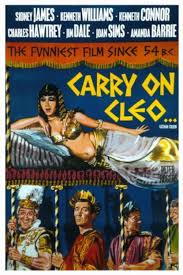
CARRY ON CLEO
UK, 1964, 90 minutes, Colour.
Sid James, Kenneth Connor, Kenneth Williams, Joan Sims, Jim Dale, Charles Hawtrey, Amanda Barrie, Victor Maddern, Julie Stevens, Sheila Hancock, Jon Pertwee, Frances DeWolff, Warren Mitchell.
Directed by Gerald Thomas.
The late 1950s to the 1980s, the Carry On… franchise was extraordinarily popular
Most of the films were produced by Peter Rogers and directed by Gerald Thomas – and a few other films during this period, not Carry on comedies, but British comedies for the wide audience. The rite of this film was Talbot Roth will who began writing comedy sketches as a prisoner of war and putting on reviews, satirical touches, wordplay, Devil traditions, and risk a. He would continue to write many more of the Carry on comedies.
Many audiences, Carry on Cleo is one of the best. It has rather lavish sets and costumes – some noting that they were leftovers from production preparation for Cleopatra, with Elizabeth Taylor and Richard Burton. In fact, this film came out the year after Cleopatra’s release, Amanda Barrie made to look like a variation on Elizabeth Taylor, some parody of the extravagant film, the bath with asses milk, and the rolling of Cleopatra out of the carpet – but, this time, with accidental crash results.
The film relies on audience appreciation of historical spectacles, the early sequences of Caesar trying to conquer Britain and the rather primitive Britain’s and their way of life, the attack, many of them going as prisoners to Rome as slaves – with the slave market sequence and Warren Mitchell representing the slave company, Marcus and Spence serious!
One of the advantages of the Carry on films was the constant cast (though Hattie Jacques is missing from this film). Sid James is just himself as Marc Anthony, Tony to his friends, with Kenneth Williams is a most unlikely Julius Caesar. Kenneth, is one of the captured British, based on the tales of An guest and Horse, Connor, by accident a hero and promoted to Caesar’s guard. (, Relies on his ability to do all kinds of impersonations, especially effective in Watch Your Stern.) Jim Dale is a pleasant leader of the slaves.
There are all kinds of puns, some of them very obvious with the audience waiting for them to be pronounced, quite a lot of innuendo. One of the most famous and everybody comments on it, so also here, Kenneth Williams Caesar about to be assassinated, “infamy, infamy, they have all got it in for me”. And there is a running joke of everybody adding countrymen to Caesar’s exasperation when he starts off “friends, Romans…”. In the final corny joke at his death, playing on the Latin, I came, I saw, I conked out.
Which means then that while this could be considered as lowbrow comedy (and many did), it entertains the lowbrow in all of us.
Big Job, The
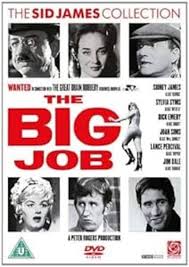
THE BIG JOB
UK, 1965, 89 minutes, Colour.
Sid James, Sylvia Syms, Dick Emery, Joan Sims, Lance Perceval, Jim Dale, Deryck Guyler, Reginald Beckwith,
Directed by Gerald Thomas.
It looks as though that in the middle of making all the Carry On films, Gerald Thomas and many of his stars decided to have something of a break, restrain, somewhat more respectable, British comedy. And this was the mid-1960s.
One might say that this Big Job is a series of robbery muddles, all kinds of tangles. It is 1950. Sid James is the leader of a motley group, Lance Perceval as the member of the group who is not the sharpest, Sylvia Sims offering the touch of glamour and romance, and, particularly effective, Dick Emery before his television show.
All of these muddles this are presented in a farcical style, especially the initial robbery, everything going wrong that could, then a whole lot of opportunities for success, and escape, travelling in a hearse, mourning cars following, but eventually cornered by the police and throwing a bag of the loot into a hollow tree.
Then, prison, 15 years, out they come to retrieve the money, teaming up with Sylvia Sims again who has her eye on marriage. However, Sid James can say all the words but one might say he is completely asexual, no romance, nothing erotic… Just complete dedication to get the money back.
As they work out where they were arrested and go back, all kinds of complications and funny situations, a housing settlement being built up rather than the open countryside, the tree now within the precincts of the local police station, the hiring rooms opposite with an overview of the tree and the station, even stealing a telescope to keep watch. There is also some romance with the lady of the house where they rent, a widow, but casting her eye on Dick Emery. And, the guest living there is one of the local young policeman, Jim Dale.
So, a whole lot of shenanigans, mostly impossible, especially the digging of a huge tunnel from under the house, under the Street, the police station.
And, when they do get the bag back – a surprise for them as well as for the audience! And the double life of the landlady!
A film to gauge the popular response of the wide audience to this kind of British comedy in the 1960s.
