Displaying items by tag: Finlay Currie
Go to Blazes
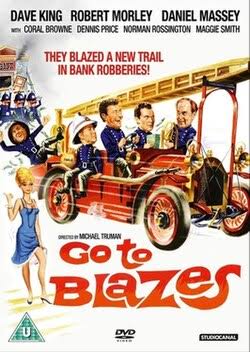
GO TO BLAZES
UK, 1962, 80 minutes, Colour.
Dave King, Robert Morley, Daniel Massey, Dennis Price, Coral Brown, Norman Rossington, Maggie Smith, Myles Malleson, Wilfred Lawson, David Lodge, Finlay Currie, James Hayter, Derek Nimmo, Hugh Lloyd, Arthur Lowe, John Le Mesurier.
Directed by Michael Truman.
Pleasantly light farcical comedy from the early 60s, very much of British comedy in the 1950s – and indicating the trend to greater farce, innuendo, with the style introduced by the Carry on series.
This is the story of a smash and grab trio, smashing the window of a jewellery store and grabbing, the getaway car – but, unfortunately, caught by the police at a roadblock. Jail time. Then the realisation that the best getaway that everybody stops for is a fire engine! So, jail, it again and examining fire engines (with an enthusiastic Miles Malleson), they find an old wreck, steal a good fire engine, inserting the wreck and setting the place ablaze.
Most of the film is about the attempt to smash and grab, the elegant Daniel Massey being prevented a number of times, the other two, Dave King and Norman Rossington, going round and round with their fire engine, caught by a rather idiotic Derek Nimmo because of the flood in his shop, their realising they need to do some training and finding a disgraced fire chief, Dennis Price, who will train them.
In the meantime, Daniel Massey has made a fool of himself fleeing and entering into a fashion show at a highbrow shop, managed by Coral Browne, and with a French consultant, Maggie Smith very early role (and, at one stage, the French accent dropping to a blimey English accent when surprised). And, the realisation that the fashion store is next to a bank. They consult an expert on fire insurance, setting fires, all kinds of skills – and, very enjoyably, played by Robert Morley in full bombast.
It almost works. But, in the escape, they are recognised by the two ladies and the initial policeman pursuing goes in chase, the firemen kindly stopping to help some little girls with their treehouse doll rescue, trees then on fire, the police – and, disaster because they had filled their water hose with all the bank notes from the robbery!
On their way back to jail, that pass the Queen and the Duke of Edinburgh and realise that this is a car that everybody stops for!
There are a lot of popular names from British films in the cast – but, for most of them, their appearances last only a minute or two!
Laxdale Hall
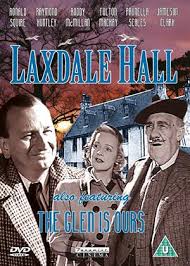
LAXDALE HALL
UK, 1953, 77 minutes, Black-and-white.
Ronald Squire, Raymond Huntley, Kathleen Ryan, Sebastian Shaw, Fulton Mackay, Jean Colin, Jameson Clark, Keith Faulkner, Prunella Scales, Kynaston Reeves, Andrew Keir.
Directed by John Eldridge.
A small film from the UK in the 1950s, the kind of film that offered a view of post-war Britain, politics in London, isolated life in the Scottish Highlands (and the Americans retitling the film for accessibility, Scotch on the Rocks!).
The film opens in Westminster, a member of Parliament, played by the always dignified (until he has a slight drunk scene here) Raymond Huntley. He has family connections with the Scottish town centred on Laxdale Hall. The inhabitants are refusing to pay their taxes demanding a better road and port accessibility (scenes illustrating the need). Assisting the MP are a more conciliatory visitor, Sebastien Shaw, and the secretary played by Fulton Mackay, looking very young and nothing like his middle-aged-older look when he was the prison guard continually clashing with Ronnie Barker’s Fletcher in Porridge.
The lord of Laxdale Hall is played genially by Ronald Squire with Kathleen Ryan as his proper daughter. In the meantime, there are all kinds of shenanigans with the locals, who poach fish, the local outspoken church minister, the midwife, the funeral director, the schoolteacher – and she is played by very young Prunella Scales, long before Fawlty Towers.
Most of the screenplay runs as expected, the visitors initially stranded because of a gale, coming to the town, the MP presumptuously giving a speech about moving all inhabitants in land to get industrial jobs and a regular salary but a huge reaction against his proposals. There is hospitality. There is some poaching. There are schoolchildren in classes. And there are a team of poachers on the prowl from Glasgow.
Some touches of romance, especially with the teacher and the secretary. Battle hijinks as the locals all band together one night to attack the Glasgow poachers. In the meantime, MP stranded in a car with a wheel that needs to be replaced, finding a bottle of whiskey and comforting himself during the night with drinking, and to be under suspicion by the police and arrested and handcuffed.
But, there was a pleasant scene with the MP sitting dangling his feet in the river – an indication that he will relent (although the incriminating photo may have some influence). Finally, as he leaves, he gives a speech encouraging the locals and their way of life.
One might say nicely and cosily British.
Cracksman, The
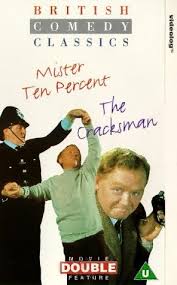
THE CRACKSMAN
UK, 1963, 112 minutes, Colour.
Charlie Drake, George Sanders, Dennis Price, Nyree Dawn Porter, Eddie Byrne, Finlay Currie, Percy Herbert, Geoffrey Keen, Patrick Cargill, Norman Bird, Ronnie Barker.
Directed by Peter Graham Scott.
Despite the notable cast, and the big Cinemascope and colour treatment, this is a comedy that is very much of its time, indication of British cinema in the early 1960s, but not the kind of comedy that lasts.
It is a star vehicle for comedian, Charlie Drake, who had his major successes in television series in the late 1950s and early 1960s – and continued after his slate of films which did not bring him lasting cinema success. While popular at the time, he is very much an acquired taste.
Charlie Drake contributed to the writing of the screenplay, a star vehicle for himself, naivete personified, a completely ingenuous character. He is a locksmith, working in the London streets, content with himself and his ability for being able to unlock any lock, no matter how difficult. So, short in stature, roly-poly in size, naive as well as wisecracking, he is played on by quite a number of characters starting with Dennis Price who passes himself off as a wealthy man and is able to persuade the cracksman to enter a house to rob it. And the police arresting.
The scenario happens over and over again throughout the film, the cracksman being taken in, doing a range of jobs, back in prison where, in fact, he is rather admired – but also played on. (And, for fans of the two Ronnies, here is Ronnie Barker as a prisoner, prior to his television term as Fletcher in Porridge.)
Ultimately, when the cracksman is out of jail, he is used by two gangs for quite an elaborate robbery, one gang led by Eddie Byrne, the other, more suave, led by, of all people, George Sanders. Ultimately, the ingenuous cracksman who has fallen for an undercover policeman, Nyree Dawn Porter, is able to set the two gangs in a fight against each other.
The supporting cast is enjoyable, Patrick Cargill as a snobby guide in the Museum, Finlay Currie as a good old prisoner, Percy Herbert leading the gangs in prison, Geoffrey Keen as a magistrate.
