Displaying items by tag: Eddie Byrne
Cracksman, The
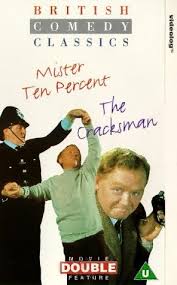
THE CRACKSMAN
UK, 1963, 112 minutes, Colour.
Charlie Drake, George Sanders, Dennis Price, Nyree Dawn Porter, Eddie Byrne, Finlay Currie, Percy Herbert, Geoffrey Keen, Patrick Cargill, Norman Bird, Ronnie Barker.
Directed by Peter Graham Scott.
Despite the notable cast, and the big Cinemascope and colour treatment, this is a comedy that is very much of its time, indication of British cinema in the early 1960s, but not the kind of comedy that lasts.
It is a star vehicle for comedian, Charlie Drake, who had his major successes in television series in the late 1950s and early 1960s – and continued after his slate of films which did not bring him lasting cinema success. While popular at the time, he is very much an acquired taste.
Charlie Drake contributed to the writing of the screenplay, a star vehicle for himself, naivete personified, a completely ingenuous character. He is a locksmith, working in the London streets, content with himself and his ability for being able to unlock any lock, no matter how difficult. So, short in stature, roly-poly in size, naive as well as wisecracking, he is played on by quite a number of characters starting with Dennis Price who passes himself off as a wealthy man and is able to persuade the cracksman to enter a house to rob it. And the police arresting.
The scenario happens over and over again throughout the film, the cracksman being taken in, doing a range of jobs, back in prison where, in fact, he is rather admired – but also played on. (And, for fans of the two Ronnies, here is Ronnie Barker as a prisoner, prior to his television term as Fletcher in Porridge.)
Ultimately, when the cracksman is out of jail, he is used by two gangs for quite an elaborate robbery, one gang led by Eddie Byrne, the other, more suave, led by, of all people, George Sanders. Ultimately, the ingenuous cracksman who has fallen for an undercover policeman, Nyree Dawn Porter, is able to set the two gangs in a fight against each other.
The supporting cast is enjoyable, Patrick Cargill as a snobby guide in the Museum, Finlay Currie as a good old prisoner, Percy Herbert leading the gangs in prison, Geoffrey Keen as a magistrate.
Bridal Path, The
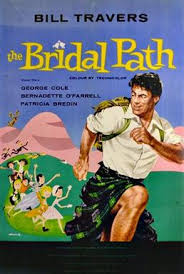
THE BRIDAL PATH
UK, 1959, 95 minutes, Colour.
Bill Travers, Bernadette O'Farrell, George Cole, Duncan Macrae, Eddie Byrne, Terry Scott.
Directed by Frank Launder.
This is a pleasant picaresque story set in Scotland.
Bill Travers, who had emerged successfully in Geordie and appeared in such films as The Barretts of Wimpole Street, and then with his wife, Virginia McKenna, in Born Free (and the giving of their life and attention to Africa and animals), plays a vigorous, strapping Scot who lives on an island, and the issue of his marriage.
He goes to the mainland, gets himself involved in a lot of tangles, even with the police, testing out various women with his criteria for marriage, restrictive in terms of clans and religion from the island perspective.
This is a pleasant story even if it does seem rather far-fetched!
There is a good supporting cast with character actors like Duncan Macrae (The Kidnappers) and comedian Terry Scott as a policeman.
The screenplay was written by veteran Frank Launder who directed the film. He has 75 writing credits from 1929 to 1985.
- The title, marriage in the Scottish Isles, traditions, requirements for marriage, and a search for a wife?
- The Scottish settings, the colour photography, the landscapes, the sea, the town on the streets, shops, the countryside and its range, hotels, police precincts…? And the musical score and the choral singing?
- Life on the island, the minister and his return, his sermon, the issue of consanguinity, cousins on the island marrying? Taking the issue seriously?
- Ewan, with Siona, the children, cousins, the bond between them, Siona and her determination to go to Glasgow? Ewan, the prescriptions for finding a wife, his going to the mainland?
- The film as a comedy of errors, Ewan as the naive islander, his presence, his height, charm, awkwardness, his going to the bank, the £400 and two shillings, going to the restaurant, eyeing the waitress, his being ousted? The male gaze of 1959 from Scotland, his looking at the various women? But according to the prescriptions on his list, no Catholics, no Campbells, wanting children, good with cows…?
- The range of events, going to the inn, the flirtatious wife of the policeman, his being continually misunderstood, the young woman reading the book about white slavery, his explaining that he wanted to look over girls, her alarm, calling the police?
- The continued chases, out in the countryside, along the roads, the rail tracks, getting wet, the policeman’s wife and his clothes, the Campbell rug, the effect on Ewan, the policeman with the bike, the pound notes flying, paying for the bike and taking it?
- The various police officers, disbelief, the more information, the headquarters, getting in the authorities? The phone calls, the pursuits, the sightings? The games, the elaborate chase, the participation of the police, pulling out of the events, tug-of-war et cetera, Ewan continually escaping?
- The interview with Sgt Bruce, his fear of his wife, having to stay the night, getting the breakfast, the other police arriving, Ewan getting them cups of tea, then his escape?
- Taking refuge with the farming woman, her wanting to escape, buying the boat, rowing out, persuading the boat to target him?
- Adrift, finally getting home, recounting his adventures? The encounter with Siona, the mother’s wife telling the truth about his origins, not cousins, his courage in proposing, acceptance? Happy ending?
Beautiful Stranger/ Twist of Fate
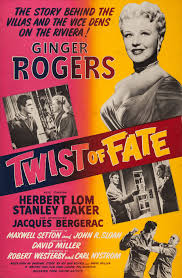
BEAUTIFUL STRANGER/TWIST OF FATE
UK, 1954, 89 minutes, Black-and-white.
Ginger Rogers, Jacques Bergerac, Stanley Baker, Herbert Lom, Eddie Byrne, Margaret Rawlings, Coral Browne, Ferdy Mayne, John Le Mesurier.
Directed by David Miller.
Title and the credits love song indicate that Love is the beautiful stranger. However, it may also be the character of Johnny, former chorus girl dancer, played by Ginger Rogers.
During the 1950s, many of the American stars, with the introduction of television, came to England to star in smaller films, enhancing their reputations. Ginger Rogers had a strong career from the 1930s, dancing with Fred Astaire, an Oscar in 1940 for Kitty Foyle, her later career during the 40s and 50s in comedies and dramas.
The two leading men, 16 and 17 years younger than she, are the seemingly emotionless Stanley Baker and the French heartthrob in American films and television, Jacques Bergerac. He and Ginger Rogers were married at the time of making this film. There is an interesting supporting cast led by Herbert Lom in a rather sinister role, Eddie Byrne as a criminal contact, Corel Browne’s appearance at the hairdressers, Ferdy Mayne as the police officer, John Le Mesurier in a scene in the casino. Direction is by experienced American director, David Miller.
Riviera setting, crime and forgery, gambling, violence, betrayals… An entertainment rather than a serious portrait of credible characters and situations.
- The original title, the theme song: Love is a Beautiful Stranger? The international title and its relationship to plot twists?
- British filmmaking, American actors and directors, British cast? French Riviera locations? Musical score?
- Johnny, the central character, Ginger Rogers, in her early 40s, the leading men 16 and 17 years younger? Her glamour, the range of costumes, her screen presence? Her story, theatre and dancing, hard times, the encounter with Louis, infatuated with him, his wealth, the yacht, the house, the gifts of jewellery, the high life, the casinos? The possibility of marriage? The effect on her, the encounter with Emil, the money, her friend in the sanatorium? Upset with Louis, his marriage, his business, the phone calls, her driving the car, the crash, the encounter with Pierre, the artists, the friendship, the pottery, the return, falling in love? Her dilemmas, Louis and his absences, his return, suspicions, and feels payment with the necklace, his balls conclusions, confrontations with Johnny?
- Louis, business, his wife and relationship, her brothers, the forgeries, his gang, the sale of the coins, the plan for each of forgery, the collection, Emil paying with the necklace and his suspicions, the plan with Luigi, with Johnny, going to Africa? The scenes with his wife, the clash? His suspicions, the confrontations, his unexpected death?
- Emil, past friendship with Johnny, the casino, the money and gambling, the selling of the coins, Luigi, the necklace, Emil and his lies, robbing the safe, the necklace, returning, robbing the safe of the cash, the encounter with Louis, the fight, Louis’s death, putting the body in the car, following, trying to burn the body, the irony of his coat, the money in the fire, pursuing him, the fight, Luigi shooting him?
- Luigi, working with Louis, loyalty, collecting the coins, the money, the final plan, Louis not arriving, following Emil? His death?
- Background characters, life at the casino, the local police and their activities?
- A variation on film noir? An entertainment rather than realistic characters and situations?
