Displaying items by tag: Robert Morley
Go to Blazes
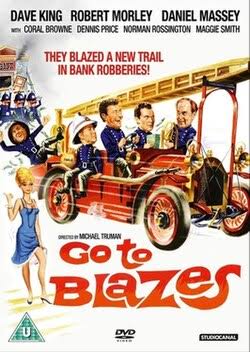
GO TO BLAZES
UK, 1962, 80 minutes, Colour.
Dave King, Robert Morley, Daniel Massey, Dennis Price, Coral Brown, Norman Rossington, Maggie Smith, Myles Malleson, Wilfred Lawson, David Lodge, Finlay Currie, James Hayter, Derek Nimmo, Hugh Lloyd, Arthur Lowe, John Le Mesurier.
Directed by Michael Truman.
Pleasantly light farcical comedy from the early 60s, very much of British comedy in the 1950s – and indicating the trend to greater farce, innuendo, with the style introduced by the Carry on series.
This is the story of a smash and grab trio, smashing the window of a jewellery store and grabbing, the getaway car – but, unfortunately, caught by the police at a roadblock. Jail time. Then the realisation that the best getaway that everybody stops for is a fire engine! So, jail, it again and examining fire engines (with an enthusiastic Miles Malleson), they find an old wreck, steal a good fire engine, inserting the wreck and setting the place ablaze.
Most of the film is about the attempt to smash and grab, the elegant Daniel Massey being prevented a number of times, the other two, Dave King and Norman Rossington, going round and round with their fire engine, caught by a rather idiotic Derek Nimmo because of the flood in his shop, their realising they need to do some training and finding a disgraced fire chief, Dennis Price, who will train them.
In the meantime, Daniel Massey has made a fool of himself fleeing and entering into a fashion show at a highbrow shop, managed by Coral Browne, and with a French consultant, Maggie Smith very early role (and, at one stage, the French accent dropping to a blimey English accent when surprised). And, the realisation that the fashion store is next to a bank. They consult an expert on fire insurance, setting fires, all kinds of skills – and, very enjoyably, played by Robert Morley in full bombast.
It almost works. But, in the escape, they are recognised by the two ladies and the initial policeman pursuing goes in chase, the firemen kindly stopping to help some little girls with their treehouse doll rescue, trees then on fire, the police – and, disaster because they had filled their water hose with all the bank notes from the robbery!
On their way back to jail, that pass the Queen and the Duke of Edinburgh and realise that this is a car that everybody stops for!
There are a lot of popular names from British films in the cast – but, for most of them, their appearances last only a minute or two!
Young Mr Pitt, The
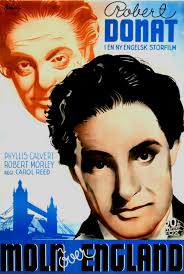
THE YOUNG MR PITT
UK, 1942, 102 minutes, Black-and-white.
Robert Donat, Robert Morley, Phyllis Calvert, John Mills, Raymond Lovell, Felix Aylmer, Max Adrian, Herbert Lom, Jean Kandel.
Directed by Carol Reed.
The film is a star vehicle for renowned British actor, Robert Donat, during World War II. (Comparisons implied between Napoleon and his aggression and the Nazi overwhelming of your about to Hitler. Comparisons between William Pitt and his stances against Napoleon and Churchill confronting Hitler.)
Donat had made a great impression on stage in London but also in the film, especially with his role in The Private Life of Henry VIII, then as the Count of Monte Cristo, a succession of prestigious roles, serious and comic in the latter part of the 1930s, culminating in his Oscar-winning role in Goodbye Mr Chips, 1939.
There was a break between Goodbye Mr Chips and The Young Mr Pitt, three years.
The film is a detailed re-creation of England, especially at the end of the 18th century and the beginning of the Napoleonic wars. Robert Donat also appears as the older Pitt, passing on his political legacy to his son, the credits noting that the speeches by both Pitts came from the actual records.
Pitt is was prime minister for several decades, falling briefly out of favour with the threat from France after the Revolution but then regaining the prime ministership and the confronting of Napoleon. Robert Morley appears as Fox, invited to collaborate with Pitt but refusing, mocking, but eventually coming onto his side.
There is a gallery of British character actors in support and, interestingly, an early John Mills appearance as William Wilberforce. Herbert Lom all yes yes is what is there and stops on’s’s offices are all there is the’s plays Napoleon – and was to do so in 1956 in War and Peace.
The film was directed by Carol Reed who had been emerging during the 1930s with such films as The Citadel. Perhaps his most famous film, from 1949, was his version of Graham Greene’s The Third Man. Reed continued directing during the 1950s and, surprisingly, won the Oscar for Best Director in 1968 for Oliver.
- Audience knowledge of William Pitt, his father, his long prime ministership, during the French Revolution, the rise of Napoleon, the war with France? Nelson?
- British filmmaking in 1942, World War II, dramatising British history, in wartime, the leadership of the Prime Minister, an enemy from the continent (Pitt and Napoleon, Churchill and Hitler)? The public supporting the war effort?
- The film as “intelligent”? The quality of the screenplay language, well articulated, period sequences yet conveying a great deal of history and character? Costumes and decor, vivid recreation of the period? The musical score?
- The introduction, the senior Pitt, his political role, verbatim speeches from history, his evening with his son, passing on the inheritance? The drinking, the respect, the family pride?
- Robert Donat’s presence and performance, credibility, deliverance of speeches, also verbatim from history? His age, his inheritance, his skills, the ridicule of the political opposition, the king, appointing him prime minister? His approach to Charles Fox, refusing? Entry to parliament, the exaggerated mockery? His speeches?
- The screenplay, moving through almost 20 years, not many indications of dates and how much time passing? Audience applying this?
- Pitt, his advisers, the relationship with William Wilberforce, Smith as his assistant and secretary? The other friends? The incident of his being mobbed, the physical training centre, the man coming to the rescue and joining the fight, indicating Pitt’s support amongst the people? The newspaper headlines, Fox losing popularity, Pitt, in Parliament?
- The overview of his social achievements? Hard work?
- Issues in France, the French Revolution, the execution of the king, Fox and his sympathy for the French? His speeches in the parliament, ridiculing of Pitt? Pitt and his stances, national pride?
- Napoleon, his signature, his rise, power, the 1790s, Toulon, the siege, British ships, Pitt and his decision to build up the navy? The collage of huge ships filled and launched? Confrontations with Napoleon? The scenes with Napoleon, building up his presence on par? The visit by Talleyrand, by the American, Pitt and his stances?
- Opposition to his approach, the ridicule and the parliament? The irony of his reading the message about the victory in Egypt? The choice of Nelson, the church sequence, the appointment, Nelson and his achievements, especially Trafalgar?
- Lord Auckland, diplomatic, his daughter, Pitt and the visits, playing games with the children, the attraction to the daughter, the conversations? Her support? The coach and nodding off and driving to the house, her waiting, Pitt turning back to his work?
- The new Prime Minister, appointed by the king, the parallels with 1938 and appeasement of Hitler, the appeasement of Napoleon, focusing on domestic issues rather than defence?
- The further dangers, the appointment by the king, Fox coming to support him, Wilberforce after an initial hesitation, support?
- Pitt and his help, the doctor’s advice, the nanny and her care, his long working hours, drinking, ignoring the medicine?
- The film and its tribute, his achievement, death at 46? And morale boosting in 1942?
Story of Gilbert and Sullivan, The
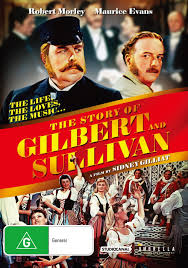
THE STORY OF GILBERT AND SULLIVAN
UK, 1953, 109 minutes, Colour.
Robert Morley, Maurice Evans, Eileen Herlieh, Peter Finch, Martyn Green, Dina Sheridan, Isabel Dean, Wilfred Hyde-White, Muriel Aked, Michael Ripper.
Directed by Sidney Gilliat.
From a 21st-century perspective, it is surprising to discover that this film was not successful at the box office on its release in the early 1950s. Yet, the operettas of Gilbert and Sullivan continued to be very, very popular.
This is quite a lavish production, sets and costumes, theatrical design, English society in the latter part of the 19th century.
For audiences interested in Gilbert and Sullivan, Robert Morley gives a variation on his enjoyably pompous performances as the self-confident Gilbert, master of words and witty lines, yet dreading opening nights, avoiding them, returning to hear applause and go happily on stage. Maurice Evans is Sullivan, classical composer of oratorios, eventually an Opera, teaming up with Gilbert, challenged by friends and a potential fiancee played by Dinah Sheridan, to honour his talent for high art. However, he is carried away and has composed many wonderful melodies, songs to accompany Gilbert’s words, but the music having a stand alone and entertainment value.
The screenplay follows the various productions, reproducing scenes from some of the most famous and well known. The film starts with an extensive excerpt from Trial By Jury, then moves into such favourites as HMS Pinafore, the Pirates of Penzance, The Mikado, The Gondoliers and Yeomen of the Guard, Iolanthe. And references to other creations like The Sorcerer.
Peter Finch appears as D’Oyley Carte, the manager of the company, the builder of the Savoy Theatre, involved in the building of the Opera house. There are quite a number of British character actors in support, Eileen Herlie as Helen D’Oyley Carte, a successful business partner with her husband, Isabel Dean as Gilbert’s wife and an entertaining cameo from Wilfred Hyde-who is to who enjoys the performances unlike his snobbish daughter.
There is some pathos at the end after Gilbert and Sullivan’s falling out, not speaking for some years, a possible reconciliation, the turn-of-the-century performance of the Yeomen of the Guard and the news of Sullivan’s death. Gilbert continued and was knighted by Queen Victoria, the culmination of the film.
In 1999, writer-director, Mike Leigh, did more than justice to Gilbert and Sullivan and their creations in his lavish and engaging film, Topsy Turvey.
Loser Takes All
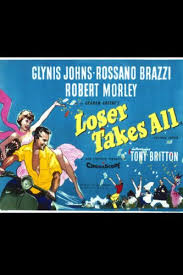
LOSER TAKES ALL
UK, 1956, 88 minutes, Colour.
Glynis Johns, Rossano Brazzi, Robert Morley, Tony Britton, Felix Aylmer, Joyce Carey, Geoffrey Keane, Albert Lieven, A.E.Matthews.
Directed by Ken Annakin.
In retrospect, the biggest surprise about this film is that it is based on a Graham Greene short story and the screenplay has, in fact, been written by Graham Greene. (He is said not to have been so happy about the finished product – he would not have given it a good review in the days when he was a film reviewer!).
It has lavish treatment, a strong cast and Monte Carlo locations and fashions. But, it has a brief running time, a type of British screwball comedy. Characters are not meant to be consistent and, here, they definitely are not. And they are slightly sketched overall.
Rossano Brazzi is a meticulous accountant, wins the favour of businessmen, Robert Morley, who invites him to Monte Carlo for a holiday where he is to marry his fiancee, Glynis Johns. The wealthy man does not turn up and the couple have very limited resources. However, they do get married. A stranger offers a gambling system to the husband and he becomes absorbed, winning a great deal of money and enabling the couple to live something of a high life. But, the husband gets so involved that he neglects his wife and she has caught the eye of a British gambler, played by Tony Britton in his first film.
The plotline is somewhat predictable but the credibility of the characters following the predictable plotline is very doubtful. Perhaps the actors are doing their best, but Rossano Brazzi becomes too serious and avaricious and Glynis Johns more flighty.
There are several character actors in support, a surprising turn by Joyce Carey who has her own schemes in the casinos, Geoffrey Keane as a manager being very superior to the customers.
The film is an early film directed by Ken Annakin who was to have a successful career in the UK and the US, dramas as well is blockbusters.
