Displaying items by tag: Ronald Squires
Josephine and Men
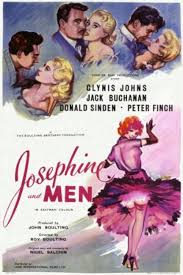
JOSEPHINE AND MEN
UK, 1955, 95 minutes, Colour.
Glynis Johns, Donald Sinden, Jack Buchanan, Peter Finch, Heather Thatcher, Ronald Squire, William Hartnell, Gerald Sim, Victor Maddern, Thorley Walters, Laurence Naismith, John Le Mesurier, Lisa Gastoni.
Directed by Roy Boulting.
This is an all-stops-out comedy drama of the mid-1950s. It has a strong leading cast but it is also a film with many well-known British character actors in supporting roles.
The Josephine of the title is played by Glynis Johns, busy, organised, intervening, engaged to Donnell Sinden, an upcoming businessman. Also around is her playboy uncle who narrates the story into a bartender, played by veteran Jack Buchanan, in films since 1917, Broadway since 1924, very well known for his starring role in The Bandwagon. And, then there is the emerging Peter Finch as a playwright.
The film should have worked better than it does. Perhaps Nigel Balchn, creator of thriller novels and screenplays is not the best choice for writing this kind of comedy drama. And, Roy Boulting had great success with films like Brighton Rock.
The actors give their all but the treatment seems, at least in retrospect, somewhat laboured. Josephine with a compulsion to help needy men, encountering the disorganised playwright, breaking the engagement to the businessman, marrying the playwright and, over the years, supporting him, urging him, and his having great success. On the other hand, the businessman has resigned, successful but suddenly turning up on their doorstep with the police after him because of allegations of fraud.
And, at the same time, the wandering, uncle also turns up.
So, Josephine with her compulsion needs to be helping the businessman on the run and so neglecting her husband. All kinds of complications, misunderstandings, the police in pursuit and interrogations, some amusing supporting characters with their roles.
But, many decades later, does not have the impact it may have had in its day.
Laxdale Hall
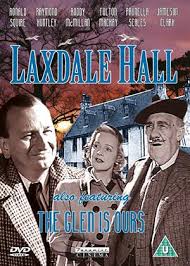
LAXDALE HALL
UK, 1953, 77 minutes, Black-and-white.
Ronald Squire, Raymond Huntley, Kathleen Ryan, Sebastian Shaw, Fulton Mackay, Jean Colin, Jameson Clark, Keith Faulkner, Prunella Scales, Kynaston Reeves, Andrew Keir.
Directed by John Eldridge.
A small film from the UK in the 1950s, the kind of film that offered a view of post-war Britain, politics in London, isolated life in the Scottish Highlands (and the Americans retitling the film for accessibility, Scotch on the Rocks!).
The film opens in Westminster, a member of Parliament, played by the always dignified (until he has a slight drunk scene here) Raymond Huntley. He has family connections with the Scottish town centred on Laxdale Hall. The inhabitants are refusing to pay their taxes demanding a better road and port accessibility (scenes illustrating the need). Assisting the MP are a more conciliatory visitor, Sebastien Shaw, and the secretary played by Fulton Mackay, looking very young and nothing like his middle-aged-older look when he was the prison guard continually clashing with Ronnie Barker’s Fletcher in Porridge.
The lord of Laxdale Hall is played genially by Ronald Squire with Kathleen Ryan as his proper daughter. In the meantime, there are all kinds of shenanigans with the locals, who poach fish, the local outspoken church minister, the midwife, the funeral director, the schoolteacher – and she is played by very young Prunella Scales, long before Fawlty Towers.
Most of the screenplay runs as expected, the visitors initially stranded because of a gale, coming to the town, the MP presumptuously giving a speech about moving all inhabitants in land to get industrial jobs and a regular salary but a huge reaction against his proposals. There is hospitality. There is some poaching. There are schoolchildren in classes. And there are a team of poachers on the prowl from Glasgow.
Some touches of romance, especially with the teacher and the secretary. Battle hijinks as the locals all band together one night to attack the Glasgow poachers. In the meantime, MP stranded in a car with a wheel that needs to be replaced, finding a bottle of whiskey and comforting himself during the night with drinking, and to be under suspicion by the police and arrested and handcuffed.
But, there was a pleasant scene with the MP sitting dangling his feet in the river – an indication that he will relent (although the incriminating photo may have some influence). Finally, as he leaves, he gives a speech encouraging the locals and their way of life.
One might say nicely and cosily British.
Now and Forever/ 1956
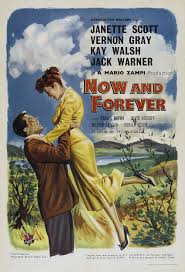
NOW AND FOREVER
UK, 1956, 90 minutes, Colour.
Janette Scott, Vernon Gray, Kay Walsh, Jack Warner, Pamela Brown, Charles Victor, Marjorie Rhodes, Ronald Squire, Wilfred Lawson, Sonia Dresdel, David Kossoff, Moultrie Kelsall, Guy Middleton, Michael Pertwee, Bryan Forbes, Thora Hird.
Directed by Mario Zampi.
Not a well-known British film from the mid-1950s – a young romance, and in colour.
It is a star vehicle for Janette Scott who was to appear in a number of British films in the coming decade, and she appears with her actress mother, Thora Hird, as the family cook. Her co-star is the Canadian Vernon Gray, who made only a few films.
What will be of interest to audiences who like watching the British films of the 1950s, generally small, local issues… Will be very interested in the range of the supporting cast, Kay Walsh is the school headmistress, Jack Warner not a policeman this time but the owner of a garage, father of the character played by Vernon Gray. Pamela Brown is the young girl’s severe mother, Pamela Brown expert at this kind of superior disdainful kind of character. There is Charles Victor a sympathetic, and Marjorie Rhodes his unsympathetic wife, Sonia Dresdel as one of the schoolteachers, David Kossoff in a small role as a pawnbroker, Guy Middleton as the mother’s boyfriend, and Ronald Squire as an eyebrow-raising waiter in a cafe.
The film was directed by Mario Zampi, an Italian who set up the company in London. His best-known films are Laughter in Paradise, with Alistair Sim, and Too Many Crooks.
The story is the familiar one that would be treated in a much more open, even permissive way in the 21st-century. The 18-year-old daughter lives with her mother, a severe socialite, but loves her father who has been divorced from her mother. Then the news that he dies. She encounters the son of the local garage mechanic, her mother hiring him for drives. They are attracted to each other, he driving her to school, her mother disapproving, his father more tolerant, then all kinds of ups and downs, her mother wanting to send her to Canada, her feeling suicidal, the help of the headmistress, the plan to elope with the young man, the police after them, various escapades, and their being caught on the Scottish border, the young man’s father being kindly, trying to persuade her mother to some kind of compassion.
All very familiar – but with a 1950s kind of propriety and reticence.
