Displaying items by tag: Ronald Howard
Nurse on Wheels
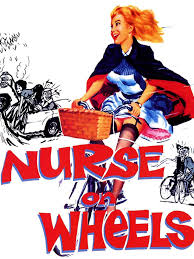
NURSE ON WHEELS
UK, 1963, 85 minutes, Black-and-white.
Juliet Mills, Ronald Lewis, Joan Sims, Noel Purcell, Esma Cannon, Raymond Huntley, Athene Seyler, Norman Rossington, Ronald Howard, Joan Hickson, Renee Houston, Jim Dale, George Woodbridge.
Directed by Gerald Thomas.
A pleasant, old-fashioned British comedy. It was directed by Gerald Thomas taking some time off from making Carry on films. It was written by Norman Hudis who had written the early Carry on films but was giving way to Talbot Rothwell. And, it is very much geared towards the widest audience, only a little innuendo and a spoilt flirtation sequence.
Juliet Mills, in her early 20s, plays a district nurse, new to the district, under suspicion by the patients of the previous nurse, sometimes rude to her, offhand. She is strong-minded, rides a bike, has a driving lesson – and a later driving escapade which proves that she is far better on her bicycle. Ultimately, of course, her patients relent and she is accepted. There is also a romance with Ronald Lewis as a local farmer, sometimes curt, especially to a young man and his pregnant wife who want to park on his land, but, of course, a final reconciliation.
The film is striking for the number of character actors who take the roles generally of the locals, suspicious, hard, gradually relenting. And, there are at least half a dozen regulars from the Carry on films, Joan Sims with a very straightforward role as the vicar’s daughter, Raymond Huntley is the vicar, Jim Dale as the husband, and Joan Hickson as a housekeeper. And, especially, Esma Cannon as the nurses pleasantly dithery as the nurse’s mother.
There is a jaunty theme playing every time the nurse appears on her bike and then more frequently, possibly too often!
Life in English country towns in the early 1960s, the NHS, the district nurse, local doctors, and a variety of local characters.
Laxdale Hall
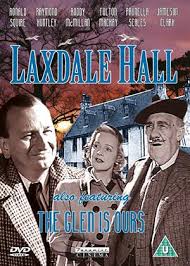
LAXDALE HALL
UK, 1953, 77 minutes, Black-and-white.
Ronald Squire, Raymond Huntley, Kathleen Ryan, Sebastian Shaw, Fulton Mackay, Jean Colin, Jameson Clark, Keith Faulkner, Prunella Scales, Kynaston Reeves, Andrew Keir.
Directed by John Eldridge.
A small film from the UK in the 1950s, the kind of film that offered a view of post-war Britain, politics in London, isolated life in the Scottish Highlands (and the Americans retitling the film for accessibility, Scotch on the Rocks!).
The film opens in Westminster, a member of Parliament, played by the always dignified (until he has a slight drunk scene here) Raymond Huntley. He has family connections with the Scottish town centred on Laxdale Hall. The inhabitants are refusing to pay their taxes demanding a better road and port accessibility (scenes illustrating the need). Assisting the MP are a more conciliatory visitor, Sebastien Shaw, and the secretary played by Fulton Mackay, looking very young and nothing like his middle-aged-older look when he was the prison guard continually clashing with Ronnie Barker’s Fletcher in Porridge.
The lord of Laxdale Hall is played genially by Ronald Squire with Kathleen Ryan as his proper daughter. In the meantime, there are all kinds of shenanigans with the locals, who poach fish, the local outspoken church minister, the midwife, the funeral director, the schoolteacher – and she is played by very young Prunella Scales, long before Fawlty Towers.
Most of the screenplay runs as expected, the visitors initially stranded because of a gale, coming to the town, the MP presumptuously giving a speech about moving all inhabitants in land to get industrial jobs and a regular salary but a huge reaction against his proposals. There is hospitality. There is some poaching. There are schoolchildren in classes. And there are a team of poachers on the prowl from Glasgow.
Some touches of romance, especially with the teacher and the secretary. Battle hijinks as the locals all band together one night to attack the Glasgow poachers. In the meantime, MP stranded in a car with a wheel that needs to be replaced, finding a bottle of whiskey and comforting himself during the night with drinking, and to be under suspicion by the police and arrested and handcuffed.
But, there was a pleasant scene with the MP sitting dangling his feet in the river – an indication that he will relent (although the incriminating photo may have some influence). Finally, as he leaves, he gives a speech encouraging the locals and their way of life.
One might say nicely and cosily British.
Spider's Web, The/ 1960
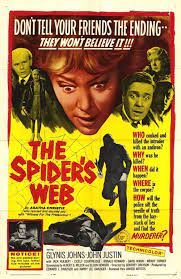
THE SPIDER'S WEB
UK, 1960, 89 minutes, Colour.
Glynis Johns, John Justin, Jack Hulbert, Cicely Courtneidge, Ronald Howard, David Nixon, Wendy Turner, Basil Dignam, Ferdy Mayne, Peter Butterworth, Anton Rodgers.
Directed by Godfrey Grayson.
Based on a play by Agatha Christie. However, it is very slight, even lighthearted in comparison with The Mousetrap and, especially, Witness for the Prosecution.
The action all takes place in a mansion, over a couple of hours. The running time is brief – the remake in 1982 with Penelope Keith is 15 minutes longer.
The first 20 minutes or so establish the characters, especially Glynis Johns as the new wife of diplomat, John Justin, prone to speculating and imagination, influencing her stepdaughter in the same vein. There are mysterious servants. And there is a mysterious gardener, Mrs Peake, played by Cicely Courtney. The mansion was previously owned by an antiques dealer – and there is a secret object which the murder is after.
The action develops when a sinister visitor arrives, who has married John Justin’s ex-wife. He claims to come to get the daughter back. However, he returns, searches a mysterious desk, and is found murdered. While the stepdaughter has played with some voodoo dolls and is upset that she killed the visitor, her stepmother decides to take the blame, calls back her friends who are at the club to help her move the body.
Many will remember The Trouble with Harry or Weekend at Bernie’s and disappearing corpses. Fortunately, this old mansion has secret doors and a secret hiding place!
While there is the question of who done it, there is the big question of where to hide the body. Peter Butterworth, in unusual casting, is the police inspector. The friends of the family include a neighbour, a magistrate, a former member of the Secret Service.
The whole thing seems rather dated, 1960s style, rather stage bound, and a somewhat flighty performance, which many have found charming, from Glynis Johns.
Ronald Howard (son of celebrated actor Leslie Howard) with his glasses and build seems to be anticipating Colin Firth!
And, there is the satisfaction of finding out, eventually, whodunnit.
