Displaying items by tag: Hugh Lloyd
Go to Blazes
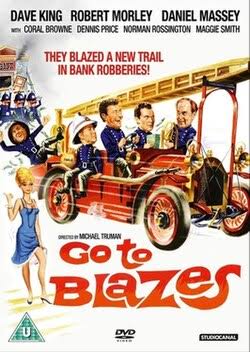
GO TO BLAZES
UK, 1962, 80 minutes, Colour.
Dave King, Robert Morley, Daniel Massey, Dennis Price, Coral Brown, Norman Rossington, Maggie Smith, Myles Malleson, Wilfred Lawson, David Lodge, Finlay Currie, James Hayter, Derek Nimmo, Hugh Lloyd, Arthur Lowe, John Le Mesurier.
Directed by Michael Truman.
Pleasantly light farcical comedy from the early 60s, very much of British comedy in the 1950s – and indicating the trend to greater farce, innuendo, with the style introduced by the Carry on series.
This is the story of a smash and grab trio, smashing the window of a jewellery store and grabbing, the getaway car – but, unfortunately, caught by the police at a roadblock. Jail time. Then the realisation that the best getaway that everybody stops for is a fire engine! So, jail, it again and examining fire engines (with an enthusiastic Miles Malleson), they find an old wreck, steal a good fire engine, inserting the wreck and setting the place ablaze.
Most of the film is about the attempt to smash and grab, the elegant Daniel Massey being prevented a number of times, the other two, Dave King and Norman Rossington, going round and round with their fire engine, caught by a rather idiotic Derek Nimmo because of the flood in his shop, their realising they need to do some training and finding a disgraced fire chief, Dennis Price, who will train them.
In the meantime, Daniel Massey has made a fool of himself fleeing and entering into a fashion show at a highbrow shop, managed by Coral Browne, and with a French consultant, Maggie Smith very early role (and, at one stage, the French accent dropping to a blimey English accent when surprised). And, the realisation that the fashion store is next to a bank. They consult an expert on fire insurance, setting fires, all kinds of skills – and, very enjoyably, played by Robert Morley in full bombast.
It almost works. But, in the escape, they are recognised by the two ladies and the initial policeman pursuing goes in chase, the firemen kindly stopping to help some little girls with their treehouse doll rescue, trees then on fire, the police – and, disaster because they had filled their water hose with all the bank notes from the robbery!
On their way back to jail, that pass the Queen and the Duke of Edinburgh and realise that this is a car that everybody stops for!
There are a lot of popular names from British films in the cast – but, for most of them, their appearances last only a minute or two!
She'll Have to Go
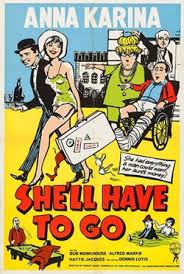
SHE'LL HAVE TO GO
UK, 1962, 89 minutes, Black-and-white.
Bob Monkhouse, Alfred Marks, Hattie Jacques, Anna Karina, Dennis Lotis, Graham Stark, Clive Dunn, Hugh Lloyd, Peter Butterworth.
Directed by Robert Asher.
A very broad British farcical comedy, based on a play, typical of popular comedies in Britain in the early 1960s – and, with some of the humour that characterises the Carry On comedies.
Bob Monkhouse was a popular film and television personality, Alfred Marks more serious. The Carry On the connection can be seen with the presence of Hattie Jacques, much more dominating and posh as an intrusive journalist. A number of popular British comedians of the time have comedy cameos, Graham Stark, before the Pink Panther films, as the journalist’s cameraman, Clive Dunn as a bumbling chemist, Hugh Lloyd as a pompous lawyer, Peter Butterworth as a shortsighted doctor getting himself into tangles.
However, the surprise for many cineastes who come across this comedy is the presence of Anna Karina, the Danish born actress who appeared in films for many decades, a variety of films in the UK, US, European countries – but is still best known as the wife of Jean-Luc Godard in the 1960s and starred in a number of his memorable films of the 1960s. Most would not associate her with this kind of British comedy.
Two brothers, novelists, live in a mansion, little income, manservant played by Dennis Lotis, getting news that a remote cousin was going to inherit the house and probably oust them. The title indicates the tone of the film, the option of marrying her and retaining the money or of murdering her. Which means there are some romantic scenes and several attempts on her life. She arrives, charms the journalist, charms the man servant, escapes all the attempts on her life, then turns the tables on them.
A great number of farcical situations, puns and quips, exaggerations all round. Nowadays mainly for film historians.
