Displaying items by tag: James Hayter
Go to Blazes
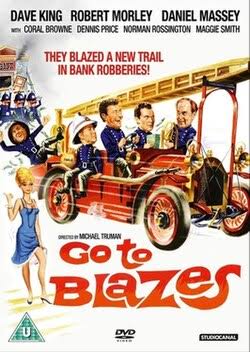
GO TO BLAZES
UK, 1962, 80 minutes, Colour.
Dave King, Robert Morley, Daniel Massey, Dennis Price, Coral Brown, Norman Rossington, Maggie Smith, Myles Malleson, Wilfred Lawson, David Lodge, Finlay Currie, James Hayter, Derek Nimmo, Hugh Lloyd, Arthur Lowe, John Le Mesurier.
Directed by Michael Truman.
Pleasantly light farcical comedy from the early 60s, very much of British comedy in the 1950s – and indicating the trend to greater farce, innuendo, with the style introduced by the Carry on series.
This is the story of a smash and grab trio, smashing the window of a jewellery store and grabbing, the getaway car – but, unfortunately, caught by the police at a roadblock. Jail time. Then the realisation that the best getaway that everybody stops for is a fire engine! So, jail, it again and examining fire engines (with an enthusiastic Miles Malleson), they find an old wreck, steal a good fire engine, inserting the wreck and setting the place ablaze.
Most of the film is about the attempt to smash and grab, the elegant Daniel Massey being prevented a number of times, the other two, Dave King and Norman Rossington, going round and round with their fire engine, caught by a rather idiotic Derek Nimmo because of the flood in his shop, their realising they need to do some training and finding a disgraced fire chief, Dennis Price, who will train them.
In the meantime, Daniel Massey has made a fool of himself fleeing and entering into a fashion show at a highbrow shop, managed by Coral Browne, and with a French consultant, Maggie Smith very early role (and, at one stage, the French accent dropping to a blimey English accent when surprised). And, the realisation that the fashion store is next to a bank. They consult an expert on fire insurance, setting fires, all kinds of skills – and, very enjoyably, played by Robert Morley in full bombast.
It almost works. But, in the escape, they are recognised by the two ladies and the initial policeman pursuing goes in chase, the firemen kindly stopping to help some little girls with their treehouse doll rescue, trees then on fire, the police – and, disaster because they had filled their water hose with all the bank notes from the robbery!
On their way back to jail, that pass the Queen and the Duke of Edinburgh and realise that this is a car that everybody stops for!
There are a lot of popular names from British films in the cast – but, for most of them, their appearances last only a minute or two!
Horror of Frankenstein
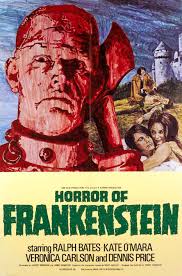
HORRORS OF FRANKENSTEIN
UK, 1970, 95 minutes, Colour.
Ralph Bates, Kate O'Mara, Graham James, Dennis Price, David Prowse, Jon Finch, Bernard Archard, James Hayter, Joan Rice, Veronica Carlson, James Cossins.
Directed by Jimmy Sangster.
In the 1950s, Hammer Studios began a series of films focusing on Frankenstein, Curse of…, Evil of… And Dr Frankenstein was played by Peter Cushing. He does not appear in this film, from 1970, the writer of the first two films, Jimmy Sangster, writer of other horror films, coming again to this theme and directing the film.
Dr Frankenstein, younger, is played by Ralph Bates, arrogant, narcissistic, cruel, killing the opposition, a ladies’ man… And the film capitalising on the more explicit presentations of sexuality and nudity that emerged during the 1960s.
Mary Shelley’s original stories are echoed but the film takes the narrative beyond her original novel.
For fans of the horror films from Hammer Studios – but it does not have the inspiration and quality, style and tone of the original two films.
- The work of Mary Shelley? 18 century? Science and fantasy? Scientist playing God? Creation of creatures, monsters? This variation on characters created by Mary Shelley?
- The setting, Germany/Austria, castles, the forests, costumes and decor? The interiors of the Frankenstein Council? The laboratory?
- The interpretation of Victor Frankenstein, Ralph Bates’ presence and performance, style? Seen in class, drawing, reminded of the teacher, the punishment and Victor’s refusal, his challenging of the teacher, overcoming him? His friendship with William? The presence of the women in the class and the attraction to Victor? The graduation and his return home, with William?
- The scene with his father, his father, sexual liaison with Alice, his demands on his son, refusal for his education? Victor, the gun, altering it, hunting, his father’s death? The funeral? His inheritance?
- The character of Victor Frankenstein here, young, obsessed, narcissistic, obsessive, sociopathic, science, his aims, playing God, creation, but a creator more like Satan than God? His behaviour in the Castle, his reliance on Alice, sexual, criticising her cooking, bringing in Stephan? His continued work with William and William support?
- Employing the gravedigger, having the arm and stealing it from the University, the various body parts, the number of deaths, his drawing of the human body and numbering its parts, filling in the parts?
- Elizabeth, her father, the encounter with the highway men, William wanting to help, Victor and his shrewdness, the rescue, shooting the highway man? Henry, police, past friendship, the investigations?
- The meal with Elizabeth and her father, poisoning him, his death, the gravedigger getting his skull, the brain, the scratch and the deterioration, preserving the brain?
- The doctor, his concern about Victor, his visit, his being electrocuted? The gravedigger, his money, greed, putting him in the that? The unscrupulous deaths?
- Elizabeth, her property, coming to the Castle, in love with Viktor, his being willing to have a recipe housekeeper?
- The experiments with William, William and his suspicions, critique, deciding to leave, Victor killing him?
- The final creation of the creature, the experiments with the animals, electric power bringing them to life, the turtle? The appearance of the creature, giant, not speaking? Victor and his controlling him?
- The creature, out in the countryside, the little girl, the deaths, Henry and the police investigation, Stephane and his being blamed? Imprisoned? Victor’s callous this interest in everything, his lies, covering? The attack on Elizabeth, her testimony, Henry arriving?
- Victor and his sessions with the creature, the police search of the house, Victor and his hiding the creature – in the bath? The little girl playing, turning the taps, the acid, the destruction of the creature, the skeleton?
- Leaving Victor for further experimentation?
For Better, For Worse
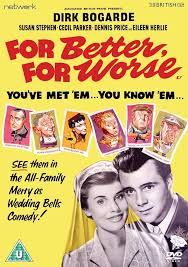
FOR BETTER, FOR WORSE
UK, 1954, 85 minutes, Colour.
Dirk Bogarde, Susan Stephen, Cecil Parker, Eileen Herlie, Athene Seyler, Dennis Price, Pia Teri, James Hayter, Thora Hird, George Woodbridge, Charles Victor, Sidney James, Robin Bailey.
Directed by J. Lee Thompson.
British domestic story from the mid-1950s – and, on the evidence of this film, it would seem a long time ago.
It was something of a prestige film at its time, written and directed by J. Lee Thompson who was to go on to international success with many films, especially The Guns of Navarone and a number of Charles Bronson thrillers. At this time Dirk Bogarde was emerging as a comedian, after many thrillers, especially with Doctor in the House. Susan Stephen was a regular star of this period. Cecil Parker was a very popular character actor – and there are so many more character actors in the supporting roles in this film which makes it so much more enjoyable as we recognise them.
Dirk Bogarde, playing 10 years younger than he actually was, earnestly wants to marry Susan Stephen. The film opens as they watch a romance on screen, then a proposal, then the meeting with her mother, Eileen Herlie, who becomes almost immediately sympathetic, and then the meeting with her father, Cecil Parker, demanding but far less pompously aristocratic than in many of his roles.
There is the issue of getting a job which he eventually does with the government but is it enough to live on? And what about a house? They go to a one-room flat, managed by Dennis Price, there are arguments for and against but their placing the deposit.
One of the main sections, especially for some comedy, has Susan Stephen preparing a dinner for her parents – and the elderly neighbour who is always coming in to use the phone, interfering, but ultimately nice; the local cleaner, played by Thora Hird, who is helpful in preparing the dinner; James Hayter as the plumber who is at the end of an attack by the husband. The other big scene is the arrival of so much furniture, with Charles Victor and George Woodbridge as the sympathetic carriers – and then a glimpse of Sidney James, not so sympathetic.
If this appeals, with its mid-1950s British style, beliefs about the working husband, the wife staying at home…, Then this may be an appealing pastime. (And, for distribution in the US, as with many British the time, very strange title changes – and this one was called, of all things, Cocktails in the Kitchen.)
