Displaying items by tag: Raymond Huntley
Bottoms Up
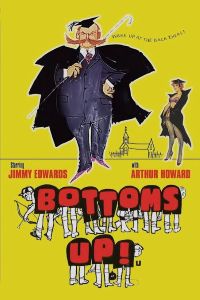
BOTTOMS UP
UK, 1960, 90 minutes, Black-and-white.
Jimmy Edwards, Arthur Howard, Martita Hunt, Sidney Tafler, Raymond Huntley, Reginald Beckwith, Melvyn Hayes, John Mitchell, Richard Briers.
Directed by Mario Zampi.
Bottoms up, especially for receiving a caning in old-style British schools!
Jimmy Edwards was a popular comedian on radio and television in the 1950s. He brings his schoolmaster character from those media to the big screen. Whether it appeals to later generations is a moot point.
And, looking back over the decades and attitudes towards discipline in schools, physical punishment, delivered by staff and other students, this comedy seems particularly old-fashioned. A past that is receding into long distance.
And, a critical look back at plot developments show a subplot concerning a Prince from a colonial country, blackface disguise, not accepted in later generations. And, the most mischievous of the boys is played by the son of a bishop.
The film could be seen as a male version of the popular St Trinians’ girls schools comedies, lots of misbehaving children, lots of frustrated staff, all kinds of slapstick comedy, all kinds of misadventures and plots, turning into a school battlefield and military strategies, humorous dialogue, lots play on words (those masters of English language in radio programs, Frank Muir and Dennis Norden, receive credits for the screenplay). And, some touches of innuendo – after all, this was the era when the Carry on series began.
Jimmy Edwards is huge, bluff, imposing, but also the victim of all kinds of pranks. The fall guy, so to speak, is his hapless assistant, so often the victim of pranks as well as their masters’ bullying, is played by Arthur Howard (brother of Leslie Howard). There is comedy with snobbery, especially with Martita Hunt (so memorable as Miss Havisham in Great Expectations) and the perennially rather snooty government official played by Raymond Huntley. Richard Briers, early in his career, is in the cast.
The film was directed by Italian born Mario Zampi who made a number of comedies in England, notably Laughter in Paradise with Alistair Sim and Too Many Crooks with Terry Thomas (and Carry on stars, Sid James and Bernard Bresslaw).
A curiosity item, broad British comedy in the 1950s and 1960s.
Nurse on Wheels
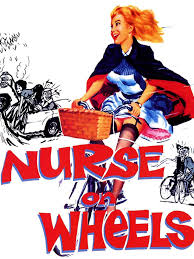
NURSE ON WHEELS
UK, 1963, 85 minutes, Black-and-white.
Juliet Mills, Ronald Lewis, Joan Sims, Noel Purcell, Esma Cannon, Raymond Huntley, Athene Seyler, Norman Rossington, Ronald Howard, Joan Hickson, Renee Houston, Jim Dale, George Woodbridge.
Directed by Gerald Thomas.
A pleasant, old-fashioned British comedy. It was directed by Gerald Thomas taking some time off from making Carry on films. It was written by Norman Hudis who had written the early Carry on films but was giving way to Talbot Rothwell. And, it is very much geared towards the widest audience, only a little innuendo and a spoilt flirtation sequence.
Juliet Mills, in her early 20s, plays a district nurse, new to the district, under suspicion by the patients of the previous nurse, sometimes rude to her, offhand. She is strong-minded, rides a bike, has a driving lesson – and a later driving escapade which proves that she is far better on her bicycle. Ultimately, of course, her patients relent and she is accepted. There is also a romance with Ronald Lewis as a local farmer, sometimes curt, especially to a young man and his pregnant wife who want to park on his land, but, of course, a final reconciliation.
The film is striking for the number of character actors who take the roles generally of the locals, suspicious, hard, gradually relenting. And, there are at least half a dozen regulars from the Carry on films, Joan Sims with a very straightforward role as the vicar’s daughter, Raymond Huntley is the vicar, Jim Dale as the husband, and Joan Hickson as a housekeeper. And, especially, Esma Cannon as the nurses pleasantly dithery as the nurse’s mother.
There is a jaunty theme playing every time the nurse appears on her bike and then more frequently, possibly too often!
Life in English country towns in the early 1960s, the NHS, the district nurse, local doctors, and a variety of local characters.
Laxdale Hall
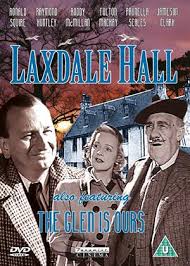
LAXDALE HALL
UK, 1953, 77 minutes, Black-and-white.
Ronald Squire, Raymond Huntley, Kathleen Ryan, Sebastian Shaw, Fulton Mackay, Jean Colin, Jameson Clark, Keith Faulkner, Prunella Scales, Kynaston Reeves, Andrew Keir.
Directed by John Eldridge.
A small film from the UK in the 1950s, the kind of film that offered a view of post-war Britain, politics in London, isolated life in the Scottish Highlands (and the Americans retitling the film for accessibility, Scotch on the Rocks!).
The film opens in Westminster, a member of Parliament, played by the always dignified (until he has a slight drunk scene here) Raymond Huntley. He has family connections with the Scottish town centred on Laxdale Hall. The inhabitants are refusing to pay their taxes demanding a better road and port accessibility (scenes illustrating the need). Assisting the MP are a more conciliatory visitor, Sebastien Shaw, and the secretary played by Fulton Mackay, looking very young and nothing like his middle-aged-older look when he was the prison guard continually clashing with Ronnie Barker’s Fletcher in Porridge.
The lord of Laxdale Hall is played genially by Ronald Squire with Kathleen Ryan as his proper daughter. In the meantime, there are all kinds of shenanigans with the locals, who poach fish, the local outspoken church minister, the midwife, the funeral director, the schoolteacher – and she is played by very young Prunella Scales, long before Fawlty Towers.
Most of the screenplay runs as expected, the visitors initially stranded because of a gale, coming to the town, the MP presumptuously giving a speech about moving all inhabitants in land to get industrial jobs and a regular salary but a huge reaction against his proposals. There is hospitality. There is some poaching. There are schoolchildren in classes. And there are a team of poachers on the prowl from Glasgow.
Some touches of romance, especially with the teacher and the secretary. Battle hijinks as the locals all band together one night to attack the Glasgow poachers. In the meantime, MP stranded in a car with a wheel that needs to be replaced, finding a bottle of whiskey and comforting himself during the night with drinking, and to be under suspicion by the police and arrested and handcuffed.
But, there was a pleasant scene with the MP sitting dangling his feet in the river – an indication that he will relent (although the incriminating photo may have some influence). Finally, as he leaves, he gives a speech encouraging the locals and their way of life.
One might say nicely and cosily British.
Suspect/ The Risk
SUSPECT/THE RISK
UK, 1960, 81 minutes, Black-and-white.
Tony Britton, Virginia Maskell, Peter Cushing, Ian Bannen, Raymond Huntley, Thorley Walters, Donald Pleasence, Spike Milligan, Kenneth Griffith, Robert Bruce, Anthony Booth, Basil Dignam, Sam Kydd, Murray Melvin.
Directed by John Boulting, Roy Boulting.
British Nigel Balchin wrote thrillers and wrote the screenplay for this brief film. The Boulting brothers had a strong presence in British cinema from the 1940s. Their intention with this film was to enhance the quality of British supporting features, small budget, filmed in 17 days, brief running time. Critics at the time were harsh on the film, American critics more sympathetic.
With the writing, the Boulting Brothers’ direction, and the considerable quality of the supporting cast, serious issues of scientific experimentation, wartime security, espionage and stealing secrets, there is quite a lot of material in 81 minutes. The locations are confined, home, laboratory, restaurants, espionage. With the supporting cast so articulate, the dialogue makes a strong impression.
In fact, Tony Britton and Virginia Maskell as the stars are not as strong as the character actors, some veterans like Raymond Huntley as the politician, Peter Cushing as the professor, Kenneth Griffith as his assistant, Donald Pleasence, always sinister, Thorley Walters as an eccentric investigator, Ian Bannen as the cynical war invalid, all bring quality to the performances. And there are quite a number of interesting cameos from actors like Spike Milligan, serious and comic at the end, Sam Kydd, Murray Melvin, Anthony Booth.
A curiosity item of the period but an interesting and entertaining 80 minutes.
- Small-budget supporting feature, a television filming style?
- Nigel Balchin thriller, his writing the screenplay, nation, science, politics, espionage, romance? Popular ingredients?
- The cast, the range of British character actors, the focus on dialogue, interactions, intensity, themes articulated in the British style?
- The focus on scientific experimentation, the professor, years of experience, Peter Cushing’s style, the staff, summoned by the government, closure on his experiments, his reactions, the staff, the situation with the dedication of the statue? His discovery of Marriott with the documents, his reaction, the police, covering for Marriott?
- Bob Marriott and Lucy Byrne, colleagues, skills, the date to the pictures, Lucy and her reticence, the situation with Alan, losing his arms in war, her caring for him, past fiancee, his manner, cynical? His meeting with Marriott, charming exterior, undermining him, the connection with Brown, the situation about the government ban, the documents, saving the experiments, handing them over?
- Lucy, her work, with Marriott, the attraction, her helping with Alan, the meeting with Brown, her ignorance, her being interrogated?
- Marriott, his character, dedicated to his work, the experiment with his arm, his reaction to the ban, led on by Alan, the meeting with Brown, taking the documents, the meeting with the spies?
- Dr Shole, collaboration, personality, Mr Prince making the contact, with his assistant, the suspicions, summoning him, the information? The scenes with the professor?
- Mr Prince, his role in the investigations, sometimes doddery, absent-minded, his office a mess, the meetings with Dr Shole, relying on his assistant, the interviews, his hypotheses?
- Brown, his background, sinister, Donald Pleasence’s style, his eyes, the arrangements, the meeting, being the documents, the person in charge, the police, gunshots?
- The politics, the Minister, calling in the professor, good mannered but intense, forbidding the experiments, danger for enemies getting hold of them, the dedication of the statue, his assistant, his visit to the laboratory in meeting the staff?
- The assistant at the office, Spike Milligan, more serious – the final comedy with the monkey?
- British politics in world politics in the late 1950s? This film seen in retrospect?
Ghost of St Michael's, The
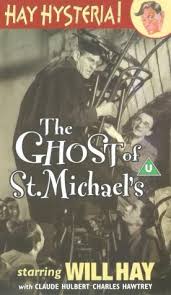
THE GHOST OF ST MICHAELS
UK, 1941, 82 minutes, Black-and-white.
Will Hay, Charles Hawtrey, Claude Hulbert, Felix Aylmer, Raymond Huntley, John Laurie, Hay Petrie, Brefni O'Rourke.
Directed by Marcel Varnel.
An example of popular comedy produced in the UK in the late 1930s and early 1940s. Will A, the scientist and astronomer in training and hobby, was popular as a comedian in a series of small-budget films at the time. He was revered and audiences now watching his films will be interested in his status and impact at that time. But, it seems quite dated.
This is a wartime story, an indication of spies operating in England and Scotland. It is a story of a transfer of school students to an old Castle in Scotland, travelling by ferry to an island, and the old Castle reputed to have ghosts. (Those interested in screenwriting might note that one of the contributors here, John Dighton, made the school comedy, The Happiest Days of Your Life almost 10 years later.)
The comedy is very broad, farcical, the suggestion of ghosts and eerie music, especially agitated by the Scots staff member, John Laurie. And, in fact, there are two deaths, not by ghost but by a spy. In the two deaths are of the serious characters in the film, two headmasters, Felix Aylmer and Raymond Huntley, playing straight rather than comic roles.
However, in retrospect, the surprise of the film is the presence of Charles Hawtrey at the age of 26, already a strong career in film and radio, really the commanding presence of the film even over Will Pay. He portrays a very precocious student, shrewd, mischievous, a touch self-righteous, the contributing strongly to the solution of the mysteries. It would be another 15 or 16 years before he made his first Carry on film, starring in 23 of the series. And, his style in 1941 certainly prefigured his comic abilities in his Carry on career.
One for the historical record and for film history buffs.
