Displaying items by tag: Denis Price
Go to Blazes
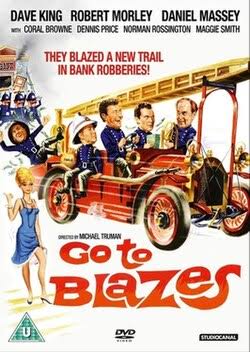
GO TO BLAZES
UK, 1962, 80 minutes, Colour.
Dave King, Robert Morley, Daniel Massey, Dennis Price, Coral Brown, Norman Rossington, Maggie Smith, Myles Malleson, Wilfred Lawson, David Lodge, Finlay Currie, James Hayter, Derek Nimmo, Hugh Lloyd, Arthur Lowe, John Le Mesurier.
Directed by Michael Truman.
Pleasantly light farcical comedy from the early 60s, very much of British comedy in the 1950s – and indicating the trend to greater farce, innuendo, with the style introduced by the Carry on series.
This is the story of a smash and grab trio, smashing the window of a jewellery store and grabbing, the getaway car – but, unfortunately, caught by the police at a roadblock. Jail time. Then the realisation that the best getaway that everybody stops for is a fire engine! So, jail, it again and examining fire engines (with an enthusiastic Miles Malleson), they find an old wreck, steal a good fire engine, inserting the wreck and setting the place ablaze.
Most of the film is about the attempt to smash and grab, the elegant Daniel Massey being prevented a number of times, the other two, Dave King and Norman Rossington, going round and round with their fire engine, caught by a rather idiotic Derek Nimmo because of the flood in his shop, their realising they need to do some training and finding a disgraced fire chief, Dennis Price, who will train them.
In the meantime, Daniel Massey has made a fool of himself fleeing and entering into a fashion show at a highbrow shop, managed by Coral Browne, and with a French consultant, Maggie Smith very early role (and, at one stage, the French accent dropping to a blimey English accent when surprised). And, the realisation that the fashion store is next to a bank. They consult an expert on fire insurance, setting fires, all kinds of skills – and, very enjoyably, played by Robert Morley in full bombast.
It almost works. But, in the escape, they are recognised by the two ladies and the initial policeman pursuing goes in chase, the firemen kindly stopping to help some little girls with their treehouse doll rescue, trees then on fire, the police – and, disaster because they had filled their water hose with all the bank notes from the robbery!
On their way back to jail, that pass the Queen and the Duke of Edinburgh and realise that this is a car that everybody stops for!
There are a lot of popular names from British films in the cast – but, for most of them, their appearances last only a minute or two!
For Better, For Worse
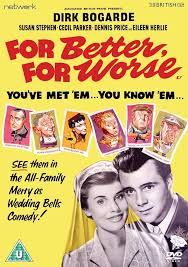
FOR BETTER, FOR WORSE
UK, 1954, 85 minutes, Colour.
Dirk Bogarde, Susan Stephen, Cecil Parker, Eileen Herlie, Athene Seyler, Dennis Price, Pia Teri, James Hayter, Thora Hird, George Woodbridge, Charles Victor, Sidney James, Robin Bailey.
Directed by J. Lee Thompson.
British domestic story from the mid-1950s – and, on the evidence of this film, it would seem a long time ago.
It was something of a prestige film at its time, written and directed by J. Lee Thompson who was to go on to international success with many films, especially The Guns of Navarone and a number of Charles Bronson thrillers. At this time Dirk Bogarde was emerging as a comedian, after many thrillers, especially with Doctor in the House. Susan Stephen was a regular star of this period. Cecil Parker was a very popular character actor – and there are so many more character actors in the supporting roles in this film which makes it so much more enjoyable as we recognise them.
Dirk Bogarde, playing 10 years younger than he actually was, earnestly wants to marry Susan Stephen. The film opens as they watch a romance on screen, then a proposal, then the meeting with her mother, Eileen Herlie, who becomes almost immediately sympathetic, and then the meeting with her father, Cecil Parker, demanding but far less pompously aristocratic than in many of his roles.
There is the issue of getting a job which he eventually does with the government but is it enough to live on? And what about a house? They go to a one-room flat, managed by Dennis Price, there are arguments for and against but their placing the deposit.
One of the main sections, especially for some comedy, has Susan Stephen preparing a dinner for her parents – and the elderly neighbour who is always coming in to use the phone, interfering, but ultimately nice; the local cleaner, played by Thora Hird, who is helpful in preparing the dinner; James Hayter as the plumber who is at the end of an attack by the husband. The other big scene is the arrival of so much furniture, with Charles Victor and George Woodbridge as the sympathetic carriers – and then a glimpse of Sidney James, not so sympathetic.
If this appeals, with its mid-1950s British style, beliefs about the working husband, the wife staying at home…, Then this may be an appealing pastime. (And, for distribution in the US, as with many British the time, very strange title changes – and this one was called, of all things, Cocktails in the Kitchen.)
Oh...Rosalinda!
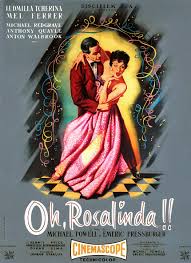
OH… ROSALINDA!
UK, 1955, 101 minutes, Colour.
Anton Walbrook, Michael Redgrave, Ludmila Tcherina, Anthony Quayle, Dennis Price, Mel Ferrer, Anneliese Rothenberger.
Directed by Michael Powell.
Film-buffs will appreciate the films of Michael Powell and Emeric Pressburger, especially admiring their very successful and striking films of the 1940s, will want to see this film, the last of their experiments, their coming to the end of their collaboration in the late 1950s.
The screenplay is an updating of Strauss’s Die Fledermaus, The Bat, set in 1899, a light operetta, romance, deceptions, the touches of farce.
However, this film will be something of an acquired taste. The basic plot and characters from the original have been transferred to 1955, post-war Vienna, divided, rather like Berlin, into various zones, Russian, British, American, French. Audiences who appreciate the Strauss music will enjoy it. Audiences who find this kind of operetta something of a strain, will definitely feel the strain.
But, the adaptation to Vienna 1955, the international implications of the time, friendships and hostilities, the role of the Soviet Union, British propriety, the Americans being American, and the French touches of a more, is persuasive.
The film is very stylised, staged, emphasis on elaborate decor, lavish costumes, more than a touch of the bedroom farce. But, it is the cast which is quite striking. Michael Redgrave, surprisingly, represents the French, a man about town, married to Rosalinda, but always with an eye to other women, eventually being trapped. This is not the Michael Redgrave we are used to, doing his own singing, dancing, surprising high kicks, and into the air with the heel clicking zest. On the other hand, Dennis Price is typically British – enough said. Anthony Quayle is bombastic as the Russian representative. Mel Ferrer is the romantic American.
Entering the proceedings, introducing them, manipulating events, tantalising characters is the host, played by Anton Walbrook, veteran of several Powell-Pressburger films, The 49th Parallel, Colonel Blimp, The Red Shoes. He is obviously enjoying himself here.
Singer-dancer, Ludmila Tcherina is Rosalinda.
A specialised film for film buffs, Strauss lovers, those who enjoy this kind of operetta farce.
