Displaying items by tag: John Le Mesurier
Go to Blazes
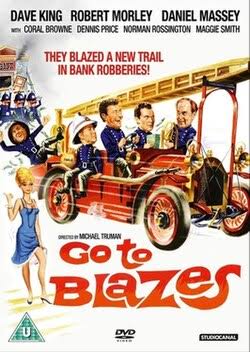
GO TO BLAZES
UK, 1962, 80 minutes, Colour.
Dave King, Robert Morley, Daniel Massey, Dennis Price, Coral Brown, Norman Rossington, Maggie Smith, Myles Malleson, Wilfred Lawson, David Lodge, Finlay Currie, James Hayter, Derek Nimmo, Hugh Lloyd, Arthur Lowe, John Le Mesurier.
Directed by Michael Truman.
Pleasantly light farcical comedy from the early 60s, very much of British comedy in the 1950s – and indicating the trend to greater farce, innuendo, with the style introduced by the Carry on series.
This is the story of a smash and grab trio, smashing the window of a jewellery store and grabbing, the getaway car – but, unfortunately, caught by the police at a roadblock. Jail time. Then the realisation that the best getaway that everybody stops for is a fire engine! So, jail, it again and examining fire engines (with an enthusiastic Miles Malleson), they find an old wreck, steal a good fire engine, inserting the wreck and setting the place ablaze.
Most of the film is about the attempt to smash and grab, the elegant Daniel Massey being prevented a number of times, the other two, Dave King and Norman Rossington, going round and round with their fire engine, caught by a rather idiotic Derek Nimmo because of the flood in his shop, their realising they need to do some training and finding a disgraced fire chief, Dennis Price, who will train them.
In the meantime, Daniel Massey has made a fool of himself fleeing and entering into a fashion show at a highbrow shop, managed by Coral Browne, and with a French consultant, Maggie Smith very early role (and, at one stage, the French accent dropping to a blimey English accent when surprised). And, the realisation that the fashion store is next to a bank. They consult an expert on fire insurance, setting fires, all kinds of skills – and, very enjoyably, played by Robert Morley in full bombast.
It almost works. But, in the escape, they are recognised by the two ladies and the initial policeman pursuing goes in chase, the firemen kindly stopping to help some little girls with their treehouse doll rescue, trees then on fire, the police – and, disaster because they had filled their water hose with all the bank notes from the robbery!
On their way back to jail, that pass the Queen and the Duke of Edinburgh and realise that this is a car that everybody stops for!
There are a lot of popular names from British films in the cast – but, for most of them, their appearances last only a minute or two!
Mister Ten Per Cent
MR TEN PER CENT
UK, 1967, 84 minutes, Colour.
Charlie Drake, Derek Nimmo, Wanda Ventham, John Le Mesurier, Anthony Nichols, Noel Dyson, John Laurie, George Baker, Una Stubbs.
Directed by Peter Graham Scott.
Dear oh dear!
The diminutive comedian, Charlie Drake, was very popular on British television in the 1960s. He also made four films, slight comedies, not particularly well received by critics or the public, The Cracksman being the most successful.
This, his final starring role, is for diehards only, his complete fans. Yet he continued to have a successful career on television and was appearing in supporting roles in various films for the next 30 years.
In retrospect, many audiences will find his performance highly contrived, often very silly, trying too hard.
The film opens with his explaining Swan Lake while working on a building site, pairing with a policeman. Later, with an eye on the portrait of Oscar Wilde, he fancies himself as a dramatist, posh accent though mixing vocabulary, and later will fancy himself advising on how he his play should be produced. But, the play is highly dramatic, comes across as farcical. The unscrupulous entrepreneur, played by John Le Mesurier, decides to profit by investing in a commercial failure. His chosen director is played by Derek Nimmo, himself a very eccentric performer (most successful in television’s Oh Brother).
The would-be playwright interferes with the rehearsals, is taken in by a financier, does not realise how he is being used – but, eventually, ousted from the play, tries to sabotage the London performance, audiences flocking to see and laugh at the farcical play.
Only Charlie Drake’s fans will be persuaded by the last sequence, where the audience realises that he is sincere, hopeful, and applauds him.
The same theme was far more successfully handled by expert Mel Brooks the following year with his comedy classic, The Producers, with Zero Mostel and Gene Wilder (as well as the musical version in the 2000s with Nathan Lane and Matthew Broderick) – and we all remember the extraordinary song and dance routine, Springtime with Hitler!
We Joined the Navy
WE JOINED THE NAVY
UK, 1962, 104 minutes, Colour.
Kenneth More, Lloyd Nolan, Joan O’Brien, Jeremy Lloyd, Dinsdale Landon, Derek Fowlds, Mischa Auer, John Le Mesurier, Lally Bowers, Laurence Naismith, Andrew Cruickshank, Walter Fitzgerald, Ronald Leigh-Hunt, Esma Cannon, Kenneth Griffith, Warren Mitchell, Graham Crowden, Cameos: Michael Bentine, Rodney Bewes, Dirk Bogarde, Sid James.
Directed by Wendy Toye.
British comedy at the beginning of the 1960s, broadening of humour, the period of the beginning of the Carry on series… And, glancing at the cast list, quite a number of names of popular British actors of the time and those who were emerging (and a couple of celebrity cameos, particularly Dirk Bogarde as Dr Simon Sparrow, his character in the Doctor series, where he played with Kenneth More). Sid James does a chuckling variation on his Carry on characters. Notable supporting performances from Kenneth Griffith and, especially, Warren Mitchell. And for fans of veteran actress, Esma Cannon, this is one that definitely should be seen, decked out in official royalty costume and with an accent!
There are several Americans in the cast because of the screenplay, notably Lloyd Nolan, first appearing in American films in the mid-1930s, a 50 years career, his last film Woody Allen’s Hannah and her Sisters.
Much of the screenplay now seems very corny. And there is a great deal of farce. There are interview sequences for inept candidates for the Navy. There are plenty of training sequences. But, with Kenneth More as the central character, always speaking out and being transferred to other jobs, put in command of three potential officers, Jeremy Lloyd (actor but later writer of such television series as Are You Being Served and ‘Ullo ‘Ullo), Dinsdale Landon and Derek Fowlds who came to prominence as the meek public servant in Yes, Minister and Yes, Prime Minister.
There are sequences in the Riviera, clashes between the Brits and the Yanks, more farce about romance for Kenneth More.
Finally, an intervention in an African revolution, Kenneth Griffiths, often so meek on screen, as a yelling and ranting revolutionary, veteran Mischa Auer as two characters leading the country, extremely eccentric.
This comedy has, some humour, but a great deal of silliness as well.
Josephine and Men
JOSEPHINE AND MEN
UK, 1955, 95 minutes, Colour.
Glynis Johns, Donald Sinden, Jack Buchanan, Peter Finch, Heather Thatcher, Ronald Squire, William Hartnell, Gerald Sim, Victor Maddern, Thorley Walters, Laurence Naismith, John Le Mesurier, Lisa Gastoni.
Directed by Roy Boulting.
This is an all-stops-out comedy drama of the mid-1950s. It has a strong leading cast but it is also a film with many well-known British character actors in supporting roles.
The Josephine of the title is played by Glynis Johns, busy, organised, intervening, engaged to Donnell Sinden, an upcoming businessman. Also around is her playboy uncle who narrates the story into a bartender, played by veteran Jack Buchanan, in films since 1917, Broadway since 1924, very well known for his starring role in The Bandwagon. And, then there is the emerging Peter Finch as a playwright.
The film should have worked better than it does. Perhaps Nigel Balchn, creator of thriller novels and screenplays is not the best choice for writing this kind of comedy drama. And, Roy Boulting had great success with films like Brighton Rock.
The actors give their all but the treatment seems, at least in retrospect, somewhat laboured. Josephine with a compulsion to help needy men, encountering the disorganised playwright, breaking the engagement to the businessman, marrying the playwright and, over the years, supporting him, urging him, and his having great success. On the other hand, the businessman has resigned, successful but suddenly turning up on their doorstep with the police after him because of allegations of fraud.
And, at the same time, the wandering, uncle also turns up.
So, Josephine with her compulsion needs to be helping the businessman on the run and so neglecting her husband. All kinds of complications, misunderstandings, the police in pursuit and interrogations, some amusing supporting characters with their roles.
But, many decades later, does not have the impact it may have had in its day.
