Displaying items by tag: Dirk Bogarde
We Joined the Navy

WE JOINED THE NAVY
UK, 1962, 104 minutes, Colour.
Kenneth More, Lloyd Nolan, Joan O’Brien, Jeremy Lloyd, Dinsdale Landon, Derek Fowlds, Mischa Auer, John Le Mesurier, Lally Bowers, Laurence Naismith, Andrew Cruickshank, Walter Fitzgerald, Ronald Leigh-Hunt, Esma Cannon, Kenneth Griffith, Warren Mitchell, Graham Crowden, Cameos: Michael Bentine, Rodney Bewes, Dirk Bogarde, Sid James.
Directed by Wendy Toye.
British comedy at the beginning of the 1960s, broadening of humour, the period of the beginning of the Carry on series… And, glancing at the cast list, quite a number of names of popular British actors of the time and those who were emerging (and a couple of celebrity cameos, particularly Dirk Bogarde as Dr Simon Sparrow, his character in the Doctor series, where he played with Kenneth More). Sid James does a chuckling variation on his Carry on characters. Notable supporting performances from Kenneth Griffith and, especially, Warren Mitchell. And for fans of veteran actress, Esma Cannon, this is one that definitely should be seen, decked out in official royalty costume and with an accent!
There are several Americans in the cast because of the screenplay, notably Lloyd Nolan, first appearing in American films in the mid-1930s, a 50 years career, his last film Woody Allen’s Hannah and her Sisters.
Much of the screenplay now seems very corny. And there is a great deal of farce. There are interview sequences for inept candidates for the Navy. There are plenty of training sequences. But, with Kenneth More as the central character, always speaking out and being transferred to other jobs, put in command of three potential officers, Jeremy Lloyd (actor but later writer of such television series as Are You Being Served and ‘Ullo ‘Ullo), Dinsdale Landon and Derek Fowlds who came to prominence as the meek public servant in Yes, Minister and Yes, Prime Minister.
There are sequences in the Riviera, clashes between the Brits and the Yanks, more farce about romance for Kenneth More.
Finally, an intervention in an African revolution, Kenneth Griffiths, often so meek on screen, as a yelling and ranting revolutionary, veteran Mischa Auer as two characters leading the country, extremely eccentric.
This comedy has, some humour, but a great deal of silliness as well.
For Better, For Worse
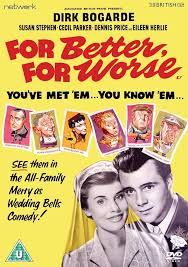
FOR BETTER, FOR WORSE
UK, 1954, 85 minutes, Colour.
Dirk Bogarde, Susan Stephen, Cecil Parker, Eileen Herlie, Athene Seyler, Dennis Price, Pia Teri, James Hayter, Thora Hird, George Woodbridge, Charles Victor, Sidney James, Robin Bailey.
Directed by J. Lee Thompson.
British domestic story from the mid-1950s – and, on the evidence of this film, it would seem a long time ago.
It was something of a prestige film at its time, written and directed by J. Lee Thompson who was to go on to international success with many films, especially The Guns of Navarone and a number of Charles Bronson thrillers. At this time Dirk Bogarde was emerging as a comedian, after many thrillers, especially with Doctor in the House. Susan Stephen was a regular star of this period. Cecil Parker was a very popular character actor – and there are so many more character actors in the supporting roles in this film which makes it so much more enjoyable as we recognise them.
Dirk Bogarde, playing 10 years younger than he actually was, earnestly wants to marry Susan Stephen. The film opens as they watch a romance on screen, then a proposal, then the meeting with her mother, Eileen Herlie, who becomes almost immediately sympathetic, and then the meeting with her father, Cecil Parker, demanding but far less pompously aristocratic than in many of his roles.
There is the issue of getting a job which he eventually does with the government but is it enough to live on? And what about a house? They go to a one-room flat, managed by Dennis Price, there are arguments for and against but their placing the deposit.
One of the main sections, especially for some comedy, has Susan Stephen preparing a dinner for her parents – and the elderly neighbour who is always coming in to use the phone, interfering, but ultimately nice; the local cleaner, played by Thora Hird, who is helpful in preparing the dinner; James Hayter as the plumber who is at the end of an attack by the husband. The other big scene is the arrival of so much furniture, with Charles Victor and George Woodbridge as the sympathetic carriers – and then a glimpse of Sidney James, not so sympathetic.
If this appeals, with its mid-1950s British style, beliefs about the working husband, the wife staying at home…, Then this may be an appealing pastime. (And, for distribution in the US, as with many British the time, very strange title changes – and this one was called, of all things, Cocktails in the Kitchen.)
Boys in Brown
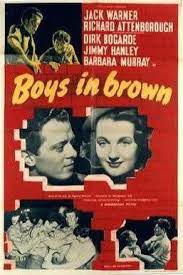
BOYS IN BROWN
UK, 1949, 85 minutes, Black-and-white.
Jack Warner, Richard Attenborough, Dirk Bogarde, Jimmy Hanley, Barbara Murray, Patrick Holt, Andrew Crawford, Thora Hird, Michael Medwin, Alfie Bass, Cyril Chamberlain.
Directed by Montgomery Tully.
Boys in Brown refers to the institution of the Borstal, not exactly a prison, but centres where boys and young men who have committed criminal offences are housed with the hope for rehabilitation and programs to assist this.
This is very much a film of the late 1940s, the post-war period, brief, in black and white, seasoned stars like Jack Warner (later with The Blue Lamp and his several hundred episodes of Dixon of Dock Green), Thora Hird, as well as up-and-coming actors like Richard Attenborough, Dirk Bogarde, Jimmy Hanley, Alfie Bass.
The focus here is on the character played by Richard Attenborough, a failed getaway attempt after a robbery, his going to the Borstal, trying to obey but entangled with some of those who are recalcitrant, wanting to escape. The most sinister is played by Dirk Bogarde, rather Machiavellian, something of a Iago and his sinister advice to Richard Attenborough and to bring him down.
There are emotional tangles, someone released (Jimmy Hanley) who visits the family, has a photo of the girlfriend (Barbara Murray) which Dirk Bogarde’s Iago uses to mislead Attenborough and to involve him in the escape. It comes to something of a melodramatic head with the escape and an attack on one of the staff.
This was an original play by actor in so many British films, Reginald Beckwith. Montgomery Tully was a director of this kind of film from the 40s to the 60s.
- Title? Criminal offences, the Borstal situation, prison/rehabilitation, the role of the authorities, the programs? Written in the 1940s?
- British film of the 1940s, the cast and their careers, Jack Warner and his status, black-and-white photography, issues? Social concern?
- The focus on Jackie, his background, easily led, his relationship with his mother, getaway driver, failure of the car, his being chased, arrested, the sentence, Borstal? Richard Attenborough and his performance on screen presence? His intention to serve at the time? The group, entering, the speeches, the Gov and his support? The mixed reaction of the group? Encounter with Alfie and his influence?
- Life of the Borstal, work, interactions, friendships, antipathy is? Theatre, rehearsals, Alfie and his performance? Labour?
- The group, planning the escape, Jackie not wanting to be part, their pressure on him, Alfie and his Machiavellian manipulation of Jackie?
- Jackie, the background, the friendship with Kitty, the photos, her visit? Jackie’s mother and his allowing her to come?
- Bill, serving his time, his background, intentions, leaving, the Borstal is part of the record, difficulty in getting a job, being targeted? Meeting Kitty, the attraction, the dance? Bill being caught up, the return, the photo with Kitty, Alfie and his manipulation, Jack and his motivations, forced to join the group?
- The plan, the escape, the confrontation with the member of staff, the violence, Jackie and his reaction, the man taken to hospital, the escape, everybody captured?
- The meeting with the governor and the authorities, his reaction, speeches, the recalcitrant Casey, Alfie being exposed, Jackie and his revolution to finish his sentence?
