Displaying items by tag: Terry Scott
Carry on Henry
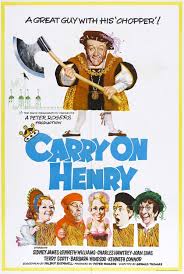
CARRY ON HENRY
UK, 1971, 89 minutes, Colour.
Sid James, Kenneth Williams, Charles Hawtrey, Joan Sims, Terry Scott, Barbara Windsor, Kenneth Connor, Julian Holloway, Peter Gilmore, William Mervyn, Bill Maynard.
Directed by Gerald Thomas.
Of all British Kings, Henry VIII would be the least to need the advice to Carry on! By 1971, Carry on films had a 13 year history, tapping a number of historical situations. Here is an invention that the king had two more wives than his six, chronicled by William Cobler, so a load of old cobblers as the introduction suggests, to the background of Greensleeves (and later Chanson D’Amour and variations on the Trumpet Voluntary).
Sid James continues as a chuckling lecherer as the king, with the same performance as always. Kenneth Williams performance is always the same, but he provides good comedy as Thomas Cromwell. Terry Scott hams it up as Cardinal Woolsey. And Kenneth Connor, shows that he can give quite a different performance in every film. And, many of the supporting cast are present again, especially Barbara Windsor as the possible Queen. But, dominating everything is Joan Sims as the princess from Normandy.
In fact, a lot of the central plot hinges on French love garlic, the Princess putting it into her mouth in the bedroom, the king repelled by garlic, and various Gallic/garlic jokes throughout the film.
A lot of shenanigans, quite some pageantry, Charles Hawtrey as the least likely gallant knight attending to the Queen.
With the subject of Henry VIII, the emphasis on sex is more prominent than usual, crude jokes, clever innuendo, and, of course, as with the king himself, the female members of the cast seen as sexual objects for male gaze and groping. How would they remake this film in the 21st-century!?
Carry on Matron
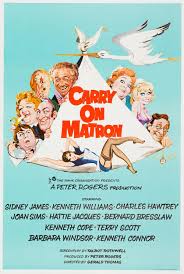
CARRY ON MATRON
UK, 1972, 88 minutes, Colour.
Hattie Jacques, Sidney James, Kenneth Williams, Kenneth Connor, Joan Sims, Bernard Bresslaw, Bill Maynard, Kenneth Cope, Barbara Windsor, Terry Scott, Charles Hawtrey, Patsy Rowlands.
Directed by Gerald Thomas.
Before this episode in the medical Carry on comedies, Nurse, Doctor, Doctor again. And, by this time, the Carry on films had been carrying on for 14 years. Most of the regular cast appear in this film.
There is a story of the hospital, Finisham, with wards named Bunn and Oven. And, there a place on the title at the opening, From Here to Maternity, Womb with a View…
Hattie Jacques, once again, is matron, sympathetic if dominating, but infatuated with the head of the hospital, Sir Bernard Cutting, once again Kenneth Williams doing his shtick, hypochondriac, fearing that he was having a sex change, pursued by the matron.
And there is something of a plot, Sid James leading a gang of crooks, including Bernard Briesslaw and Bill Maynard with Sid James’s son, Kenneth Cope, having to disguise himself as a trainee nurse, infiltrate the hospital and get the plans for where the contraceptive pills are stored so that the gang could steal them and sell them. So, lots of comedy with Cyril, the son, dressed as a nurse, sharing a room with Barbara Windsor, becoming a sensation in helping to deliver triplets in an ambulance! And, the intensity of the robbery, disguises, misadventures, and, ultimately, a gathering in some panic, everybody involved at the hospital.
Kenneth Connor, is able to create another character, a railway man waiting long hours for his pregnant wife to give birth, Joan Sims as the wife, seen continually eating hefty helpings and capitalising on the free meals. There is Terry Scott as a doctor with his eyes on the ladies. And Charles Hawtrey is able to do his shtick as a psychiatrist on the hospital staff, clashing with Kenneth Williams.
Lots of puns, lots of innuendo, some titillation, some slapstick, a typical Carry on comedy.
Carry on Camping
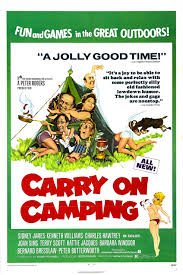
CARRY ON CAMPING
UK, 1969, 88 minutes, Colour.
Sid James, Kenneth Williams, Charles Hawtrey, Joan Sims, Terry Scott, Barbara Windsor, Hattie Jacques, Bernard Bresslaw, Julian Holloway, Dilys Laye, Peter Butterworth, Betty Marsden, Trisha Noble.
Directed by Gerald Thomas.
By this time, the Carry On series had been going for over a decade, with small black and white, it is to cover comedies and strong popularity, not only in the UK but overseas – but, not so much in the United States.
A great number of bloggers on the IMDb considered as one of the best of the Carry on series.
For this reviewer, it seemed one of the weakest. It is 1969, the film opens with an extensive coverage of a nudist film, something of a breakthrough for mainstream films in the late 1960s (not a feature of popular comedies from the US). It is take for granted that there will be sex jokes and references, innuendo, objects recycled, obvious is… And that is certainly the case here. However, this to be more of a leering turn their in many of the other films, Sid James being particularly ogling and leering here.
One of the advantages of the film is that so many of the regular cast are present. A very sympathetic presences, especially Joan Sims and Bernard Breslau (always putting his foot in it as since good friend). And, there is the young Barbara Windsor – exactly and inhibited presence on screen. Hattie Jacques is serious, even in a comedy and Kenneth Williams is always himself. Many might find Charles Hawtrey very irritating this time round and there are troubles between Terry Scott Betty Marston as his non-listening falling wife.
It would be interesting to see a feminist review of Carry on Camping and its presentation of the objectification of women, especially young women, this comedy presentation of the male gaze with Sid James’s line: what are the young women always there where I’m staring!
And, with the ending the people gathering for music Festival, remembering that 1969 was the year of Woodstock – although the oldies and regulars from the Carry on films are against the festival and oust everyone.
Carry on Sergeant
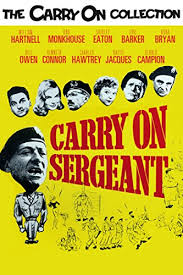
CARRY ON SERGEANT
UK, 1958, 84 minutes, Black-and-white.
William Hartnell, Shirley Eaton, Bob Monkhouse, Eric Barker, Dora Bryan, Bill Owen, Charles Hawtrey, Kenneth Connor, Kenneth Williams, Terrence Longden, Norman Rossington, Hattie Jacques, Terry Scott, Ed Devereaux.
Directed by Gerald Thomas.
The first of the Carry on films which were to continue into the 60s and 70s, all of them directed by Gerald Thomas. This film was typical enough of the comedy of the 1950s, a focus on the military, a group of national service for 10 weeks training, a motley and comical group, as well as a focus on the sergeant who wants to win an award for the best company, his corporal assistant and the commanding officer. Very much focus on the male characters.
However, Shirley Eaton, some years before Goldfinger, is the just married wife of one of the recruits, Bob Monkhouse, and Dora Bryan does her usual comic thing as a rather flighty cook.
In many ways, this is a straightforward British comedy, a basis for the future Carry on films, but very different from the jokey, sometimes a leering style of the subsequent films. (Comparison can be made with Operation Bullshine of 1959, the army, much more in the vein of the later Carry on films.)
Which means that this film is enjoyable for audiences of British comedy of the 1950s.
Interestingly, in view of the later Carry on films, the first list of cast seen in the opening credits highlights stars who were not regulars in most of the Carry on films (William Hartnell as the sergeant having top billing, Eric Barker, in some of the films, as the commander and the later top-rated billing of Bob Monkhouse). Then, the next list has the regulars who are there right from the beginning, Kenneth Connor, Kenneth Williams, Charles Hawtrey, then Hattie Jacques and even a glimpse at the beginning of Terry Scott, conversing with Ed Devereaux.
Kenneth Connor is an extreme hypochondriac, Hattie Jacques the doctor, Charles Hawtrey as usual, but enjoyable to see Kenneth Williams as an intellectual soldier, helping others, but his usual speaking style.
No Sid James until the third Carry on film. No Joan Sims, but she appeared in the next one.
For fans of the Carry on series, instructive and perhaps surprisingly enjoyable, especially with its reticence, reminding us how the series began.
Carry on up the Khyber
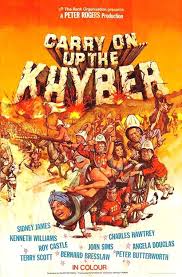
CARRY ON UP THE KHYBER
UK, 1968, 95 minutes, Colour.
Sidney James, Kenneth Williams, Charles Hawtrey, Roy Castle, Joan Sims, Bernard Bresslaw, Peter Butterworth, Terry Scott, Angela Douglas, Cardew Robinson, Julian Holloway, Peter Gilmore.
Directed by Gerald Thomas.
By 1968, the Carry on series had been popular for 10 years – and there were more than 10 years more to come.
For devotees of the series, this is considered one of the best, with some plot borrowed from the many stories of British presence in India, uprisings, British stiff upper lip… And plenty of the humour associated with the series.
For those who are beginning to dislike the series, put it down, it is considered one of the worst.
While the setup has its background of humour, Sid James as the British representative, Sir Ruff-Diamond, and Joan Sims as his pompously silly wife, various officials…, there are problems at the Khyber pass, Kenneth Williams as the local chief, doing his usual, Bernard Bresslaw with his name punning on Gunga din, wanting to oust the British.
Critics say that the basic premise is infantile. Rather, it is the kind of joking of young boys. The regiment protecting the past is the Foot and Mouth regiment, wearing kilts. And, the whole situation is whether somebody wears underpants or not, regulation say not, Charles Hwtrey doing his usual stick is found wearing underpants and a photo taken to be used with the locals to show they should not fear the British.
This joke continues throughout the film, poking fun at the British, especially the Sergeant Major played by Terry Scott.
There is a huge bombardment sequence at the end while the British sit at their table, enjoying their lavish meal, everything being shot up around them, including the orchestra who has been playing and, after their being shot at, getting up to continue playing, the only person noticing the damage is the fake religious preacher played by Peter Butterworth.
And, what is the strategy for finally defeating the uprising, the kilted men all lining up at the moment of ceasefire, raising their kilts and the Indians running for the hills.
Bridal Path, The
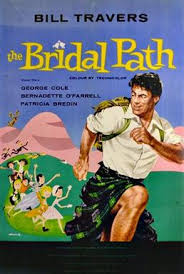
THE BRIDAL PATH
UK, 1959, 95 minutes, Colour.
Bill Travers, Bernadette O'Farrell, George Cole, Duncan Macrae, Eddie Byrne, Terry Scott.
Directed by Frank Launder.
This is a pleasant picaresque story set in Scotland.
Bill Travers, who had emerged successfully in Geordie and appeared in such films as The Barretts of Wimpole Street, and then with his wife, Virginia McKenna, in Born Free (and the giving of their life and attention to Africa and animals), plays a vigorous, strapping Scot who lives on an island, and the issue of his marriage.
He goes to the mainland, gets himself involved in a lot of tangles, even with the police, testing out various women with his criteria for marriage, restrictive in terms of clans and religion from the island perspective.
This is a pleasant story even if it does seem rather far-fetched!
There is a good supporting cast with character actors like Duncan Macrae (The Kidnappers) and comedian Terry Scott as a policeman.
The screenplay was written by veteran Frank Launder who directed the film. He has 75 writing credits from 1929 to 1985.
- The title, marriage in the Scottish Isles, traditions, requirements for marriage, and a search for a wife?
- The Scottish settings, the colour photography, the landscapes, the sea, the town on the streets, shops, the countryside and its range, hotels, police precincts…? And the musical score and the choral singing?
- Life on the island, the minister and his return, his sermon, the issue of consanguinity, cousins on the island marrying? Taking the issue seriously?
- Ewan, with Siona, the children, cousins, the bond between them, Siona and her determination to go to Glasgow? Ewan, the prescriptions for finding a wife, his going to the mainland?
- The film as a comedy of errors, Ewan as the naive islander, his presence, his height, charm, awkwardness, his going to the bank, the £400 and two shillings, going to the restaurant, eyeing the waitress, his being ousted? The male gaze of 1959 from Scotland, his looking at the various women? But according to the prescriptions on his list, no Catholics, no Campbells, wanting children, good with cows…?
- The range of events, going to the inn, the flirtatious wife of the policeman, his being continually misunderstood, the young woman reading the book about white slavery, his explaining that he wanted to look over girls, her alarm, calling the police?
- The continued chases, out in the countryside, along the roads, the rail tracks, getting wet, the policeman’s wife and his clothes, the Campbell rug, the effect on Ewan, the policeman with the bike, the pound notes flying, paying for the bike and taking it?
- The various police officers, disbelief, the more information, the headquarters, getting in the authorities? The phone calls, the pursuits, the sightings? The games, the elaborate chase, the participation of the police, pulling out of the events, tug-of-war et cetera, Ewan continually escaping?
- The interview with Sgt Bruce, his fear of his wife, having to stay the night, getting the breakfast, the other police arriving, Ewan getting them cups of tea, then his escape?
- Taking refuge with the farming woman, her wanting to escape, buying the boat, rowing out, persuading the boat to target him?
- Adrift, finally getting home, recounting his adventures? The encounter with Siona, the mother’s wife telling the truth about his origins, not cousins, his courage in proposing, acceptance? Happy ending?
