Displaying items by tag: Kenneth Griffith
We Joined the Navy

WE JOINED THE NAVY
UK, 1962, 104 minutes, Colour.
Kenneth More, Lloyd Nolan, Joan O’Brien, Jeremy Lloyd, Dinsdale Landon, Derek Fowlds, Mischa Auer, John Le Mesurier, Lally Bowers, Laurence Naismith, Andrew Cruickshank, Walter Fitzgerald, Ronald Leigh-Hunt, Esma Cannon, Kenneth Griffith, Warren Mitchell, Graham Crowden, Cameos: Michael Bentine, Rodney Bewes, Dirk Bogarde, Sid James.
Directed by Wendy Toye.
British comedy at the beginning of the 1960s, broadening of humour, the period of the beginning of the Carry on series… And, glancing at the cast list, quite a number of names of popular British actors of the time and those who were emerging (and a couple of celebrity cameos, particularly Dirk Bogarde as Dr Simon Sparrow, his character in the Doctor series, where he played with Kenneth More). Sid James does a chuckling variation on his Carry on characters. Notable supporting performances from Kenneth Griffith and, especially, Warren Mitchell. And for fans of veteran actress, Esma Cannon, this is one that definitely should be seen, decked out in official royalty costume and with an accent!
There are several Americans in the cast because of the screenplay, notably Lloyd Nolan, first appearing in American films in the mid-1930s, a 50 years career, his last film Woody Allen’s Hannah and her Sisters.
Much of the screenplay now seems very corny. And there is a great deal of farce. There are interview sequences for inept candidates for the Navy. There are plenty of training sequences. But, with Kenneth More as the central character, always speaking out and being transferred to other jobs, put in command of three potential officers, Jeremy Lloyd (actor but later writer of such television series as Are You Being Served and ‘Ullo ‘Ullo), Dinsdale Landon and Derek Fowlds who came to prominence as the meek public servant in Yes, Minister and Yes, Prime Minister.
There are sequences in the Riviera, clashes between the Brits and the Yanks, more farce about romance for Kenneth More.
Finally, an intervention in an African revolution, Kenneth Griffiths, often so meek on screen, as a yelling and ranting revolutionary, veteran Mischa Auer as two characters leading the country, extremely eccentric.
This comedy has, some humour, but a great deal of silliness as well.
Man Upstairs, The
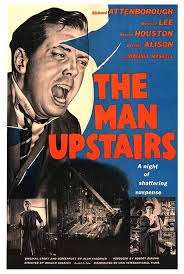
THE MAN UPSTAIRS
UK, 1958, 88 minutes, Black-and-white.
Richard Attenborough, Bernard Lee, Donald Houston, Dorothy Allison, Virginia Maskell, Kenneth Griffith, Patricia Jessel, Alfred Burke, Charles Houston, Maureen Connell, Walter Hudd.
Directed by Don Chaffey.
British 1950s psychological drama. There is an ensemble British cast led by Richard Attenborough, persuasive as a man who has been involved in an accident causing death which has taken its toll on him.
The action takes place over several hours in the early hours of the morning, the man upstairs waking, nightmares, upset, interacting with various members who live in the block of flats in London, attacking one, barricading himself in his room, the police arriving with strong, unsympathetic tactics (led by Bernard Lee), contrasting with the sympathetic wife and mother downstairs, Dorothy Alison, and different reactions from members of the household, especially the righteous Kenneth Griffith. Donald Huston plays a local counsellor who does get an opportunity to talk with the man upstairs but with little effect.
The action takes place within the block of flats, sometimes going outside to see the crowds, the police holding them back, the fire brigade arriving.
Some commentators have noted that this film came out just after the American 12 Angry Men, a drama in a room where members of the jury argue the different aspects of the case. Some bloggers have noted that they found the film tedious. Others, more sympathetic, will be interested in the character and experience of the man upstairs as well as the variety of responses to him.
- The title, the anonymity, the false name, the real name? Upstairs, the block of flats, the upstairs room, the stairs, the window, looking out to the street? Black and white photography?
- The British ensemble cast and its effectiveness?
- The situation, John Wilson/Peter Watson, waking, upset, in his room, there for three weeks, his bewildered reactions, the early hours of the morning? The encounter with the artist and his not helping? The encounter with Mr Pollen, hitting him and the reaction? The friendship with Mrs Barnes, helping her son with his homework? The continued trauma and bewilderment?
- The arrival of Helen, Mrs Barnes calling her, the story of the past, the accident, her brother’s death, the court case, the man’s outburst, his having a record?
- The gathering of those in the block, the harsh landlady, Dolly herself up, with Mr Pollen, the drinking, her harsh attitudes, cynical touches? The contrast with the elderly lady, frightened in her bed, brought downstairs? The artist, his work, his girlfriend present, trying to conceal her presence? Mr Pollen, fussy, civil defence, calling the police, backing the police? Mr Barnes arriving home after work? The range of people, the drama of their points of view, conflicts, final reactions, Mrs Barnes urging them all to go upstairs, Mr Pollen holding out, the going up the stairs?
- The arrival of the police, police attitudes, Thompson, his straightforward attitudes, harsh, unsympathetic to mental illness, doing his job? Intervening, the police going upstairs, the man pushing the policeman and his falling over the railing, to hospital? Thompson aggravated? The role of the other police, standing guard, guns, the arrival of the superintendent, the range of discussions, his decisions, Thompson disagreeing?
- Sanderson, his role in the borough, wanting to talk, Thompson’s lack of sympathy, the superintendent allowing him up, his attempts to talk, knocking, going in, the man’s reactions? Support with Mrs Barnes? The discussions with the superintendent?
- The fire brigade, the police, the teargas issue and its use?
- The light, into the room, the man upset, the suitcase on the window ledge, his pushing it over? The gun and the threats? With Sanderson and overcoming him?
- Mrs Barnes, urging, agreements and disagreements, the decision to go upstairs, her leadership, the meeting with the police? Her being allowed to go up, knocking, talking, the three minutes time limit, the man eventually coming out?
- The man, let downstairs, led away?
- The film of the 1950s, the role of the police, the role of mental illness, treatment, sympathy, harsh attitudes?
Suspect/ The Risk
SUSPECT/THE RISK
UK, 1960, 81 minutes, Black-and-white.
Tony Britton, Virginia Maskell, Peter Cushing, Ian Bannen, Raymond Huntley, Thorley Walters, Donald Pleasence, Spike Milligan, Kenneth Griffith, Robert Bruce, Anthony Booth, Basil Dignam, Sam Kydd, Murray Melvin.
Directed by John Boulting, Roy Boulting.
British Nigel Balchin wrote thrillers and wrote the screenplay for this brief film. The Boulting brothers had a strong presence in British cinema from the 1940s. Their intention with this film was to enhance the quality of British supporting features, small budget, filmed in 17 days, brief running time. Critics at the time were harsh on the film, American critics more sympathetic.
With the writing, the Boulting Brothers’ direction, and the considerable quality of the supporting cast, serious issues of scientific experimentation, wartime security, espionage and stealing secrets, there is quite a lot of material in 81 minutes. The locations are confined, home, laboratory, restaurants, espionage. With the supporting cast so articulate, the dialogue makes a strong impression.
In fact, Tony Britton and Virginia Maskell as the stars are not as strong as the character actors, some veterans like Raymond Huntley as the politician, Peter Cushing as the professor, Kenneth Griffith as his assistant, Donald Pleasence, always sinister, Thorley Walters as an eccentric investigator, Ian Bannen as the cynical war invalid, all bring quality to the performances. And there are quite a number of interesting cameos from actors like Spike Milligan, serious and comic at the end, Sam Kydd, Murray Melvin, Anthony Booth.
A curiosity item of the period but an interesting and entertaining 80 minutes.
- Small-budget supporting feature, a television filming style?
- Nigel Balchin thriller, his writing the screenplay, nation, science, politics, espionage, romance? Popular ingredients?
- The cast, the range of British character actors, the focus on dialogue, interactions, intensity, themes articulated in the British style?
- The focus on scientific experimentation, the professor, years of experience, Peter Cushing’s style, the staff, summoned by the government, closure on his experiments, his reactions, the staff, the situation with the dedication of the statue? His discovery of Marriott with the documents, his reaction, the police, covering for Marriott?
- Bob Marriott and Lucy Byrne, colleagues, skills, the date to the pictures, Lucy and her reticence, the situation with Alan, losing his arms in war, her caring for him, past fiancee, his manner, cynical? His meeting with Marriott, charming exterior, undermining him, the connection with Brown, the situation about the government ban, the documents, saving the experiments, handing them over?
- Lucy, her work, with Marriott, the attraction, her helping with Alan, the meeting with Brown, her ignorance, her being interrogated?
- Marriott, his character, dedicated to his work, the experiment with his arm, his reaction to the ban, led on by Alan, the meeting with Brown, taking the documents, the meeting with the spies?
- Dr Shole, collaboration, personality, Mr Prince making the contact, with his assistant, the suspicions, summoning him, the information? The scenes with the professor?
- Mr Prince, his role in the investigations, sometimes doddery, absent-minded, his office a mess, the meetings with Dr Shole, relying on his assistant, the interviews, his hypotheses?
- Brown, his background, sinister, Donald Pleasence’s style, his eyes, the arrangements, the meeting, being the documents, the person in charge, the police, gunshots?
- The politics, the Minister, calling in the professor, good mannered but intense, forbidding the experiments, danger for enemies getting hold of them, the dedication of the statue, his assistant, his visit to the laboratory in meeting the staff?
- The assistant at the office, Spike Milligan, more serious – the final comedy with the monkey?
- British politics in world politics in the late 1950s? This film seen in retrospect?
