Displaying items by tag: Sidney Tafler
Bottoms Up
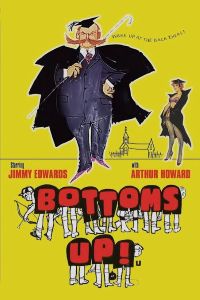
BOTTOMS UP
UK, 1960, 90 minutes, Black-and-white.
Jimmy Edwards, Arthur Howard, Martita Hunt, Sidney Tafler, Raymond Huntley, Reginald Beckwith, Melvyn Hayes, John Mitchell, Richard Briers.
Directed by Mario Zampi.
Bottoms up, especially for receiving a caning in old-style British schools!
Jimmy Edwards was a popular comedian on radio and television in the 1950s. He brings his schoolmaster character from those media to the big screen. Whether it appeals to later generations is a moot point.
And, looking back over the decades and attitudes towards discipline in schools, physical punishment, delivered by staff and other students, this comedy seems particularly old-fashioned. A past that is receding into long distance.
And, a critical look back at plot developments show a subplot concerning a Prince from a colonial country, blackface disguise, not accepted in later generations. And, the most mischievous of the boys is played by the son of a bishop.
The film could be seen as a male version of the popular St Trinians’ girls schools comedies, lots of misbehaving children, lots of frustrated staff, all kinds of slapstick comedy, all kinds of misadventures and plots, turning into a school battlefield and military strategies, humorous dialogue, lots play on words (those masters of English language in radio programs, Frank Muir and Dennis Norden, receive credits for the screenplay). And, some touches of innuendo – after all, this was the era when the Carry on series began.
Jimmy Edwards is huge, bluff, imposing, but also the victim of all kinds of pranks. The fall guy, so to speak, is his hapless assistant, so often the victim of pranks as well as their masters’ bullying, is played by Arthur Howard (brother of Leslie Howard). There is comedy with snobbery, especially with Martita Hunt (so memorable as Miss Havisham in Great Expectations) and the perennially rather snooty government official played by Raymond Huntley. Richard Briers, early in his career, is in the cast.
The film was directed by Italian born Mario Zampi who made a number of comedies in England, notably Laughter in Paradise with Alistair Sim and Too Many Crooks with Terry Thomas (and Carry on stars, Sid James and Bernard Bresslaw).
A curiosity item, broad British comedy in the 1950s and 1960s.
Carry on Regardless
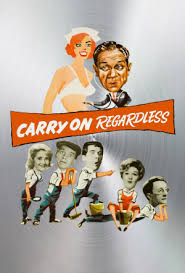
CARRY ON REGARDLESS
UK, 1961, 90 minutes, Black-and-white.
Sidney James, Kenneth Connor, Charles Hawtrey, Joan Sims, Kenneth Williams, Bill Owen, Liz Fraser, Terrence Longdon, Hattie Jacques, Esma Cannon, Sidney Tafler, Terrence Alexander, Stanley Unwin, Joan Hickson, Fenella Fielding, David Lodge.
Directed by Gerald Thomas.
The fifth film in the series, by now getting underway, and this film having most of the cast from the early films.
The screenplay was written by Norman Hudis who wrote the early screenplays before the transition to Talbot Rothwell who wrote most of the subsequent Carry on films. This one is very straightforward. Sidney James and Esma Cannon run the Helping Hand agency, ready to help out in any emergency. Meanwhile, at the labour exchange, there are a whole lot of characters looking for jobs and who descend on the agency – at one stage, in a scene at the agency, nine of the popular members of the cast are all assembled in the one room.
There is no plot as such. Rather, the film is a succession of farcical episodes, slapstick comedy, each of the new members of the agency going out on jobs and generally mucking them up. And, for a variation, in the last part of the film they go to a mixup of addresses, again with some disastrous results. And finally, their gobbledygook-speaking landlord, Stanley Unwin, interpreted by Kenneth Williams’ character who speaks 16 languages! indicates that he wants the premises renovated. Needless to say, they all help but create disasters, only to find that with all the mess that they have made, it will be all right because the landlord has decided to demolish the building.
Not so much innuendo in this particular version – though, Liz Fraser does offer an opportunity for some sex comedy. And, it is interesting to see Sid James in a fairly straightforward role. And, it is a pleasure to see most of the members of the staff as well as a number of supporting British character actors who appeared in a number of films in the series.
Floating Dutchman, The
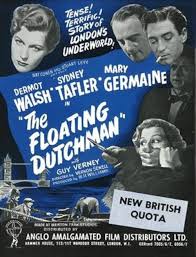
THE FLOATING DUTCHMAN
UK, 1954, 76 minutes, Black-and-white.
Dermot Walsh, Sidney Tafler, Mary Germaine, Guy Verney.
Directed by Vernon Sewell.
Not essential viewing but a small, entertaining thriller, a supporting feature from the British industry in the mid-1950s. The Floating Dutchman this time is a courier whose body is found in the Thames. Police investigate, second an undercover officer to infiltrate the gang and find the murderer.
Dermot Walsh is fairly stolid as the hero. Sidney Tafler, in many of this kind of film and later television series, is much better, a touch more showy as the owner of a club, organising the diamond trade. There is a touch of romance with a woman who works in the club. There are various underlings with sinister backgrounds. And there is an old diamond jeweller in London, a fence for all the diamonds, ultimately trying to protect himself.
Familiar material but a glance back at British filmmaking in the mid-20th century.
Mystery Junction
MYSTERY JUNCTION
UK, 1951, 65 minutes, Black-and-white.
Sydney Tafler, Barbara Murray, Patricia Owens, Martin Benson.
Directed by Michael McCarthy.
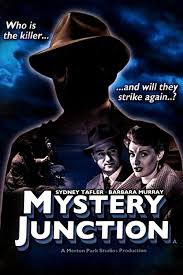 An entertaining 65 minutes. This is a film about a detective story writer, recognised in a train by an old lady passenger, asking him about his work, his narrating the story being dramatised.
A prisoner is handcuffed to a police officer on the train, travelling to a court case, his being protected because he has promised to speak out against other criminals. Then, the police assistant is thrown from the train, the killer disguised as the ticket collector.
The writer and the old lady then discover two show girls hiding out in the luggage compartment, the ticket collector knocked out… The passengers in the carriage are all gathered together and, then, they are stranded at the junction because of the weather.
When the lights go out, the police officer is shot dead – and, gradual revelations of the criminal, his associates on the train, a young man who won’t reveal where he was going, confrontations, the gang driving away returning, and the various interrogations and threats, the arrival of the police in the morning, and the revelation of the killer and why.
An amusing postscript when the old lady is reading her novel and looks up at her fellow passenger and sees characters who are lookalikes of some of the villains in the story!
