Displaying items by tag: Eric Barker
Three Hats for Lisa
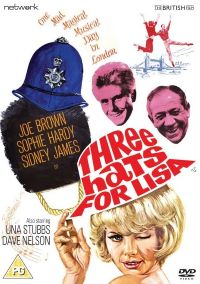
THREE HATS FOR LISA
UK, 1965, 99 minutes, Colour.
Joe Brown, Sophie Hardy, Sidney James, Una Stubbs, Dave Nelson, Peter Bowles, Eric Barker, Seymour Green, Josephine Blake, Jeremy Lloyd.
Directed by Sidney Hayers.
This is very much a film of its times, the colourful swinging London of the mid-1960s. But now it looks very, very dated.
However, one reason for looking at it now is that it provides something of a treat for Sid James fans. Once again, he gives a typical performance as a cab driver. However, this is a musical, quite a lot of songs and dances, and here is Sid James, both singing and dancing! He is certainly worth a look, more versatile than we might imagine.
The star of the film is Joe Brown, popular singer of the period – but, not exactly an appealing screen character, rather more “in your face” than we might have liked. His singing voice resembles that of the popular Cliff Richard, and this film is something in the vein of the Cliff Richard musicals like Summer Holiday.
Three Londoners spend the day taking an Italian film star around London, she wanting to steal three hats to complete her collection! She is played by French actress, Sophie Hardy. The other two on the day out are played by Una Stubbs and Dave Nelson.
But, there is Peter Bowles, a decade before To the Manner Born, very much overacting. On the other hand, there is a good cameo by comedian, Eric Barker, at the police station. Actor and writer, Jeremy Lloyd, is also there.
The surprise is that the music is by Leslie Bricusse, Oliver, Stop the world… There is a lot of exuberance but not so much more. And, he co-wrote the screenplay with Talbot Rothwell who, at this time, was writing all the Carry on films. It is not his greatest screenplay either.
There is quite a lot of song and dance, round different venues in London, lots of workers, passers-by, all joining in. Fans of West Side Story may notice the resemblance of many of the dance routines, especially with the male dancers, to the choreography of the classic musical.
Spoiler: Lisa does eventually get her three hats!
Carry on Constable
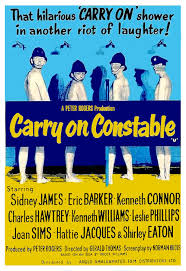
CARRY ON CONSTABLE
UK, 1960, 86 minutes, Black and white.
Sid James, Kenneth Williams, Eric Barker, Kenneth Connor, Charles Hawtrey, Leslie Phillips, Joan Sims, Hattie Jacques, Shirley Eaton, Cyril Chamberlain, Joan Hickson, Irene Handl, Esma Cannon, Terence Longden, Jill Adams, Victor Maddern.
Directed by Gerald Thomas.
One of the earliest of the Carry on series, two years after it began, the atmosphere of British filmmaking in 1960, popular comedy, the transition to the more permissive 1960s. In the retrospect of the later films, Carry on Constable seems comparatively innocent certainly some sexual references, some shower and bathroom scenes, some ogling by the male stars but, in comparison with later films, rather more of the light touch.
In fact, the film was written by the writer of the earlier Carry on films, Norman Hudis. Then there was a transition to Talbot Rothwell who scripted most of the Carry on films, more explicit with sexual themes, a great deal of innuendo.
This was the first Carry on film with Sid James, rather more straightforward role, sometimes sympathetic, but he was to develop into the chuckling lecherer during the 60s and 70s. But, it is pleasing to see so many of the regulars in this film, the two Kenneths and Charles Hawtrey, much more explicitly gay in this film than later, especially with the cross dressing of Kenneth Williams and Hawtrey, Hawtrey even passing passably for female.
Joan Sims and Hattie Jacques are happily present and there are a whole number of guest female stars, young like Shirley Eaton, three years before Goldfinger, and Jill Adams, and veterans like Esme Canon as a deaf old lady trying to cross the road, Irene Handl erupting about a misbehaving boy, and, especially, two scenes with Joan Hickson as an aristocratic alcoholic showing her as an excellent comedienne as well as dramatic actress, later Miss Marple.
Eric Barker, doing his usual shtick as a befuddled authority, is in charge of the police station and employing four new recruits, the two Kenneths, Charles Hawtrey and, appearing in several of the Carry on films, Leslie Phillips.
A whole lot of farcical situations in the office and a succession of muddled police activity with special sequences for each of the four, their own kind of comedy which was to develop during the success of films.
Popular and easy humour, easy to watch.
Carry on Spying
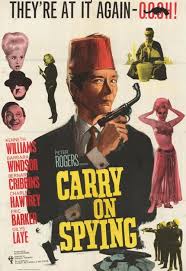
CARRY ON SPYING
UK, 1964, 87 minutes, Black-and-white.
Kenneth Williams, Barbara Windsor, Bernard Cribbins, Charles Hawtrey, Eric Barker, Dilys Laye, Jim Dale, Richard Wattis, Eric Pohlmann, Victor Maddern, Judith Furse, John Bluthal.
Directed by Gerald Thomas.
With James Bond film, Dr No, 1962, followed by From Russia With Love, it was probably inevitable that the Carry on series would move into the world of espionage and British agents. And so it was.
This episode was released at the same time as Carry on Cleo. The series had moved colour but this episode returns to black-and-white. And key members of the team are absent, Sid James, Joan Sims, Hattie Jacques, Kenneth Connnor. But, Bernard Cribbins had been the Kenneth Connor type character in Carry on Jack and does the same here. But, this was the first Carry on film for Barbara Windsor and she certainly makes a big impression, sense of comedy and fun, but also showing that the female characters, while definitely for the male gaze, have character and could contribute to the more serious aspects of the plot.
Not that there are very many more serious aspects. This is very basic Carry on material, really just an espionage farce, with some of the usual jokes and more than innuendo. The screenplay was written by Talbot Rothwell, who was becoming the regular writer, but he collaborates with Sid Colin, writer of many comedies with the Chastity Belt and Up The Front comedies to come.
OF course, it is all a parody of British espionage, four dimwitted agents, Eric Barker as the version of M, Richard Wattis as a kind of Q. And there are various villains, especially led by Eric Pohlman, the in the number of British films at the time.
The impact depends on the presence of Kenneth Williams, not quite his usual role, in fact, giving up his posh accent for a rather flat one. But, a lot of the same shtick in the world of agents. Bernard Cribbins is genial but rather dumb. Charles Hawtrey is as always. And, Jim Dale is very enjoyable in a whole range of disguises as their contact. Dilys Laye sings songs and is ambiguous in her loyalties. Judith Furse is a variation on Blofeld. And, instead of SPECTRE, there is STENCH, Society for the Total Extinction of Non-Conforming Humans.
In and Algiers, an impossible number of extensive changes of costume and disguises. Some laughs, some nods to Bond and, explicitly with the zither music, The Third Man’s scene of Orson Welles emerging from the sewers. But, very basic British comedy.
Dentist on the Job
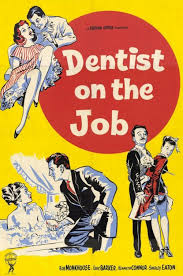
DENTIST ON THE JOB
UK, 1961, 88 minutes, Black-and-white.
Bob Monkhouse, Kenneth Connor, Shirley Eaton, Eric Barker, Richard Wattis, Ronnie Stevens, Reginald Beckwith, Graham Stark, Charles Hawtrey.
Directed by C.M. Pennington-Richards.
A star vehicle for Bob Monkhouse, popular film and television star. Good-looking, presentable, but playing characters who seem rather smugly satisfied with themselves.
This is a sequel to Dentist in the Chair. It was released in 1961, the years when the Carry on series was emerging. And, quite a number of Carry on stars appear, especially Kenneth Connor, in the central role, along with a cameo by Charles Hawtrey, and key roles by Eric Barker and Shirley Eaton. The other main character is played by Ronnie Stevens.
The film could have been called Carry on Dentist, Carry on Advertising, or, even, Carry on Toothpaste!
The film is about a campaign for a new toothpaste which is not doing very well, Richard Wattid the very prim executive, Reginald Beckwith one of the sales representatives. Because a dentist, qualified, will be taken off the register for promoting a product, Monkhouse and Stevens are tricked into signing up to promote this toothpaste. So, all the usual shenanigans, quite some ogling, lots of sexual innuendo.
However, Kenneth Connor, is an ex-convict has plenty of opportunities to do his impersonations, projects and, then American accent. Shirley Eaton obviously enjoys this kind of role. And, Eric Barker, has two roles, two cousins.
Lots of knockabout comedy, parody of filming commercials, and a completely impossible situation whereby the doctors prepare take to a recorded message substituted for one going into space which will advertise the toothpaste all over the universe! There is some comment on security but, a more security-conscious public will think that these episodes, because not to be taken too seriously, are absolutely impossible.
Along with the Carry on series and other small comedies, this was British comedy on screen in the early 1960s.
Carry on Sergeant
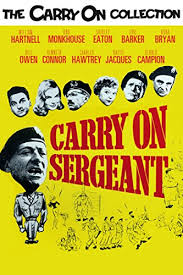
CARRY ON SERGEANT
UK, 1958, 84 minutes, Black-and-white.
William Hartnell, Shirley Eaton, Bob Monkhouse, Eric Barker, Dora Bryan, Bill Owen, Charles Hawtrey, Kenneth Connor, Kenneth Williams, Terrence Longden, Norman Rossington, Hattie Jacques, Terry Scott, Ed Devereaux.
Directed by Gerald Thomas.
The first of the Carry on films which were to continue into the 60s and 70s, all of them directed by Gerald Thomas. This film was typical enough of the comedy of the 1950s, a focus on the military, a group of national service for 10 weeks training, a motley and comical group, as well as a focus on the sergeant who wants to win an award for the best company, his corporal assistant and the commanding officer. Very much focus on the male characters.
However, Shirley Eaton, some years before Goldfinger, is the just married wife of one of the recruits, Bob Monkhouse, and Dora Bryan does her usual comic thing as a rather flighty cook.
In many ways, this is a straightforward British comedy, a basis for the future Carry on films, but very different from the jokey, sometimes a leering style of the subsequent films. (Comparison can be made with Operation Bullshine of 1959, the army, much more in the vein of the later Carry on films.)
Which means that this film is enjoyable for audiences of British comedy of the 1950s.
Interestingly, in view of the later Carry on films, the first list of cast seen in the opening credits highlights stars who were not regulars in most of the Carry on films (William Hartnell as the sergeant having top billing, Eric Barker, in some of the films, as the commander and the later top-rated billing of Bob Monkhouse). Then, the next list has the regulars who are there right from the beginning, Kenneth Connor, Kenneth Williams, Charles Hawtrey, then Hattie Jacques and even a glimpse at the beginning of Terry Scott, conversing with Ed Devereaux.
Kenneth Connor is an extreme hypochondriac, Hattie Jacques the doctor, Charles Hawtrey as usual, but enjoyable to see Kenneth Williams as an intellectual soldier, helping others, but his usual speaking style.
No Sid James until the third Carry on film. No Joan Sims, but she appeared in the next one.
For fans of the Carry on series, instructive and perhaps surprisingly enjoyable, especially with its reticence, reminding us how the series began.
Watch Your Stern
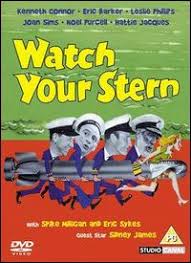
WATCH YOUR STERN
UK, 1960, 90 minutes, Black-and-white.
Kenneth Connor, Eric Barker, Leslie Phillips, Joan Sims, Noel Purcell, Hattie Jacques, Spike Milligan, Eric Sykes, Sid James, David Lodge, Victor Maddern, Ed Devereux.
Directed by Gerald Thomas.
Very much a comedy from the British past, especially around 1960. The late 50s saw the beginning of the Carry On franchise, 17 movies and television program as well as documentaries. And, there is the big cast of British comedy actors who continually appeared in the Carry On series.
And the Carry on films were directed by Gerald Thomas. And, he is the director of Watch Your Stern. And several of the Carry On stars appear here, the film as a star vehicle for regular Kenneth Connor, some prominence for Joan Sims, bumptious comedy role again for Hattie Jacques, and a rather more serious cameo for Sid James including having a beard. And one of the pleasures is to see Eric Sykes and Spike Milligan in cameo roles as electricians, Spike Milligan doing an Indian accent – and very popular with The Goon Show during these years. Australian Ed Devereux, working in British films at this time appears as an American!
The film starts momentarily seriously, the launching of an experimental torpedo by the Navy – but, then its getting out of control and boomeranging back to destroy the ship!
The action takes place more or less over the next 24 hours, and a poking fun at some of the Navy personnel and their limitations. (At the same time, the comedy On the Fiddle, with Alfred Lynch and Sean Connery, set during the war, pokes fun at a lot of the ineptitudes in connection with the RAF.)
Eric Barker maintains his seriousness as the less than efficient captain of the ship, relying on his second in command, Leslie Phillips in a typical role. And, on board, is one of the ratings who has a great knowledge of electronics and its vocabulary, Blissworth, Kenneth Connor’s character.
Blissworth seems to be in and out of the captain’s office all the time, but with many mishaps, especially the burning of the main copy of the plans for the torpedo. The only other copy is with the American visitor – and Blissworth having to chase him on a bicycle, accidentally knocking over the Admiral, not allowed to enter the train because of security reasons…
The main part of the film is having Blissworth do two impersonations of an expert being interviewed by the Admiral. The first is as a Scottish scientist, with a beard, care of some of the facial hair taken from Sid James’ character. And, fortunately, the Captain’s sister, played nicely by Joan Sims, is preparing the Navy concert and is able to do make up and costuming.
Noel Purcell is the blustering Admiral, suspicious of the Scottish expert (who looks like the later Scots actor, Brian Cox). Lots of comedy in his explanations. But, then it appears that the expert they were expecting is actually woman, Hattie Jacques. Which means that Blissworth has to be made up as a woman, the admiral very flirtatious.
So, how could it possibly end? In fact with Blissworth making a comment about the technology and the expert appreciating his advice, their working together, and a finale with the torpedo being fired again… and.
This is more straightforward comedy, especially compared with the satire and innuendo of the Carry On series – and, while this series was popular, this kind of comedy had a wider appeal.
