Displaying items by tag: Laurence Harvey
I Believe in You
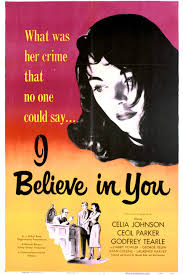
I BELIEVE IN YOU
UK, 1952, 95 minutes, Black-and-white.
Cecil Parker, Celia Johnson, Harry Fowler, Joan Collins, George Relph, Godfrey Tearle, Ernest Jay, Laurence Harvey, Ursula Howells, Sidney James, Katie Johnson, Ada Reeve, Brenda de Banzie, Gladys Henson.
Directed by Michael Relph, Basil Dearden.
This is a serious British film of the early 1950s, the team of Michael Relph and Basil Dearden, making a number of serious films together, then Basil Dearden directing on his own with such significant films as Victim and Khartoum.
Cecil Parker had established himself as a serious character actor and leads the cast here, a retiree, wanting to do something better with his life, becoming a parole officer, having to adapt his manner and even his clothing to the ordinary types that he encountered, yet able to get the trust of several, guide them, supervise, be challenged, make mistakes. He provides a voice-over for the action.
There is a very strong supporting cast led by Celia Johnson, best known for her Oscar-nominated performance in David Lean’s version of Noel Coward’s Blithe Spirit. There is a young Laurence Harvey as a surly criminal. And Joan Collins in her fourth film, making an impression – and, within two or three years, starring in Hollywood films. There is Sidney James working in an office, Katie Johnson, the famous old lady from the Ladykillers, an early role for Brenda de Banzie.
Not necessarily a film that contemporary audiences want to watch, but a worthy film and a reminder of past issues in British society.
- A serious piece of British filmmaking in the 1950s? Ordinary people, ordinary life, crime, the courts, parole officers?
- The perspective on Britain in the early 1950s, post-war, ordinary life, families, crime, courts, prisons? The role of the parole officer, supervision, counselling and help?
- Black-and-white photography, streets, homes, offices, courts, authentic feel? The musical score?
- Mr Phipps, the voice-over, Cecil Parker and his screen presence, his career, retirement, wanting to do something better, becoming a parole officer, the encounters with the other members of the staff, the friendship with Matty, the sympathy, challenging him? His quiet life at home? At the office, the interactions with the police? The range of clients, in the court, giving evidence, commissioned to check on those accused, issues of accommodation, investigating family backgrounds, the details of his interactions and friendship with Charlie, with Norma, with the old lady and the paintings from her past, the old lady and the dog being poisoned, the mother of the boy with limited intelligence…? Friendly, criticised? The confrontation with the magistrate? Reaching out to Charlie, encouraging him, the accommodation, Charlie and the crime, his intervening, the bashing, in court? Decision to retire? Talking to Matty? Staying, the magistrate bending a little under Mr Phipps’ influence?
- Matty, war widow, her work, personality, with those accused of crime, interactions with Norma, discipline, the alcoholic? The pregnant woman? Interactions with Mr Phipps, blunt, apologetic, going home for the drink? Encouraging him?
- The elderly parole officer, his health, his clients, collapse, continuing his work, encouraging Mr Phipps and handing over his clients?
- The local staff, the police, those at the desk, the busyness of the work in the office?
- Charlie, his age, crime, difficulties with his parents, accommodation, with Mr Phipps, the gradual bonding, the issue of not living in a hostel, the relationship with Norma, her background, flirtatious, the past with Jordie, imprisonment, getting out, the plans with Charlie, the pressure from Jordie, her plea to Charlie, his reaction? But the happy ending, supported by Mr Phipps?
- The elderly ladies, the lady who had posed for the paintings? The old lady and the neighbouring poisoners? The mothers? The severe fathers?
- Jordie, sullen, prison, his gang, the robbery, caught?
- Comparisons between past parole officers and later parole officers, supervision, prisons, in a world of supervision and technology?
Cairo Road
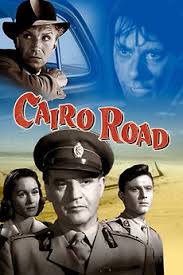
CAIRO ROAD
UK, 1950, 95 minutes, Black and white.
Eric Portman, Laurence Harvey Harold Lang, Gregoire Aslan, Karl Stepanek, John Gregson, Marne Maitland, Abraham Sofaer.
Directed by David McDonald.
With the British film industry building itself after World War II, a number of action features were filmed on location. They drew on the talented cast of British supporting players, veterans like Eric Portman and emerging stars, as here, Laurence Harvey and John Gregson.
Filming was done in Egypt. However, the very British leads were meant to be Egyptian police authorities (with British accents). Eric Portman could always show that he was in command of the situation, serious-minded, clear diction, often relentless. Laurence Harvey, in an early film, played the earnest subordinate, eager to please, continually making mistakes.
The central theme is drug running, interesting from a later point of view to see drugs and dealers in the earlier part of the 20th century.
There is a murder of businessman, police investigations, the raid on a ship, various chases, two guilty brothers, turning on each other, more murders and then the solution.
- Title and the focus of Egypt’s, Egypt 1950, location photography and atmosphere, black-and-white photography? The musical score?
- The drug situation, the role of the police, personalities, methods, local, international connections? The range of drug dealers, their backgrounds, local, international?
- Eric Portman as the commander, age, experience, manner, his attitude towards his assistant, the other members of staff, expectations? In action, shrewd, follow through, investigations?
- Laurence Harvey as the newcomer, married, from Paris, eager to please, his theories, putting them into action, his mistakes, the stealing of the vehicle, often with success?
- The range of local characters, businessmen, the murders, the brothers, one in prison, the ship, the captain of the ship, the surveillance by the Coast Guard and personnel?
- The details of the transport of the drugs, by ship, by road, camels…?
- Struggles within the group, controls, betrayals, murders, mistakes? And the final solution?
