Displaying items by tag: Kenneth More
We Joined the Navy
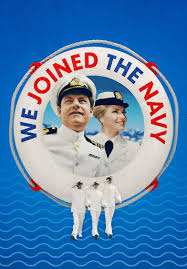
WE JOINED THE NAVY
UK, 1962, 104 minutes, Colour.
Kenneth More, Lloyd Nolan, Joan O’Brien, Jeremy Lloyd, Dinsdale Landon, Derek Fowlds, Mischa Auer, John Le Mesurier, Lally Bowers, Laurence Naismith, Andrew Cruickshank, Walter Fitzgerald, Ronald Leigh-Hunt, Esma Cannon, Kenneth Griffith, Warren Mitchell, Graham Crowden, Cameos: Michael Bentine, Rodney Bewes, Dirk Bogarde, Sid James.
Directed by Wendy Toye.
British comedy at the beginning of the 1960s, broadening of humour, the period of the beginning of the Carry on series… And, glancing at the cast list, quite a number of names of popular British actors of the time and those who were emerging (and a couple of celebrity cameos, particularly Dirk Bogarde as Dr Simon Sparrow, his character in the Doctor series, where he played with Kenneth More). Sid James does a chuckling variation on his Carry on characters. Notable supporting performances from Kenneth Griffith and, especially, Warren Mitchell. And for fans of veteran actress, Esma Cannon, this is one that definitely should be seen, decked out in official royalty costume and with an accent!
There are several Americans in the cast because of the screenplay, notably Lloyd Nolan, first appearing in American films in the mid-1930s, a 50 years career, his last film Woody Allen’s Hannah and her Sisters.
Much of the screenplay now seems very corny. And there is a great deal of farce. There are interview sequences for inept candidates for the Navy. There are plenty of training sequences. But, with Kenneth More as the central character, always speaking out and being transferred to other jobs, put in command of three potential officers, Jeremy Lloyd (actor but later writer of such television series as Are You Being Served and ‘Ullo ‘Ullo), Dinsdale Landon and Derek Fowlds who came to prominence as the meek public servant in Yes, Minister and Yes, Prime Minister.
There are sequences in the Riviera, clashes between the Brits and the Yanks, more farce about romance for Kenneth More.
Finally, an intervention in an African revolution, Kenneth Griffiths, often so meek on screen, as a yelling and ranting revolutionary, veteran Mischa Auer as two characters leading the country, extremely eccentric.
This comedy has, some humour, but a great deal of silliness as well.
Some People
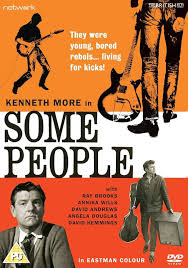
SOME PEOPLE
UK, 1962, 93 minutes, Colour.
Kenneth More, Ray Brooks, Annika Wills, David Andrews, Angela Douglas, David Hemmings, Harry H.Corbett, Cyril Luckham.
Directed by Clive Donner.
Some People is very much a film of its era, rather difficult to watch in later decades. However, it highlights some of the social changes in the UK in the early 1960s, the emergence of Teddy Boys, leading into the era of the Rockers.
The film was well received at the time, highlighting the social issues, especially amongst teenagers and young adults, as well as the possibilities for some kind of help or rehabilitation. It is the era of the Duke of Edinburgh awards for help with young people.
Quite a lot of the film shows four friends, Teddy boy types, riding their motorbikes, going through red lights, in the courts, told off by the magistrates, resentful, causing mischief. The leader is played by Ray Brooks, his later career was very much in television series, with David Andrews as the very surly and imposing type, Andrews acting for a while but then moving into film and television direction. Not so much in the limelight here, but the third member of the group is played by David Hemmings, Blow up soon to come and his much stronger career as actor and director.
The star of the film is Kenneth More, veteran, very popular in the 1950s with comedies like Genevieve and Doctor in the House as well as war films like Reach for the Sky.
He encounters the group as they move into a church, having been moved along by various authorities, and one of them talented pianist, playing. They encounter Kenneth More as the leader of the choir, much more tolerant of the youngsters, especially with his daughter and becomes involved with them, offering them opportunity for the church to be a place after choir practice for their music, developing a group, the talent in playing, the local girls talented with singing – and a number of songs with music by the very popular composer of British films of the time, Ron Grainer. Again, the songs are very much of the period of the early 1960s.
There is some background of the work in industry and aviation which Kenneth More is involved in – and some possibilities for the youngsters to get some jobs.
So, a journey back to the 1960s, the move away from polite and controlled stories in film (and in real life), the film not knowing what the rest of the 60s and changes would be like.
