Displaying items by tag: Irene Handl
Carry on Constable
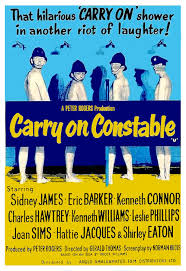
CARRY ON CONSTABLE
UK, 1960, 86 minutes, Black and white.
Sid James, Kenneth Williams, Eric Barker, Kenneth Connor, Charles Hawtrey, Leslie Phillips, Joan Sims, Hattie Jacques, Shirley Eaton, Cyril Chamberlain, Joan Hickson, Irene Handl, Esma Cannon, Terence Longden, Jill Adams, Victor Maddern.
Directed by Gerald Thomas.
One of the earliest of the Carry on series, two years after it began, the atmosphere of British filmmaking in 1960, popular comedy, the transition to the more permissive 1960s. In the retrospect of the later films, Carry on Constable seems comparatively innocent certainly some sexual references, some shower and bathroom scenes, some ogling by the male stars but, in comparison with later films, rather more of the light touch.
In fact, the film was written by the writer of the earlier Carry on films, Norman Hudis. Then there was a transition to Talbot Rothwell who scripted most of the Carry on films, more explicit with sexual themes, a great deal of innuendo.
This was the first Carry on film with Sid James, rather more straightforward role, sometimes sympathetic, but he was to develop into the chuckling lecherer during the 60s and 70s. But, it is pleasing to see so many of the regulars in this film, the two Kenneths and Charles Hawtrey, much more explicitly gay in this film than later, especially with the cross dressing of Kenneth Williams and Hawtrey, Hawtrey even passing passably for female.
Joan Sims and Hattie Jacques are happily present and there are a whole number of guest female stars, young like Shirley Eaton, three years before Goldfinger, and Jill Adams, and veterans like Esme Canon as a deaf old lady trying to cross the road, Irene Handl erupting about a misbehaving boy, and, especially, two scenes with Joan Hickson as an aristocratic alcoholic showing her as an excellent comedienne as well as dramatic actress, later Miss Marple.
Eric Barker, doing his usual shtick as a befuddled authority, is in charge of the police station and employing four new recruits, the two Kenneths, Charles Hawtrey and, appearing in several of the Carry on films, Leslie Phillips.
A whole lot of farcical situations in the office and a succession of muddled police activity with special sequences for each of the four, their own kind of comedy which was to develop during the success of films.
Popular and easy humour, easy to watch.
Carry on Nurse
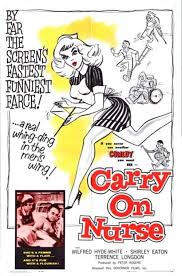
CARRY ON NURSE
UK, 1959, 86 minutes, Black-and-white.
Kenneth Connor, Kenneth Williams, Charles Hawtrey, Hattie Jacques, Joan Sims, Wilfrid Hyde White, Shirley Eaton, Terrence Longden, Bill Owen, Leslie Phillips, Susan Stephen, Susan Beaumont, Ann Firbank, Joan Hickson, Michael Medwin, Rosalind Knight, Norman Rossington, Jill Ireland, June Whitfield, Ed Devereaux, Susan Shaw, Irene Handl.
Directed by Gerald Thomas.
In retrospect, very much a film of its time, British comedy in the late 1950s, beginning the transition to explicit comedy, still a lot of innuendo but also a great number of ogling male characters.
This is the second of the Carry on series, beginning with Carry on Sergeant. Sid James, a staple of so many of the later films, had not yet joined the cast. However, a great number of the continuing cast appear here, most of the men spending their time as patients in the hospital ward. The women are nurses or visiting their husbands and boyfriends.
Hattie Jacques begins her several appearances as matron, Joan Hickson as a rather strict numbers (anticipating Miss Marple), Shirley Eaton, five years before Goldfinger, leads the nursing staff, and Joan Sims, the most regular of Carry on characters appears for the first time. There are some guest appearances by Wilfrid Hyde White and Michael Medwin. And there are some amusing cameos by various British character actors including Bill Owen, a myopic Rosalind Knight, Irene Handl and an early appearance by Jill Ireland.
While Kenneth Williams is more subdued, less facial idiosyncrasies, he plays the superior patient, interested in studying, until, at the end, the men in the ward, with drink and laughing gas, trying to remove a bunion on Leslie Phillips‘ foot, Kenneth Williams in charge of surgery. Kenneth Connor, always plays quite a different role in each film and here he is a boxer.
A lot of the verbal humour, a lot of expected hospitals shenanigans in the ward, innuendo, the 1950s British male gaze – and seeming very much more slight and innocent the later developments in the Carry on series.
- Carry on Nurse movie
- Gerald Thomas
- Joan Sims
- Hattie Jacques
- Kenneth Williams
- Kenneth Connor
- Charles Hawtrey
- Leslie Phillips
- Norman Rossington
- Wilfrid HydeWhite
- Peter Malone's Movie Reviews
- Susan Stephen
- Jill Ireland
- Rosalind Knight
- Irene Handl
- Shirley Eaton
- Bill Owen
- Ed Devereaux
- Susan Shaw
- Joan Hickson
- Michael Medwin
Rebel, The
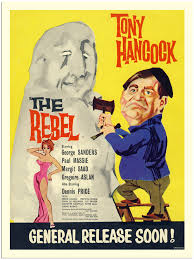
THE REBEL
UK, 1961, 105 minutes, Colour.
Tony Hancock, George Sanders, Paul Massie, Margit Saad, Gregoire Aslan, Dennis Price, Irene Handl, John Le Mesurier, Liz Fraser, Mervyn Johns, Peter Bull, Nanette Newman, Oliver Reed.
Directed by Robert Day.
British comedian Tony Hancock was extremely popular on radio and television, especially during the 1950s. This was his main feature film – appearing in small roles in a few films during the 1960s. Certainly, alcohol and drug problems, depression, he committed suicide in Sydney in 1968 at the age of 44. However, he is still considered highly in the history of British comedy.
The screenplay was written by the team of Ray Eagleton and Simpson, writers for his radio programs as well as television. And he keeps his own name as his character, I don’t identify with the ups and downs of his experience, the target of satire while creating satiric comment 1960s society – and especially art pretensions (many French existentialist style).
The film begins amusingly with Hancock on a railway station, she did to get a seat on the crowded train with all the men in balls and suits, and newspapers, uniformly going to work and routines office. Comedy with the boss, John the measure. At home, Hancock has a huge sculptor, complains his landlady, I really handle, then his decision to free and go to Paris as an artist.
He listens into a group of artists, especially Paul Massie (and a glimpse of Oliver Reed) in a cafe, is invited to share an apartment, and begins his art. In the meantime, Paul Massie, not confidence in himself, has produced quite a number of paintings. There are a whole lot of Sion meetings, pretentious looking artists (especially a cameo by Dennis Price) and women, looking the same, black hair, white asked. And, they listen to Hancock who has the gift of the gap and who is feted, especially taken up by an aristocratic agent, a typical George Sanders role, who mistakes Paul Massie’s paintings for those of Hancock who does try to intervene but then goes and lives the celebrated life.
So, a lot of situation comedy, especially on the yacht millionaire and his glamorous wife who pursues Hancock.
Ultimately, Hancock sets at the moment of truth, and admitting that the poor work was his own but the good work was that of the artist. Goes back to the landlady and resumes his sculpture.
An example of British comedy in the 1960s, the work of Tony Hancock, still amusing in its satire and his impersonations and gift of the gap, but still rather dated.
