Displaying items by tag: Joan Collins
Alfie Darling
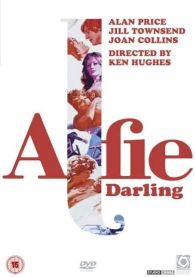
ALFIE DARLING
Kay, 1975, 102 days, Colour.
Alan Price, Jill Townsend, Paul Copley, Joan Collins, Annie Ross.
Directed by Ken Hughes.
Michael Caine made a big impression in 1966 in his role as Alfie. (Remade in 2004 starring Jude law.) This sequel in the middle of the 1970s style was not successful. It was written by Bill Naughton, writer of the original story (and Spring and Port Wine, The Family Way). Adaptation for the screen is by the director, Ken Hughes (Chitty Chitty Bang Bang, Cromwell).
Alfie is a truck driver, working with his partner, played by Paul Copley. A lot of the film shows trucks driving round France and the UK, and a lot of car driving as well. He is the self-confident young man, with a girl in every port. That seems to be is only aim in life.
He encounters a woman who takes his fancy, who drives faster than he, turns out to be a magazine executive. He continues to pursue her, beginning a relationship with her, eventually proposing and her being taken aback, his pride being hurt. She gives some thought to the matter and eventually agrees – and the film opts out with an unsatisfactory ending, her dying in crash.
While the film presents the picture of the promiscuous young man, his cavalier attitude towards women with a touch of the misogynists, seeing them as some kind of an immediately conquered, there is also a lot of dialogue, especially on the part of the women, criticising his attitudes, suggesting that sex does not equal love… It is interesting to note these parts of the dialogue in terms of feminism and women’s movements at the time.
Musician-composer, Alan Price (O Lucky Man) offers a straightforward performance, not particularly nuanced in terms of the challenges made by the women in his life. He has a relationship with an older married woman played by Joan Collins.
There was a series in the UK in the 1970s, Confessions of… This film follows something of the pattern for a Confessions of a Truck Driver.
I Believe in You
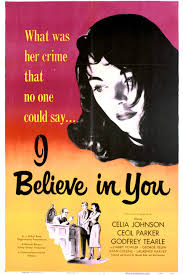
I BELIEVE IN YOU
UK, 1952, 95 minutes, Black-and-white.
Cecil Parker, Celia Johnson, Harry Fowler, Joan Collins, George Relph, Godfrey Tearle, Ernest Jay, Laurence Harvey, Ursula Howells, Sidney James, Katie Johnson, Ada Reeve, Brenda de Banzie, Gladys Henson.
Directed by Michael Relph, Basil Dearden.
This is a serious British film of the early 1950s, the team of Michael Relph and Basil Dearden, making a number of serious films together, then Basil Dearden directing on his own with such significant films as Victim and Khartoum.
Cecil Parker had established himself as a serious character actor and leads the cast here, a retiree, wanting to do something better with his life, becoming a parole officer, having to adapt his manner and even his clothing to the ordinary types that he encountered, yet able to get the trust of several, guide them, supervise, be challenged, make mistakes. He provides a voice-over for the action.
There is a very strong supporting cast led by Celia Johnson, best known for her Oscar-nominated performance in David Lean’s version of Noel Coward’s Blithe Spirit. There is a young Laurence Harvey as a surly criminal. And Joan Collins in her fourth film, making an impression – and, within two or three years, starring in Hollywood films. There is Sidney James working in an office, Katie Johnson, the famous old lady from the Ladykillers, an early role for Brenda de Banzie.
Not necessarily a film that contemporary audiences want to watch, but a worthy film and a reminder of past issues in British society.
- A serious piece of British filmmaking in the 1950s? Ordinary people, ordinary life, crime, the courts, parole officers?
- The perspective on Britain in the early 1950s, post-war, ordinary life, families, crime, courts, prisons? The role of the parole officer, supervision, counselling and help?
- Black-and-white photography, streets, homes, offices, courts, authentic feel? The musical score?
- Mr Phipps, the voice-over, Cecil Parker and his screen presence, his career, retirement, wanting to do something better, becoming a parole officer, the encounters with the other members of the staff, the friendship with Matty, the sympathy, challenging him? His quiet life at home? At the office, the interactions with the police? The range of clients, in the court, giving evidence, commissioned to check on those accused, issues of accommodation, investigating family backgrounds, the details of his interactions and friendship with Charlie, with Norma, with the old lady and the paintings from her past, the old lady and the dog being poisoned, the mother of the boy with limited intelligence…? Friendly, criticised? The confrontation with the magistrate? Reaching out to Charlie, encouraging him, the accommodation, Charlie and the crime, his intervening, the bashing, in court? Decision to retire? Talking to Matty? Staying, the magistrate bending a little under Mr Phipps’ influence?
- Matty, war widow, her work, personality, with those accused of crime, interactions with Norma, discipline, the alcoholic? The pregnant woman? Interactions with Mr Phipps, blunt, apologetic, going home for the drink? Encouraging him?
- The elderly parole officer, his health, his clients, collapse, continuing his work, encouraging Mr Phipps and handing over his clients?
- The local staff, the police, those at the desk, the busyness of the work in the office?
- Charlie, his age, crime, difficulties with his parents, accommodation, with Mr Phipps, the gradual bonding, the issue of not living in a hostel, the relationship with Norma, her background, flirtatious, the past with Jordie, imprisonment, getting out, the plans with Charlie, the pressure from Jordie, her plea to Charlie, his reaction? But the happy ending, supported by Mr Phipps?
- The elderly ladies, the lady who had posed for the paintings? The old lady and the neighbouring poisoners? The mothers? The severe fathers?
- Jordie, sullen, prison, his gang, the robbery, caught?
- Comparisons between past parole officers and later parole officers, supervision, prisons, in a world of supervision and technology?
This is Joan Collins
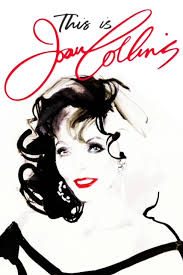
THIS IS JOAN COLLINS
UK, 2022, 96 minutes, Colour.
Directed by Clare Beavan.
This entertainingly comprehensive portrait of actress and celebrity, Joan Collins, was released in the year that she turned 89. She collaborated with the venture, appearing continually throughout the film, discussions about lighting and positions, reading a text, at the microphone, commenting, and some wry expressions and smiles about what she was viewing.
The film is informative on several levels. It provides an overall sketch of Joan Collins’ family, early upbringing and influences, training, moved to films, to Hollywood, marriages and divorces, relationships, ups and downs of her career, her children, American television, returning to the stage.
It also provides an overview of her career, her hopes and ambitions, training, the move to film in Britain, the invitation to Hollywood, the seven-year contract with 20th Century Fox, her early films like Land of the Pharaohs, Girl in the Red Velvet Swing, MGM, The Opposite Sex, lesser films, comment on actor she worked with, fairly derogatory on Richard Burton and Sea Wife, the diminishing of her film career, and the beginning of relationships with actors like Warren Beatty and break ups, and her regret for turning down the role in Sons and Lovers. There were her lean years, in television shows like The Virginian, horror films in England and The Empire of the Ants. And, then, dynasty and their identifying with Alexis Carrington, her popularity in the media, magazine covers and articles, television interviews. There was also her relationship with her sister, Jackie, in the background of filming The Stud and The Beach. And some details of her career, television and stage work in the 21st-century.
The film is very personal also on her relationships, her husband’s. With scenes from Maxwell reads films, there is the ugly story of date rape, her disillusionment, the marriage at 17, his wanting to prostitute her to an Arab millionaire, the divorce proceedings and his demand for alimony. There follows the marriage with Anthony newly, his growing celebrity at the time, that children, his deceiving her, the divorce, amicable. There is the marriage to the entrepreneur, Ray, a child, an affluent life and the discovery that it was built on deceptions, especially in finance. There is the surprise of the marriage to Peter home, the Swedish singer, his on-screen charm, and the realities of his persona in the real life of the marriage. Finally, there is a long time marriage to Clark Gibson, Collins finally setting and settling down.
The other aspect of interest in the film is in its portrait of Hollywood film making and the Hollywood culture from the 1950s to the 1990s, the glamour of the studios and contracts, the failing of the studios, the way prim celebrities were promoted and exploited, the emergence of television and its popularity. There is the life of the 50s, exploitations by producers like Darrell Zanuck, and Collins meeting with Marilyn Munro and her conversations, the covering up of relationships and harassment. Then there is a mood of the swinging 60s, the difficulties of the 1970s, the transition to television and television movies and exploitation films. Then, the 80s, the popular television series, the rivalry between Dallas and dynasty, the emergence of dynasty over nine years and its place in American consciousness, Joan Collins herself liking the 1980s and reminding audiences that it was the green decade, with reference to Gordon gecko and Wall Street.
There is quite an amount of material to be considered here, not necessarily in-depth exploration of some audiences might want, but an interesting and entertaining overview in just over 90 minutes.
