Displaying items by tag: Barbara Windsor
Carry on Henry
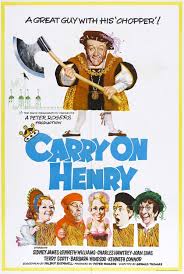
CARRY ON HENRY
UK, 1971, 89 minutes, Colour.
Sid James, Kenneth Williams, Charles Hawtrey, Joan Sims, Terry Scott, Barbara Windsor, Kenneth Connor, Julian Holloway, Peter Gilmore, William Mervyn, Bill Maynard.
Directed by Gerald Thomas.
Of all British Kings, Henry VIII would be the least to need the advice to Carry on! By 1971, Carry on films had a 13 year history, tapping a number of historical situations. Here is an invention that the king had two more wives than his six, chronicled by William Cobler, so a load of old cobblers as the introduction suggests, to the background of Greensleeves (and later Chanson D’Amour and variations on the Trumpet Voluntary).
Sid James continues as a chuckling lecherer as the king, with the same performance as always. Kenneth Williams performance is always the same, but he provides good comedy as Thomas Cromwell. Terry Scott hams it up as Cardinal Woolsey. And Kenneth Connor, shows that he can give quite a different performance in every film. And, many of the supporting cast are present again, especially Barbara Windsor as the possible Queen. But, dominating everything is Joan Sims as the princess from Normandy.
In fact, a lot of the central plot hinges on French love garlic, the Princess putting it into her mouth in the bedroom, the king repelled by garlic, and various Gallic/garlic jokes throughout the film.
A lot of shenanigans, quite some pageantry, Charles Hawtrey as the least likely gallant knight attending to the Queen.
With the subject of Henry VIII, the emphasis on sex is more prominent than usual, crude jokes, clever innuendo, and, of course, as with the king himself, the female members of the cast seen as sexual objects for male gaze and groping. How would they remake this film in the 21st-century!?
Carry on Spying
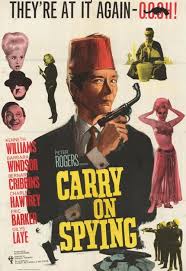
CARRY ON SPYING
UK, 1964, 87 minutes, Black-and-white.
Kenneth Williams, Barbara Windsor, Bernard Cribbins, Charles Hawtrey, Eric Barker, Dilys Laye, Jim Dale, Richard Wattis, Eric Pohlmann, Victor Maddern, Judith Furse, John Bluthal.
Directed by Gerald Thomas.
With James Bond film, Dr No, 1962, followed by From Russia With Love, it was probably inevitable that the Carry on series would move into the world of espionage and British agents. And so it was.
This episode was released at the same time as Carry on Cleo. The series had moved colour but this episode returns to black-and-white. And key members of the team are absent, Sid James, Joan Sims, Hattie Jacques, Kenneth Connnor. But, Bernard Cribbins had been the Kenneth Connor type character in Carry on Jack and does the same here. But, this was the first Carry on film for Barbara Windsor and she certainly makes a big impression, sense of comedy and fun, but also showing that the female characters, while definitely for the male gaze, have character and could contribute to the more serious aspects of the plot.
Not that there are very many more serious aspects. This is very basic Carry on material, really just an espionage farce, with some of the usual jokes and more than innuendo. The screenplay was written by Talbot Rothwell, who was becoming the regular writer, but he collaborates with Sid Colin, writer of many comedies with the Chastity Belt and Up The Front comedies to come.
OF course, it is all a parody of British espionage, four dimwitted agents, Eric Barker as the version of M, Richard Wattis as a kind of Q. And there are various villains, especially led by Eric Pohlman, the in the number of British films at the time.
The impact depends on the presence of Kenneth Williams, not quite his usual role, in fact, giving up his posh accent for a rather flat one. But, a lot of the same shtick in the world of agents. Bernard Cribbins is genial but rather dumb. Charles Hawtrey is as always. And, Jim Dale is very enjoyable in a whole range of disguises as their contact. Dilys Laye sings songs and is ambiguous in her loyalties. Judith Furse is a variation on Blofeld. And, instead of SPECTRE, there is STENCH, Society for the Total Extinction of Non-Conforming Humans.
In and Algiers, an impossible number of extensive changes of costume and disguises. Some laughs, some nods to Bond and, explicitly with the zither music, The Third Man’s scene of Orson Welles emerging from the sewers. But, very basic British comedy.
Carry on Matron
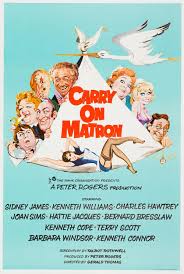
CARRY ON MATRON
UK, 1972, 88 minutes, Colour.
Hattie Jacques, Sidney James, Kenneth Williams, Kenneth Connor, Joan Sims, Bernard Bresslaw, Bill Maynard, Kenneth Cope, Barbara Windsor, Terry Scott, Charles Hawtrey, Patsy Rowlands.
Directed by Gerald Thomas.
Before this episode in the medical Carry on comedies, Nurse, Doctor, Doctor again. And, by this time, the Carry on films had been carrying on for 14 years. Most of the regular cast appear in this film.
There is a story of the hospital, Finisham, with wards named Bunn and Oven. And, there a place on the title at the opening, From Here to Maternity, Womb with a View…
Hattie Jacques, once again, is matron, sympathetic if dominating, but infatuated with the head of the hospital, Sir Bernard Cutting, once again Kenneth Williams doing his shtick, hypochondriac, fearing that he was having a sex change, pursued by the matron.
And there is something of a plot, Sid James leading a gang of crooks, including Bernard Briesslaw and Bill Maynard with Sid James’s son, Kenneth Cope, having to disguise himself as a trainee nurse, infiltrate the hospital and get the plans for where the contraceptive pills are stored so that the gang could steal them and sell them. So, lots of comedy with Cyril, the son, dressed as a nurse, sharing a room with Barbara Windsor, becoming a sensation in helping to deliver triplets in an ambulance! And, the intensity of the robbery, disguises, misadventures, and, ultimately, a gathering in some panic, everybody involved at the hospital.
Kenneth Connor, is able to create another character, a railway man waiting long hours for his pregnant wife to give birth, Joan Sims as the wife, seen continually eating hefty helpings and capitalising on the free meals. There is Terry Scott as a doctor with his eyes on the ladies. And Charles Hawtrey is able to do his shtick as a psychiatrist on the hospital staff, clashing with Kenneth Williams.
Lots of puns, lots of innuendo, some titillation, some slapstick, a typical Carry on comedy.
Carry on Camping
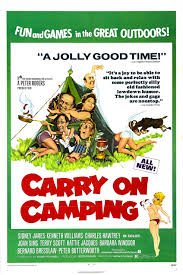
CARRY ON CAMPING
UK, 1969, 88 minutes, Colour.
Sid James, Kenneth Williams, Charles Hawtrey, Joan Sims, Terry Scott, Barbara Windsor, Hattie Jacques, Bernard Bresslaw, Julian Holloway, Dilys Laye, Peter Butterworth, Betty Marsden, Trisha Noble.
Directed by Gerald Thomas.
By this time, the Carry On series had been going for over a decade, with small black and white, it is to cover comedies and strong popularity, not only in the UK but overseas – but, not so much in the United States.
A great number of bloggers on the IMDb considered as one of the best of the Carry on series.
For this reviewer, it seemed one of the weakest. It is 1969, the film opens with an extensive coverage of a nudist film, something of a breakthrough for mainstream films in the late 1960s (not a feature of popular comedies from the US). It is take for granted that there will be sex jokes and references, innuendo, objects recycled, obvious is… And that is certainly the case here. However, this to be more of a leering turn their in many of the other films, Sid James being particularly ogling and leering here.
One of the advantages of the film is that so many of the regular cast are present. A very sympathetic presences, especially Joan Sims and Bernard Breslau (always putting his foot in it as since good friend). And, there is the young Barbara Windsor – exactly and inhibited presence on screen. Hattie Jacques is serious, even in a comedy and Kenneth Williams is always himself. Many might find Charles Hawtrey very irritating this time round and there are troubles between Terry Scott Betty Marston as his non-listening falling wife.
It would be interesting to see a feminist review of Carry on Camping and its presentation of the objectification of women, especially young women, this comedy presentation of the male gaze with Sid James’s line: what are the young women always there where I’m staring!
And, with the ending the people gathering for music Festival, remembering that 1969 was the year of Woodstock – although the oldies and regulars from the Carry on films are against the festival and oust everyone.
