Displaying items by tag: Peter Malone's Movie Reviews
Night of the Zoopocalypse
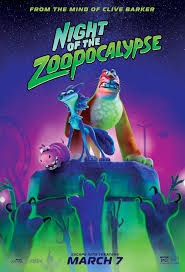
NIGHT OF THE ZOOPOCALYPSE
Belgium/Canada/France, 2024, 91 minutes, Colour.
Voices of: Gabby Kosmidis, David Harbour, Pierre Simpson, Paul Sun-Hyung Lee, Scott Thompson.
Directed by Ricardo Curtis, Roderigo Pérez-Castro.
There have been some entertaining animated horror films like The Corpse Bride. This very colourful film is something of a variation on a zombie Apocalypse theme (and one title considered was Night of the Zoombies). The present title, of course, is a nod in the direction of Zootopia.
The film opens with a suspenseful ghase, a young wolf, Gracie, being pursued by young wolves, egged on by their grandma. But, it emerges that this is a game and that the setting is a zoo. And some visuals showing the range of the animals in the zoo as well as the families enjoying the visit, reluctant to leave when time is up.
In the sky, two spacecraft collide, a piece of space debris, electrified, hurtles to earth, landing in the zoo – and a curious little bunny touches and is transformed into a zombie-like creature. Mayhem in the zoo, huge transformations, monstrous characters to frighten the young audience (and perhaps some of the older).
But, Gracie is a survivor and encounters a mountain lion in the zoo, Dan. The film follows their adventures, escapades for survival, smoke and danger, the key to the gate to escape. In the meantime, there is a motley group of survivors taking refuge in one of the zoo’s rooms. They provide chatter, humour, and become very much involved in the adventure and the fight for survival.
One of the creatures in the room is Xavier, Hispanic accented English, giving a humorous running commentary on how horror films develop, the genre, the conventions, expectations, dialogue, all of which is acted out – or, sometimes, contradicted. This provides some humour for adult audiences and horror aficionados.
The solution seems to be soap and water to turn the creatures back to normal, especially when Dan is transformed. However, the big plan to flood the pool with water and soap creates only larger monsters. And, spoiler, the antidote in fact is music!
And, happy ending, cranky grandma who has always expected the worst becoming more mellow and everyone else returns to normal!
Big Job, The
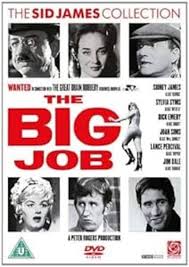
THE BIG JOB
UK, 1965, 89 minutes, Colour.
Sid James, Sylvia Syms, Dick Emery, Joan Sims, Lance Perceval, Jim Dale, Deryck Guyler, Reginald Beckwith,
Directed by Gerald Thomas.
It looks as though that in the middle of making all the Carry On films, Gerald Thomas and many of his stars decided to have something of a break, restrain, somewhat more respectable, British comedy. And this was the mid-1960s.
One might say that this Big Job is a series of robbery muddles, all kinds of tangles. It is 1950. Sid James is the leader of a motley group, Lance Perceval as the member of the group who is not the sharpest, Sylvia Sims offering the touch of glamour and romance, and, particularly effective, Dick Emery before his television show.
All of these muddles this are presented in a farcical style, especially the initial robbery, everything going wrong that could, then a whole lot of opportunities for success, and escape, travelling in a hearse, mourning cars following, but eventually cornered by the police and throwing a bag of the loot into a hollow tree.
Then, prison, 15 years, out they come to retrieve the money, teaming up with Sylvia Sims again who has her eye on marriage. However, Sid James can say all the words but one might say he is completely asexual, no romance, nothing erotic… Just complete dedication to get the money back.
As they work out where they were arrested and go back, all kinds of complications and funny situations, a housing settlement being built up rather than the open countryside, the tree now within the precincts of the local police station, the hiring rooms opposite with an overview of the tree and the station, even stealing a telescope to keep watch. There is also some romance with the lady of the house where they rent, a widow, but casting her eye on Dick Emery. And, the guest living there is one of the local young policeman, Jim Dale.
So, a whole lot of shenanigans, mostly impossible, especially the digging of a huge tunnel from under the house, under the Street, the police station.
And, when they do get the bag back – a surprise for them as well as for the audience! And the double life of the landlady!
A film to gauge the popular response of the wide audience to this kind of British comedy in the 1960s.
On the Fiddle
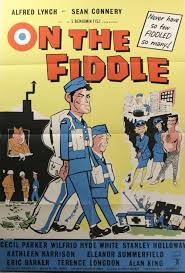
ON THE FIDDLE
UK, 1961, 89 minutes, Black-and-white.
Alfred Lynch, Sean Connery, Victor Madden, Eric Barker, Cecil Parker, Wilfrid Hyde White, John Le Mesurier, Graham Stark, Patsy Rowlands, Eleanor Summerfield, Miriam Karlin, Bill Owen, Barbara Windsor, Beatrix Lehmann.
Directed by Cyril Frankel.
The title indicates the activities of something of a rogue. And that is certainly the case here with the character and performance by comedian Alfred Lynch.
This film has a war setting, looking something like those war films from the 1940s and 1950s – but then veering into comedy, touches of parody and satire, very much the type of English comedy for the broad audience at the end of the 1950s, the early 1960s – especially remembering that this was the period of the emerging of the Carry On series.
The first part of the film shows Lynch as Horace, hanging around with all kinds of scams, and using all kind of patter to insinuate himself into the various situations – but, arrested, pretending that he was lining up for enlisting, means that his patter has landed him in the RAF.
Most of the film is a series of cons, with the supremely confident Horace, able to take charge of all kinds of situations. But, he immediately makes a friend, Peddlar, played by comparative newcomer, Sean Connery, a year before he was to be James Bond in Dr No. Peddlar is not the brightest, admires Horace, plays along with all kinds of situations, but does question Horace’s moral stances.
There is a lot of sending up of RAF officers, especially allowing themselves to be tripped so often. And, there is an interesting episode with a butcher, the meat for the RAF, attach a romantic interlude, the butcher and his wife played by Stanley Holloway and Kathleen Harrison, comedy veterans, an appearance by Wilfrid Hyde White is a quietly muttering innkeeper. And the young Barbara Windsor turns up at the end of the film.
And, while Cecil Parker has top billing, he does not appear as the flustered commander until almost the end of the film.
The Royal Navy provided cooperation, allowing the producers to film in Chatham Dockyard, and aboard HMS Jaguar and HMS Chaplet.
Perhaps this war film was a little dated by 1960 and its perspective on remembering World War II. Which means then that the targets of satire are not fresh in the cinema audience’s mind in the 21st-century but, allowing for these aspects, it is a chance to see several British comedians in action – and, course, the young Sean Connery.
Watch Your Stern
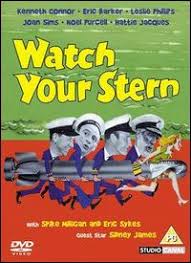
WATCH YOUR STERN
UK, 1960, 90 minutes, Black-and-white.
Kenneth Connor, Eric Barker, Leslie Phillips, Joan Sims, Noel Purcell, Hattie Jacques, Spike Milligan, Eric Sykes, Sid James, David Lodge, Victor Maddern, Ed Devereux.
Directed by Gerald Thomas.
Very much a comedy from the British past, especially around 1960. The late 50s saw the beginning of the Carry On franchise, 17 movies and television program as well as documentaries. And, there is the big cast of British comedy actors who continually appeared in the Carry On series.
And the Carry on films were directed by Gerald Thomas. And, he is the director of Watch Your Stern. And several of the Carry On stars appear here, the film as a star vehicle for regular Kenneth Connor, some prominence for Joan Sims, bumptious comedy role again for Hattie Jacques, and a rather more serious cameo for Sid James including having a beard. And one of the pleasures is to see Eric Sykes and Spike Milligan in cameo roles as electricians, Spike Milligan doing an Indian accent – and very popular with The Goon Show during these years. Australian Ed Devereux, working in British films at this time appears as an American!
The film starts momentarily seriously, the launching of an experimental torpedo by the Navy – but, then its getting out of control and boomeranging back to destroy the ship!
The action takes place more or less over the next 24 hours, and a poking fun at some of the Navy personnel and their limitations. (At the same time, the comedy On the Fiddle, with Alfred Lynch and Sean Connery, set during the war, pokes fun at a lot of the ineptitudes in connection with the RAF.)
Eric Barker maintains his seriousness as the less than efficient captain of the ship, relying on his second in command, Leslie Phillips in a typical role. And, on board, is one of the ratings who has a great knowledge of electronics and its vocabulary, Blissworth, Kenneth Connor’s character.
Blissworth seems to be in and out of the captain’s office all the time, but with many mishaps, especially the burning of the main copy of the plans for the torpedo. The only other copy is with the American visitor – and Blissworth having to chase him on a bicycle, accidentally knocking over the Admiral, not allowed to enter the train because of security reasons…
The main part of the film is having Blissworth do two impersonations of an expert being interviewed by the Admiral. The first is as a Scottish scientist, with a beard, care of some of the facial hair taken from Sid James’ character. And, fortunately, the Captain’s sister, played nicely by Joan Sims, is preparing the Navy concert and is able to do make up and costuming.
Noel Purcell is the blustering Admiral, suspicious of the Scottish expert (who looks like the later Scots actor, Brian Cox). Lots of comedy in his explanations. But, then it appears that the expert they were expecting is actually woman, Hattie Jacques. Which means that Blissworth has to be made up as a woman, the admiral very flirtatious.
So, how could it possibly end? In fact with Blissworth making a comment about the technology and the expert appreciating his advice, their working together, and a finale with the torpedo being fired again… and.
This is more straightforward comedy, especially compared with the satire and innuendo of the Carry On series – and, while this series was popular, this kind of comedy had a wider appeal.
Bridal Path, The
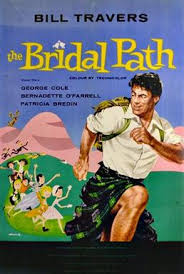
THE BRIDAL PATH
UK, 1959, 95 minutes, Colour.
Bill Travers, Bernadette O'Farrell, George Cole, Duncan Macrae, Eddie Byrne, Terry Scott.
Directed by Frank Launder.
This is a pleasant picaresque story set in Scotland.
Bill Travers, who had emerged successfully in Geordie and appeared in such films as The Barretts of Wimpole Street, and then with his wife, Virginia McKenna, in Born Free (and the giving of their life and attention to Africa and animals), plays a vigorous, strapping Scot who lives on an island, and the issue of his marriage.
He goes to the mainland, gets himself involved in a lot of tangles, even with the police, testing out various women with his criteria for marriage, restrictive in terms of clans and religion from the island perspective.
This is a pleasant story even if it does seem rather far-fetched!
There is a good supporting cast with character actors like Duncan Macrae (The Kidnappers) and comedian Terry Scott as a policeman.
The screenplay was written by veteran Frank Launder who directed the film. He has 75 writing credits from 1929 to 1985.
- The title, marriage in the Scottish Isles, traditions, requirements for marriage, and a search for a wife?
- The Scottish settings, the colour photography, the landscapes, the sea, the town on the streets, shops, the countryside and its range, hotels, police precincts…? And the musical score and the choral singing?
- Life on the island, the minister and his return, his sermon, the issue of consanguinity, cousins on the island marrying? Taking the issue seriously?
- Ewan, with Siona, the children, cousins, the bond between them, Siona and her determination to go to Glasgow? Ewan, the prescriptions for finding a wife, his going to the mainland?
- The film as a comedy of errors, Ewan as the naive islander, his presence, his height, charm, awkwardness, his going to the bank, the £400 and two shillings, going to the restaurant, eyeing the waitress, his being ousted? The male gaze of 1959 from Scotland, his looking at the various women? But according to the prescriptions on his list, no Catholics, no Campbells, wanting children, good with cows…?
- The range of events, going to the inn, the flirtatious wife of the policeman, his being continually misunderstood, the young woman reading the book about white slavery, his explaining that he wanted to look over girls, her alarm, calling the police?
- The continued chases, out in the countryside, along the roads, the rail tracks, getting wet, the policeman’s wife and his clothes, the Campbell rug, the effect on Ewan, the policeman with the bike, the pound notes flying, paying for the bike and taking it?
- The various police officers, disbelief, the more information, the headquarters, getting in the authorities? The phone calls, the pursuits, the sightings? The games, the elaborate chase, the participation of the police, pulling out of the events, tug-of-war et cetera, Ewan continually escaping?
- The interview with Sgt Bruce, his fear of his wife, having to stay the night, getting the breakfast, the other police arriving, Ewan getting them cups of tea, then his escape?
- Taking refuge with the farming woman, her wanting to escape, buying the boat, rowing out, persuading the boat to target him?
- Adrift, finally getting home, recounting his adventures? The encounter with Siona, the mother’s wife telling the truth about his origins, not cousins, his courage in proposing, acceptance? Happy ending?
Scars of Dracula
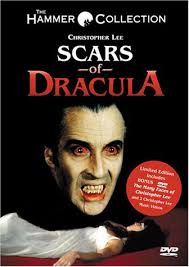
SCARS OF DRACULA
UK, 1970, 95 minutes, Colour.
Christopher Lee, Dennis Waterman, Jenny Hanley, Christopher Matthews, Patrick Troughton, Michael Gwynn, Michael Ripper.
Directed by Roy Ward Baker.
Scars of Dracula is one of the least persuasive of Christopher Lee’s Dracula films. And there were many. From the 1950s through the 1960s and several in the 1970s, even Taste the Blood Dracula released in the same year as this one.
One can say that Christopher Lee would do the role of Dracula in his sleep – and, in fact, in the early sequences of this film he is asleep (and another is seen later). His presence is somewhat iconic (and remembering that he was in his late 40s and The Lord of the Rings was 30 years in the future). He stands, gazes, bloodshot eyes, moves slowly, gazes for the blood and sexuality of his victims…
In fact, the IMDb quotes Christopher Lee: During an interview, Christopher Lee expressed his well-known frustration with this film: "I was a pantomime villain. Everything was over the top, especially the giant bat whose electrically motored wings flapped with slow deliberation as if it were doing morning exercises."
The film opens with a frequent sequence for Hammer horror, a dead body, scars of Dracula, the village upset, leaving a revolt and storming the castle. But, this story focuses on two young men, not particularly well acted by Christopher Matthews and, especially in the hero role, Dennis Waterman, later to be so successful on TV and Minder and New Tricks.
There are some sex scenes, 1970s style daring, a runaway carriage, birthday party, the young couple searching for the disappearing rake of a brother, his climbing down the castle wall, the beaten servant of Dracula and harsh treatment, with the priest, rather more significant than in other at Hammer films, his willing self-sacrifice and the brutality of his death (IMDb noting that this was modified by the British censor at the time).
No particular reason to see this one except for completion of seeing all the films with Christopher Lee as Dracula.
What My Love is For
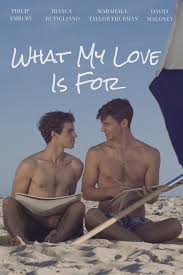
WHAT MY LOVE IS FOR
US, 2016, 75 minutes, Colour.
Philip Embury, Bianca Rutigliano, Marshall Taylor Thurman, David Maloney, Yvonne Erickson,Djaka Saoure..
Directed by Philip Embury, Sebastian Rea.
A small film, the work of Philip Embury who wrote, directed, and acts on the central role as Philip, a gay man living in rural Virginia (as did Embury in real life), on a farm, caring for horses. His father has long disappeared. He is antagonistic towards his mother and has contemporary his older brother, Douglas. He is friendly with a young woman who has had a troubled background but is finding a place on the farm.
When the relative whom he respects, his great grandma, dies in New York, he inherits her house. But, there is a complex situation in so far as she traded drugs, was involved in bootlegging, also involving her daughter in the process. He and Douglas and the young woman, Katie, find that the house is in debt. They try to market some hoops made in the basement, gatecrash an affluent party in the Hampton.
The focus of the rest of the film is on relationships, Philip attracted to an affluent young musician and artist, unsure about orientation. The film dramatises the changing relationship between the two, very reticent in its language and visuals about the relationship. Douglas, on the other hand, has drug problems, is rather promiscuous in his behaviour, especially with the host of the party, but also wanting a relationship with Katie. Katie uses the opportunity to reflect on her own situation, attitudes towards men and relationships.
There are also the difficulties at home, and the possibilities for some reconciliation ship with the mother.
Rather a quiet kind of film relying on its portrait of the characters, their questions, difficulties and relationships.
Emu Wars, The
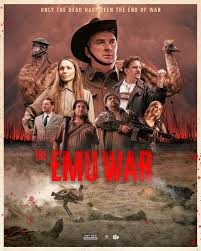
THE EMU WAR
Australia, 2023, 75 minutes, Colour.
Damien Callinan, Lisa Fineberg, Aaron Gocs, Dane Simpson, Naomi Higgins, Cameron James, Luke McGregor, Ben Russell, Jonathan Schuster.
Directed by John Campbell , Lisa Fineberg , Jay Morrissey
This is a worthy nominee for the title of worst Australian film ever.
It is intended as a broad comedy, as a spoof of history, as a spoof of Australian stances and attitudes. However, it plays as something of an improv movie, the cast making it all up as they went along.
Publicity for the film includes the words: absurd, over-the-top, bonkers!
The 1932 Emu War is historical and alluded to at the opening of this film. However, the idea is to show an Emu war incorporating various aspects of Australian history, opening up with a spoof on Harold Holt making an announcement on radio to the public, want to include a joke about peeing his pants which is not funny at all (and something of this trend continues right throughout the film, including the peeing, unfunny or some crass innuendo humour). Later Harold Holt will be lost in C and suggestions of a submarine taking him away…
Then there is a focus on an ordinary Australian family at a picnic and singing, and a sudden Emu swoop kidnapping the young son who will be brought up by the Emus and eventually confronting his father and his sister.
The basic plot is the campaign against the Emus who are presented with puppetry and voice-over, like an alternate culture of their own sovereign citizens. And, there is a small squad led by Damian Callinan, Lisa Fineberg, his daughter (Lisa) not recognised by him greeting his son, and two pals, one white and paunchy, Aaron Gocs one aboriginal with a sense of humour, Dane Simpson (more than most of the others in the film).
And, there are a whole lot of subplots including stand-up comedians, the widow of somebody killed in the war then disguising herself as an EMU and going undercover.
There are all kinds of sudden terms in the improv plot, some stand-up comedy, some ghostly fantasy, some sexual themes…
There is a presupposition, correct in many ways, that Australian audiences like to poke fun at all kinds of Aussie themes and experiences and that they don’t mind a bit of vulgarity but critic Jim Schembri notes that vulgarity for its own sake (abundant here) is boring.
For an ABC lengthy interview with the filmmakers about their intentions and the making of the film: https://www.abc.net.au/news/2024-06-20/the-emu-war-interview-hot-dad-productions/103997622
Revolt at Fort Laramie
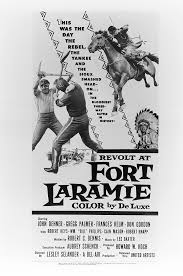
REVOLT AT FOR LARAMIE
US, 1957, 73 minutes, Colour.
John Dehner, Gregg Palmer, Frances Helm, Don Gordon, Harry Dean Stanton.
Directed by Lesley Selander.
A standard Western from the 1950s, settlers, the cavalry, a Fort, clashes with the Indians. It was directed by Lesley Selander, Selander is generally considered to be the most prolific director of feature Westerns of all time, with at least 107 to his credit between 1935-67.
What is distinctive about this film is that it is set at the beginning of the Civil War, members of the cavalry loyalty both sides, clashes, suspicions, issues of gold and dealings with the Indians, a final confrontation.
Some action, some romance, some heroism at the end.
- A standard 1950s Western, the ingredients, the settlers travelling, besieged by Indians, the cavalry coming, the clashes between cavalry and Indians, arrangements, discussions, the role of Jean Salignac, between whites and Indians?
- Colour photography, desert locations, the fort, the landscapes outside the fort? The musical score?
- The personnel, the major in charge, his age, loyalties, dealings with the Indians, his daughter, consent to the marriage, the news about forts Sumner, the Civil War, loyalties, divisions with the troops? His decisions, accusations of disloyalty, giving up his command, travelling with the gold, the confrontation with the Indians?
- Jamie, leadership, with the Major, with Melissa, romance, the prospect of marriage, the outbreak of the war?
- The other men, working together, the war, loyalties, clashes, the attack on one of the men and his death?
- Jamie, the dilemma, in command, Salignac and his news of the attack, Jamie and his decisions, going to the rescue, the clash with the Indians?
- An unusual western with the perspective of cavalry troops and divisions of loyalties?
Springsteen: Deliver Me from Nowhere
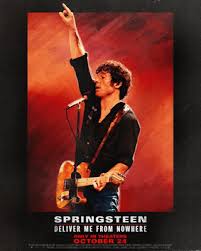
SPRINGSTEEN: DELIVER ME FROM NOWHERE
US, 2025, 120 minutes, Colour.
Jeremy Alan White, Jeremy Strong, Stephen Graham, Odessa Young, Gaby Hoffman, David Krumholz, Paul Walter Hauser, Harrison Sloan Gilbertson, Grace Gummer, Mark Maron, Matthew Anthony Pellicano Jr.
Directed by Scott Cooper.
Bruce Springsteen is a significant figure in American and world music, 20th century, 21st-century. This is a portrait of Springsteen in 1981-1982 rather than a biography, rather than an exuberant immersion in his music. That is the tone of the title, Deliver Me from Nowhere. And, in one sequence where a car salesman says to Springsteen, “I know who you are”, Springsteen replies “at least that’s one of us”.
Some background on Springsteen himself for those unfamiliar or less familiar with his life and career, courtesy of Wikipedia:
Springsteen has released 21 studio albums spanning six decades; most of his albums feature the E Street Band, his backing band since 1972. Springsteen is a pioneer of heartland rock, combining commercially successful rock with poetic, socially conscious lyrics that reflect working class American life.
And there is some Catholic background:
Springsteen attended the St. Rose of Lima Catholic School in Freehold, where he was at odds with the nuns and rebelled against the strictures imposed upon him, though some of his later music reflected a Catholic ethos and included Irish Catholic hymns with a rock music twist. In 2012, Springsteen said that it was his Catholic upbringing rather than his political ideology that most influenced his music. He said his faith gave him a "very active spiritual life" but joked that this "made it very difficult sexually" and added "once a Catholic, always a Catholic… I don't participate in my religion but I know somewhere... deep inside... I'm still on the team.”
This is very serious portrait and becomes more serious as it continues. There are black and white flashbacks to Springsteen’s childhood, a protective mother, a seriously alcoholic father, sometimes violent, demanding his son to be a man. Gaby Hoffman plays the mother and British actor, Stephen Graham (significant this year for his contribution to the series, Adolescence) is his father. But, Springsteen has the opportunity for some reconciliation with his father.
In 1981-1982, Springsteen worked in his bedroom, moved by watching the film, Badlands (1978) with Martin Sheen. It led to his reflections and a series of songs, just acoustic guitar, with very serious themes, Nebraska. And, at the same time, he composed what became something of an anthem, Born in the USA. (He is shown watching, several times, Robert Mitchum in the 1955 The Night of the Hunter, taken by his father to see it, the scenes of menace on the little boy.)
Springsteen is played effectively by Jeremy Alan White, award winner for his television series The Bear. Some have remarked that he does not look like Springsteen but, in his performance, he is able to communicate much of what drives the loner as well as the hyper-vigorous concert performances.
Supported strongly by his manager, Jon Landau, another fine performance from Jeremy Strong (Succession and frightening as Roy Cohn in The Apprentice), and by sympathetic waitress, Faye, Odessa Young, all kinds of opportunities offered to him by record companies and fans, Springsteen is often a recluse, feeling haunted many times, and an eventual acknowledgement of depression.
Which means that this film is a piece of Americana, on 20th century popular culture, an opportunity to appreciate Springsteen’s imagination and creativity, some insights into his perceptions of the US, the performance of some songs and songs in process, the American response (despite recent public condemnations of Springsteen by President Trump) rather than a concert musical.
- The title, the focus on Springsteen as a loner, depression? The experience of his loan composition of the album, Nebraska?
- Audience response to Springsteen, six decades of music, performance, public figure? Reputation, honest, medal from President Biden, criticism from President Trump?
- The film not as a concert experience although songs and performance included? The film is a portrait, flashbacks to childhood, 1981-1982, tours, composition, Nebraska, Born in the USA? Collaboration with Jon Landau? Record companies and agents, the recordings and the complications?
- Bruce Springsteen as a singer, performer, poet, creator, lyricist? And the performance by Jeremy Alan White?
- A picture of Bruce Springsteen, the New Jersey background, home life, his protective mother, going to the bar to ask his father to come home, the violence towards his mother, a to spy with his father, his father hitting him, the drinking, taking him to see The Night of the Hunter, Bruce with the baseball bat? The placing of these memories throughout the film?
- The opening concert, the energy, the performance, the exhaustion, the fans and interviews? His relationship with Jon Landau, over the years, friendship? Landau serious, knowing Springsteen’s genius, listening, advising, at home with his wife and testing ideas? Connections with the record companies, promotion, especially concerning Nebraska and the response of A whole Teller? The issue of Nebraska, the recording, the orchestra, Springsteen’s dissatisfaction, perfectionism? The mental health issues and Jon Landau’s support?
- The creation of Nebraska, watching Martin Sheen in Badlands, researching the story, the issues, resentment against society, the murders, the motivations and reactions? Is visualised? Impact, the suggestion of stories, the suggestion of songs? And the significance of the many sequences with the composing of the songs, their being played? Different from his other songs?
- At home, alone on the guitar, friendship with Mike, bringing the equipment, listening, the cassette, the limitations, the echo, Springsteen wanting this exact replication, the extent of the technicians in reproducing the sand? Then the album to be issued without name, press, promotion, tour? The scepticism of the industry?
- The episode with born in the USA, film, Paul Schrader? The composition, possessed in the performance? The promoters wanting it out there? It is being held until after Nebraska?
- Springsteen and his personal life, loner, awkward relationships, meeting the friend from school, Faye, the conversation, her being a fan, going to house, meeting her daughter, the outings, the play, his ability at being a father figure for the daughter? The merry-go-round is and all kinds of entertainment? The sexual relationship with Faye? Then his absence, not answering the phone, the conversations with Faye, leading up to her confronting him, and his leaving, her accusing him of always running away from himself?
- The issue of knowing himself or not, the quote from Flannery O’Connor about going back to the past which was not there? The car salesman and Springsteen’s response? The eventual admission of depression, going out to California, the encounter with his father, age, drink, losing his job, his mother’s concern, taking his father to hospital?
- Going to therapy, his weeping? 10 months, some recovery?
- The concert, performance, John and his support, his mother present, his father, going to see his father, the invitation to sit on his lap, the reconciliation?
- The final information, the success of Nebraska, Born in the USA, his later career – and the film over 40 years later?
