Displaying items by tag: Stephen Graham
Good Boy, The/ 2026
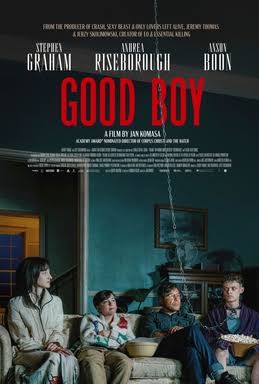
THE GOOD BOY
Poland/UK, 2025, 110 minutes, Colour.
Stephen Graham, Andrea Riseborough, Anson Boon, Kit Rakusen, Monika Frajczyk, Savannah Steyn.
Directed by Jan Komosa.
Quite an unexpected plot, disturbing and challenging, peace.
The film opens with an extended prologue showing Tommy, a young man out on the town any Yorkshire town, on the loose, no respect for anyone, allowed in crowded nightclub, music and dancing, drinking, drugs, sex, dominating his friends, violence on the streets, his eventual collapse.
Audiences will have strong opinions about young people acting like this and their seemingly reckless waste of life and time, the violent and criminal aspects, and wondering about the risks, punishment, jail time…
This is a Polish coproduction with screen Yorkshire, writing by a Polish and British team, the narrative and acting British, the technical aspects of the film, Polish.
Eventually Tommy wakes up, He finds himself in the basement of a country house, chained, bewildered and angry. Which is where the audience will start to ask questions about how to deal with this kind of young man. Actually, where he is, is the home of a couple and their young son. It quickly emerges that they have taken Tommy, not exactly to punish him but to make him aware of what he is, of what is done, the issue of rehabilitation. The audience is wondering about the motivations of the couple, the sometimes kindly, sometimes severe manner of the father, Chris (Stephen Graham) and his seemingly depressed wife (Andrea Riseborough) and the continued cheerfulness and good manners of the young son, John (Kit Rakusen). Is what the couple doing right, their motivation, a back story, issues of survival and punishment, making Tommy look at social media clips of his drunken sprees violence, his terrorising a young schoolboy?
And what will be the ultimate effect on Tommy, greater self-awareness, change in attitude, or continued bitterness and resentment? It does raise all the questions about how to treat young adult offenders, the role of prison, possibilities for rehabilitation.
And it will depend on how much the audience identifies with Tommy and how much with the husband and wife. And how the film clarifies or confuses their attitude towards methods of rehabilitation.
The film is very well acted, a complication when the couple employ a Macedonian housekeeper who is being pursued by exploitive people smugglers, and Anson Boon so effective as Tommy being seen in the various stages that he goes through, stuck in his old self, the possibilities for a better self.
- The title? The alternate title, Heel, the chain for a dog? the irony of the original title? For Tommy? To become a good boy? Jonathan as the good boy, “sunshine”?
- Polish/Yorkshire co-production? The writers, technical, Polish? British cast, locations? Universal themes?
- The prologue, Tommy, age 19, on the town, his friends, the club, music and noise, drugs, drinking, sex, violence, harassing the schoolboy flashback, his collapse in the street? His girlfriend, her not participating the drugs, her love for Tommy?
- The contrast with the country house, the grounds, interiors, Chris and Catherine, his past with the police, her grief and withdrawal, Jonathan, his age, sunshine, the good boy? The life? The background of the death of the son, his room, the memories of grief?
- The revelation of Tommy in the basement, chained, his condition, abducted? The personality of Chris, the fatherly touch, the do-gooding, talking with Tommy, the explanations, the reprimands, the morality and moralising, the videos, sequences on social media and their influence, the records of Tommy’s misbehaviour, his promoting it on social media? His reactions, Chris beating him? Conditions, the bed, food and drink?
- Kathryn, her personality, withdrawal, secluded life, the encounters with Tommy, supporting her husband, her becoming more alive?
- Jonathan, his age, with his parents, their affirmation, the encounters with Tommy, the cards, talking with him? Big Brother?
- The effect on Tommy, audience reaction to him, to the early behaviour, belief in punishment, belief in rehabilitation, Chris and his methods, the offer of the books, The Illustrated Man and the tattoos To Kill a Mockingbird…? His resentment, reactions, limitations of movement in the basement?
- The gradual change, Tommy more amenable, Chris and the conversations, letting him out of the basement, the fixing up of the roof and the ability for the chain, his greater movement, freedom in the house, meals, music, his ambiguous reactions?
- The change in the household, the freedom of movement, its effect on Tommy, the drive, the chloroform, the picnic in the countryside, returning him home? Tommy and his interactions with the family, more at home?
- Tom and his shrewdness, the numbers for the code, the implement for the chain? The quiet, his escape, the family reactions?
- Tommy, the return home, his mother, reception, going to the club, watching behaviour, his girlfriend and her succumbing to the drugs? His taking her, leaving, leaving his mother at home?
- The chloroform, taking his girlfriend, the car, burning the car, going up the drive, the family receiving him? His new family, the rehabilitation of his girlfriend? The future?
Peaky Blinders: The Immortal Man
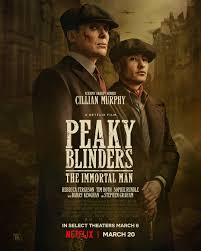
PEAKY BLINDERS: THE IMMORTAL MAN
UK, 2026, 112 minutes, Colour.
Cillian Murphy, Rebecca Ferguson, Barry Keoghan, Stephen Graham, Sophie Rundle, Tim Roth, Ned Dennehy, Pakxy Lee, Jay Lycurgo, Ian.Peck,
Directed by Tom Harper.
The connection with the long-running television series:
AI generated summary from user reviews on the Internet movie database: Reviewers say 'Peaky Blinders' is celebrated for its compelling narrative, intricate characters, and standout performances, especially Cillian Murphy as Tommy Shelby. The series is lauded for its historical accuracy, striking visuals, and unique soundtrack. Central themes include power, loyalty, and betrayal, with a focus on war and class conflict. The Shelby family's interactions and complex storylines captivate audiences, though some critics observe a dip in quality in later seasons. Its aesthetic and immersive atmosphere make it a genre standout.
The television series had a long run and there is often a call for a feature film to gather the themes and characters together. Peaky Blinders ran for over 10 years with 36 episodes, and highlighting the talent of Cillian Murphy (winning a Best Actor Oscar for playing Robert Oppenheimer).
The film takes place some years after the events in the series which moved from World War I into the 1920s and 30s. Now, it is World War II, highlighting an episode where the Third Reich forged an enormous amount of British notes to smuggle into Britain, disrupt the economy, different strategy for obtaining victory. This is visualised for us – and the traitorous go-between is played by Tim Roth.
In the meantime, Tommy Shelby has retired, living quietly, writing his book, The Immortal Man. But, his son, Duke (Barry Keoghan, featured in many films at this period, talented with quite different roles) has a difficult relationship with his father. There are also complications about Shelby and his relationships, his wife, her sister, memories, and the Gypsy community.
And, this community is tough, violence, in the streets, in the pubs…
Eventually, the arrival of the forged money at Liverpool, the British contacts, setting up some contract with the Peaky Blinders and Duke, Stephen Graham appearing in a supporting role, Shelby himself finally having to intervene.
For those familiar with the series, obviously interesting. And, with a sequel series in planning, obviously an introduction.
For those not familiar with the series, a glimpse of gangs, gangsters, violence on the streets, British style.
- The popularity of the series, over 10 years, 36 episodes, Birmingham, Gypsies, crime…?
- A feature film, the impact for those unfamiliar with the series, those who know the series? A satisfactory ending, the death of Tom Shelby?
- World War II, the opening in Germany, the concentration camp, the elaborate forging of the currency, packing, shipping it, the plan to infiltrate the currency, economic collapse, the winning of the war?
- Beckett, sympathetic to the Nazis, in Germany, arranging the transport, the interview with Duke, the sympathiser and his loose lips, Becket shooting him? Duke agreeing?
- The presence of Tom Shelby, his past reputation, World War I and action, the trenches and his memories, his relationship with his brother, the visit to the cemetery, seeing his daughter’s red scarf, his grief about his brother, the revelation of his killing him and his motivations? In the rural house, wandering around, letting go of control, writing his book, Johnny as his helper?
- Duke, son of Tom, the bonding and lack of bonding? His character, brutal, leadership, the issue of the arms and his gang appearing, rounding them up, taking them? Confrontations between the authorities and the Peaky Blinders? Duke and his personal life, leadership, at the pub?
- Tom, his wife, his children? Mysterious presence of Kaulo, sister of Zelda, Tom and his memories, appearances? The presence at the dinner, her role in the city, patriotism, leadership, her son – and her murder? The ceremonies of her burial?
- The old members of the gang, their presence, loyalty to Tom, ageing?
- The pub, the women, the drinking, the gangs? The pub ring the war, the soldiers, Tom and his arrival, control, the confrontation with the soldier, defiance, the hand grenade? Tom and his reassertion of authority?
- Seeing Tom, the relationship with Duke, their meetings, discussions, the count money, Duke and his loyalties?
- Tom, reasserting himself, the various attacks, riding the horse? The Gypsy background? His dreams and imaginings? The discussions with Duke?
- The meetings with their cake, confrontations, shooting fights? Escapes?
- The final plan, and his hold over Duke, to do the shootings, the phone, going Duke and his change of heart?
- The setting up for the arrival of the money, the taking it, the squad, the role of Stagg, his personality, loyalties? On the harbour, the boats, the crash, Tom coming through the tunnel, his dilapidated state, the accident and crash, his getting free, arriving late, the setting of the time of midnight, Becket with Duke, the clock, Tom eventually arriving?
- The final confrontation, the shootout, the death of Becket, his shooting Tom, Duke present?
- The ending of the Peaky Blinders’ tale, the death of Tom, the role of Duke? The finding of the manuscript, giving it to Duke? The final caravan, the fire?
Springsteen: Deliver Me from Nowhere
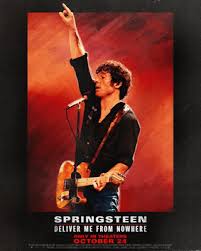
SPRINGSTEEN: DELIVER ME FROM NOWHERE
US, 2025, 120 minutes, Colour.
Jeremy Alan White, Jeremy Strong, Stephen Graham, Odessa Young, Gaby Hoffman, David Krumholz, Paul Walter Hauser, Harrison Sloan Gilbertson, Grace Gummer, Mark Maron, Matthew Anthony Pellicano Jr.
Directed by Scott Cooper.
Bruce Springsteen is a significant figure in American and world music, 20th century, 21st-century. This is a portrait of Springsteen in 1981-1982 rather than a biography, rather than an exuberant immersion in his music. That is the tone of the title, Deliver Me from Nowhere. And, in one sequence where a car salesman says to Springsteen, “I know who you are”, Springsteen replies “at least that’s one of us”.
Some background on Springsteen himself for those unfamiliar or less familiar with his life and career, courtesy of Wikipedia:
Springsteen has released 21 studio albums spanning six decades; most of his albums feature the E Street Band, his backing band since 1972. Springsteen is a pioneer of heartland rock, combining commercially successful rock with poetic, socially conscious lyrics that reflect working class American life.
And there is some Catholic background:
Springsteen attended the St. Rose of Lima Catholic School in Freehold, where he was at odds with the nuns and rebelled against the strictures imposed upon him, though some of his later music reflected a Catholic ethos and included Irish Catholic hymns with a rock music twist. In 2012, Springsteen said that it was his Catholic upbringing rather than his political ideology that most influenced his music. He said his faith gave him a "very active spiritual life" but joked that this "made it very difficult sexually" and added "once a Catholic, always a Catholic… I don't participate in my religion but I know somewhere... deep inside... I'm still on the team.”
This is very serious portrait and becomes more serious as it continues. There are black and white flashbacks to Springsteen’s childhood, a protective mother, a seriously alcoholic father, sometimes violent, demanding his son to be a man. Gaby Hoffman plays the mother and British actor, Stephen Graham (significant this year for his contribution to the series, Adolescence) is his father. But, Springsteen has the opportunity for some reconciliation with his father.
In 1981-1982, Springsteen worked in his bedroom, moved by watching the film, Badlands (1978) with Martin Sheen. It led to his reflections and a series of songs, just acoustic guitar, with very serious themes, Nebraska. And, at the same time, he composed what became something of an anthem, Born in the USA. (He is shown watching, several times, Robert Mitchum in the 1955 The Night of the Hunter, taken by his father to see it, the scenes of menace on the little boy.)
Springsteen is played effectively by Jeremy Alan White, award winner for his television series The Bear. Some have remarked that he does not look like Springsteen but, in his performance, he is able to communicate much of what drives the loner as well as the hyper-vigorous concert performances.
Supported strongly by his manager, Jon Landau, another fine performance from Jeremy Strong (Succession and frightening as Roy Cohn in The Apprentice), and by sympathetic waitress, Faye, Odessa Young, all kinds of opportunities offered to him by record companies and fans, Springsteen is often a recluse, feeling haunted many times, and an eventual acknowledgement of depression.
Which means that this film is a piece of Americana, on 20th century popular culture, an opportunity to appreciate Springsteen’s imagination and creativity, some insights into his perceptions of the US, the performance of some songs and songs in process, the American response (despite recent public condemnations of Springsteen by President Trump) rather than a concert musical.
- The title, the focus on Springsteen as a loner, depression? The experience of his loan composition of the album, Nebraska?
- Audience response to Springsteen, six decades of music, performance, public figure? Reputation, honest, medal from President Biden, criticism from President Trump?
- The film not as a concert experience although songs and performance included? The film is a portrait, flashbacks to childhood, 1981-1982, tours, composition, Nebraska, Born in the USA? Collaboration with Jon Landau? Record companies and agents, the recordings and the complications?
- Bruce Springsteen as a singer, performer, poet, creator, lyricist? And the performance by Jeremy Alan White?
- A picture of Bruce Springsteen, the New Jersey background, home life, his protective mother, going to the bar to ask his father to come home, the violence towards his mother, a to spy with his father, his father hitting him, the drinking, taking him to see The Night of the Hunter, Bruce with the baseball bat? The placing of these memories throughout the film?
- The opening concert, the energy, the performance, the exhaustion, the fans and interviews? His relationship with Jon Landau, over the years, friendship? Landau serious, knowing Springsteen’s genius, listening, advising, at home with his wife and testing ideas? Connections with the record companies, promotion, especially concerning Nebraska and the response of A whole Teller? The issue of Nebraska, the recording, the orchestra, Springsteen’s dissatisfaction, perfectionism? The mental health issues and Jon Landau’s support?
- The creation of Nebraska, watching Martin Sheen in Badlands, researching the story, the issues, resentment against society, the murders, the motivations and reactions? Is visualised? Impact, the suggestion of stories, the suggestion of songs? And the significance of the many sequences with the composing of the songs, their being played? Different from his other songs?
- At home, alone on the guitar, friendship with Mike, bringing the equipment, listening, the cassette, the limitations, the echo, Springsteen wanting this exact replication, the extent of the technicians in reproducing the sand? Then the album to be issued without name, press, promotion, tour? The scepticism of the industry?
- The episode with born in the USA, film, Paul Schrader? The composition, possessed in the performance? The promoters wanting it out there? It is being held until after Nebraska?
- Springsteen and his personal life, loner, awkward relationships, meeting the friend from school, Faye, the conversation, her being a fan, going to house, meeting her daughter, the outings, the play, his ability at being a father figure for the daughter? The merry-go-round is and all kinds of entertainment? The sexual relationship with Faye? Then his absence, not answering the phone, the conversations with Faye, leading up to her confronting him, and his leaving, her accusing him of always running away from himself?
- The issue of knowing himself or not, the quote from Flannery O’Connor about going back to the past which was not there? The car salesman and Springsteen’s response? The eventual admission of depression, going out to California, the encounter with his father, age, drink, losing his job, his mother’s concern, taking his father to hospital?
- Going to therapy, his weeping? 10 months, some recovery?
- The concert, performance, John and his support, his mother present, his father, going to see his father, the invitation to sit on his lap, the reconciliation?
- The final information, the success of Nebraska, Born in the USA, his later career – and the film over 40 years later?
Adolescence
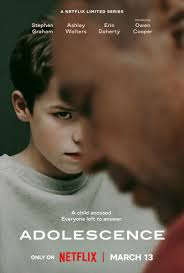
ADOLESCENCE
UK, 2025, 4x55 minutes, Colour.
Owen Cooper, Stephen Graham, Ashley Walters, Faye Marsay, Christine Tremarco, Amelie Pease, Erin Doherty, Joe Hartley.
Directed by Philip Barantini.
A television series that received immediate worldwide acclaim. It is particularly well cast in the major roles and in so many of the supporting roles, including the children at school. The screenplay has been written by veteran writer, Jack Thorne (Wonder, Radioactive, the Enola Holmes films) who was working on a new version of Golding’s Lord of the Flies at this time. He worked with Stephen Graham who brought the idea to him. The direction is by former actor, Philip Barantini, who worked with Stephen Graham in the striking film, Boiling Point, as well as the television series based on the film.
A striking aspect of the series is that each of the episodes, four, was filmed in a single take. Which gives each episode in extraordinary sense of continuity.
The idea for the series came from actor Stephen Graham, concerned about crimes committed by the young, a serious attempt to probe families, children, school and pressures, situations that lead to anger and violent crime. Each chapter provides a different perspective.
The film opens with the police, strong performance from Ashley Walters as the investigator, the police arriving, bashing their way into a house, alarming the family, arresting a 13-year-old, Jamie Miller. There has been universal acclaim for the performance, first time on screen, by Owen Cooper (who then went on to be young Heathcliff in Emerald Fennell’s version of Wuthering Heights). There is general alarm, the boy protesting that he has done nothing wrong, the upset of the family, Stephen Graham is the father, tensions, Jamie being taken to the police station, the details of classifying him, the cell, the arrival of the sympathetic legal adviser, the decision that his father would be the responsible adult to be present in all interrogations and situations. There is the fingerprinting, the taking of blood, the offer of a meal. Then there is the interrogation by the two police officers, Jamie and some questions but, on the advice of the solicitor, offering “No Comment” about the episode. The hour-long narrative is filmed in real time, the gradual revelation of the case, the death of a fellow student by stabbing in a car park at night, the protest of Jamie, the support of his father, the audience ready to take a step further.
The second episode takes place three days later, the opportunity for the police to go to the school to question various students. There are various rumours at the school, students upset. In fact, the episode shows the difficulties in contemporary schools, some students wanting to learn, other students providing all kinds of upsets and answering back to the teachers, some of the teachers effective, others exasperated by their experiences in the classroom. And, in the middle of the interrogations, the fire alarm goes off, the scene of everybody going out to the open area, the murdered girl’s best friend having a tantrum and attacking one of Jamie’s friends, her having to be counselled by one of the teachers but her angry reaction. The police interrogate Ryan, one of Jamie’s friends, the boy was attacked by the girl in the yard. Later, when he is interrogated again, he makes for a run for it, the police pursuing him and catching him, and admitting that the knife in the killing was his. The officers son is also at the school, tension between them but his explaining to his father various aspects of Instagram and online bullying, especially for teenagers and issues of celibacy, herself bullying Jamie. These discussions and the effect of photos and texting may be unfamiliar to many of the parent audiences watching the series.
The third episode takes place in real time, a psychologist coming for a second visit or talked with Jamie. It is seven months later. Erin Dougherty gives a very effective performance as the visiting psychologist and Owen Cooper shows even better his abilities as an actor, the verbal interaction between the two, the issues raised, especially about masculinity, sexuality, teenage understandings and lack of understanding, and an opportunity to see Jamie and an eruption of anger. This is a valuable hour in the understanding of a contemporary 13-year-old boy.
There is explicit reference to Andrew Tate and his large social media following, the “manosphere” and the implications of “toxic masculinity”, its being taken up by so many boys and young men, feeling oppressed, finding ways of asserting themselves, even brutally.
The last episode takes place 13 months after the crime. Surprisingly for the audience, the focus is once again on the Miller family whom the audience saw in the first episode. It is the father’s birthday, his wife preparing breakfast, the daughter alarming them with the news that the father’s van, he is a plumber, has been spray-painted with an insult. This changes the dynamic of the day which had meant to be happy, breakfast, going to the pictures, a Chinese meal. The point of this episode is to show the father’s anger, Jamie having mentioned to the counsellor an example of his father erupting. So much of the early part of the episode has the three in the van going to buy paint to respray over the insult, there is a huge revelation of the family dynamic. Some of those who work at the store recognise the father and gossip. He also sees the two young men who spray-painted and angrily attacks them, throwing paint over the side of his van, in a rage. On the return home, there is a wonderfully intimate scene between husband and wife, especially when Jamie rings and announces that he is changing his plea to guilty. Audiences will appreciate the father’s awareness of the cruelty of his own father towards him, his decision to be the opposite, but his own rage influencing his son who has put his father on a pedestal. The guilt of the father in trying to make his son into the stereotype, sports, tough, while his abilities were in art and drawing.
The series does not go back to the police or to the prison. It stays with the father and mother, acknowledging the past, having to live with it, and to build on it.
The crime might be one of an adolescent. But, the adolescent has grown up in a family.
Venom: The Last Dance
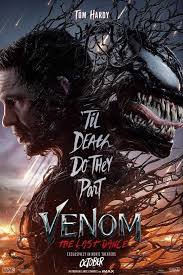
VENOM: THE LAST DANCE
US, 2024, 109 minutes, Colour.
Tom Hardy, Chiwitel Ejiofor, Juno Temple, Rhys Ifans, Stephen Graham, Clark Backo, Alana Ubach.
Directed by Kelly Marcel.
It seems that diehard Venom fans are quite pleased with this third film, the story of journalist Eddie Brock, Tom Hardy,, his being associated, Simbiotically is the word, with a parasite that lives inside him, Venom, transforming into a fearsome creature, helmet head and face, strong gnashing teeth, beyond pterodactyl wings… But, quite a conversational style voiced also by Tom Hardy, as an immigrant to the US, eager to see the Statue of Liberty and enjoy the American lifestyle, a gambling spree in Las Vegas!
However, this is an episode which may not use many converts. In many ways, the film is frequently quite grotesque, not only Venom and his dark visuals as it takes over Eddie, but a grim opening, way beyond the extremities of the universe, a sinister Xenolphage who exhorts even more fearsome and ugly creatures to destroy a codex (actually inside Eddie and Venom) and annihilate the world.
Tom Hardy, who contributed to the story with the writer of all three Venom films, Kelly Marcel, who now directs, tends to be fairly weary of it all while Venom is excited! And the film is very episodic, a kind of Roswell site about to be demolished, Chiwiltel Ejiofor is the military commander, Juno Temple an ambitious scientist, the exploits in the underground laboratories exploring parasites and Symbiotes. Eddie and Venom are in Mexico, board a plane (on the outside) for New York are involved in a sky high confrontation with monsters, falling to earth, and continually pursued by the military.
Then, cheerfully, there is a rather hippie family, led by Rhys Ifans, believing in aliens and eager to see them, giving Eddie a lift who befriends the family. But, Venom is eager for a Las Vegas experience, Sally playing the machines and losing.
But, everyone comes together at the site to be abandoned, all kinds of special effects, explosions, pursuits, mayhem… But, of course, the ending (for most if not all). A distraction came while watching the film, and a felt need for distractions for the reviewer, wondering what would God’s response be as God sat down to watch Venom, thinking about the wonders of creation and realising that it might be beyond divine powers to imagine such a grimly contorted scenario as this one!)
- Venom in the Marvel Universe? Preceding films? The continuity? This film is a climax?
- The theory of Symbiotes? Origins, appearance, creatures and monsters, helmet heads, teeth, tongues, wings, transformations? Linking with humans? Two personalities in one? With Eddie, his history, previous crises, the death of Patrick?
- The opening, the extremes of the universe, grim and dark, the Xenophage, bound, voice, the other creatures, the mission, the target, the Codex? The mission to Earth?
- Eddie, his personality, his link with Venom, Tom Hardy using both voices? In the bar, drunk, the drinks, the bartenders, the manifestations? The future, to leave Mexico, to go to New York, the Statue of Liberty?
- Introduction to Teddy Paine, the dream, with her twin brother, to be an astronaut, the storm, his death, her waking, call to work, her work with the Symbiotes, Sadie as her assistant? Her interactions with Strickland? The laboratory, below the Earth, elaborate? The work, the samples? Investigations? Reviving Patrick, the interrogations, his information?
- The situation with the plant, extensive, to be decommissioned, three days, the remnants?
- The targeting of Eddie, the mechanisms for surveillance, tracking him? The squads available to Strickland, the pursuit, the fight on the plane, the helicopter and the military, dropping into the water, confrontation with them, their deaths? The consequences for Strickland? His return to the plant?
- The encounter with the family, Martin, his background, preoccupation with aliens, gathering the family, travelling in the van, his wife’s support, the delight of the little boy, the questionings of the daughter? The encounter with Eddie, his friendliness, Eddie trying to keep Venom under control? The singing of the David Bowie song? The bonding, dropping Eddie in Las Vegas, giving him the $20?
- The Las Vegas episode, Venom wanting to gamble, the lack of money, hitting the poker machines, the people observing? Eddie looking drab, the encounter with the man in the suit, Eddie looking respectable? The encounter with the friend, up to the apartment, Venom enjoying the dance?
- Eddie, to the plant, with Teddy Paine, with Strickland, the encounter with Patrick and the explanations?
- Martin, the family, arriving at the site, under the fence, on the tower, able to observe everything, the collapsing tower? The final disillusionment with aliens!
- The buildup to the confrontation, the special effects, the creatures arriving, the commands of Xenophage, the staff, the destruction of the underground laboratory, on the surface, the Symbiotes escaping, making contact with Teddy Paine, the pursuit of Sadie?
- The buildup to the final drama, Strickland being wounded, on the platform, his code and eyes, setting the destruction in process? The explosion and destruction?
- The aftermath, Eddie, the hospital, separation from Venom? And the views of the Statue of Liberty?
- The final credits, possibility for future Venom stories?
