Displaying items by tag: George Cole
Folly to be Wise
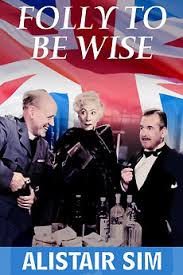
FOLLY TO BE WISE
UK, 1952, 93 minutes, Black-and-white.
Alistair Sim, Elizabeth Allan, Roland Culver, Colin Gordon, Martita Hunt, Janet Brown, Peter Martyn, Miles Malleson, Edward Chapman, Cyril Chamberlain, Michael Ripper, Robin Bailey, George Cole.
Directed by Frank Launder.
Frank Launder and his writing partner, Sydney Gilliat, contributed a great deal to British cinema in the 1940s and 1950s. They worked with Alistair Sim in The Happiest Days of Your Life and then in the Belles of St Trinian’s.
Alistair Sim was something of an institution and British cinema at this time, especially with An Inspector Calls and his two-to-forced as Ebenezer Scrooge in A Christmas Carol.
This is a very British film of the period, based on a play. And, the action is confined to offices, the hall, pubs, homes. The emphasis in.is on dialogue.
Alistair Sim is the chaplain, William Paris, who has a responsibility for organising entertainment on Saturday evenings, something artistic and intellectual instead of the soldiers gathering at the pubs.
The basic idea is to have a Brains Trust evening, a professor who conducts one on the BBC, Colin Gordon, an artist, Roland Culver very persuasive, antagonistic towards his wife, Elizabeth Allan. There is also the local Grande Dame, Martita Hunt, the local labour member, Edward Chapman. There is also the very absent-minded and deaf doctor, Miles Malleson and who does tell a joke which gets everybody laughing.
A range of confusion, Paris trying to MC the whole event, clash between husband and wife, basic question about marriage from Paris’s secretary… And some squabbling on stage as well as at home, discussions about marriage and, 1952, a reconciliation at the end which might strained credibility.
- The title, saying, knowledge, wisdom – and the brains trust?
- British films, the 1950s, small-budget, local stories, comic touches, strong British cast?
- The setting, the military, the chaplain and office, the hall, the local pubs, the parade ground? The musical score?
- Based on a play, emphasis on dialogue, action confined to offices, halls, homes, pubs?
- The military situation, 1952? The recruits, training? The role of the officers, adjourning to the pub, the spirit amongst the men?
- Captain Paris, an Alistair Sim character, his manner, style of speaking, enthusiasm, the touch of the dithery? Harassed? At the recital, the few in the audience, applause? His role as providing entertainment, the discussions with Jessie, the ensembles, the singers, cancelling appointments? The idea of the brains trust?
- Walter and Jessie, his puzzle about her eagerness for education, her earnestness? Their work for Paris? The idea of the brains trust, Jesse and her eagerness? The visit to the Sprouts, the encounter with Angela and Professor Mutch? The proposal, her enthusiasm, the professor agreeing, George and his difficulties?
- The relationship between Angela and the professor, George and his art, arrogance, manner, treatment of Angela, long friendship with the professor, the professor staying with the couple, his BBC success?
- Preparations for the Brains Trust, the request for questions, the soldiers responding, Paris going through them, some projections, Jessie and her question? Later slipping it in? The friendship with Lady Dodd, her manner, agreeing to come? The local politician and his manner? Walter and the curtains and decoration?
- The gathering, George and his drinking, the discussions? The doctor, his arriving late? The crowd in the hall, the slow clap, the beginning, the issue of the master of ceremonies, Paris and his role? The first questions, slight, the contributions, George and his drinking, cantankerous, the professor on edge, Angela, Lady Dodd, the politician and the exclusion of politics? His sensitivities?
- Jessie, the question about marriage, the handling of the situation, Paris wanting to stop, Lady Dodd and her answer, the beginning of the situation between George, Angela and the professor, tensions, Jessie insisting, the audience backing her? Her motivation, want to know about marriage and how it worked? Walter behind-the-scenes? The interval, the continuance, Jessie and her speeches, Walter and his eventual long speech and Jessie’s romantic response?
- The doctor, not hearing, absent-minded, eventually telling the joke and everybody enjoying it?
- The aftermath, driving away, ousting the professor, Paris and the others in pursuit, the confrontation in the house?
- The comeuppance for the professor, Paris and his interventions, Jessie, challenge to Angela, George and his change – and the credibility of the reconciliation?
Bridal Path, The
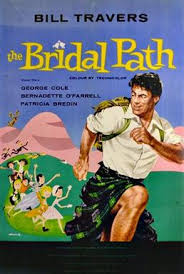
THE BRIDAL PATH
UK, 1959, 95 minutes, Colour.
Bill Travers, Bernadette O'Farrell, George Cole, Duncan Macrae, Eddie Byrne, Terry Scott.
Directed by Frank Launder.
This is a pleasant picaresque story set in Scotland.
Bill Travers, who had emerged successfully in Geordie and appeared in such films as The Barretts of Wimpole Street, and then with his wife, Virginia McKenna, in Born Free (and the giving of their life and attention to Africa and animals), plays a vigorous, strapping Scot who lives on an island, and the issue of his marriage.
He goes to the mainland, gets himself involved in a lot of tangles, even with the police, testing out various women with his criteria for marriage, restrictive in terms of clans and religion from the island perspective.
This is a pleasant story even if it does seem rather far-fetched!
There is a good supporting cast with character actors like Duncan Macrae (The Kidnappers) and comedian Terry Scott as a policeman.
The screenplay was written by veteran Frank Launder who directed the film. He has 75 writing credits from 1929 to 1985.
- The title, marriage in the Scottish Isles, traditions, requirements for marriage, and a search for a wife?
- The Scottish settings, the colour photography, the landscapes, the sea, the town on the streets, shops, the countryside and its range, hotels, police precincts…? And the musical score and the choral singing?
- Life on the island, the minister and his return, his sermon, the issue of consanguinity, cousins on the island marrying? Taking the issue seriously?
- Ewan, with Siona, the children, cousins, the bond between them, Siona and her determination to go to Glasgow? Ewan, the prescriptions for finding a wife, his going to the mainland?
- The film as a comedy of errors, Ewan as the naive islander, his presence, his height, charm, awkwardness, his going to the bank, the £400 and two shillings, going to the restaurant, eyeing the waitress, his being ousted? The male gaze of 1959 from Scotland, his looking at the various women? But according to the prescriptions on his list, no Catholics, no Campbells, wanting children, good with cows…?
- The range of events, going to the inn, the flirtatious wife of the policeman, his being continually misunderstood, the young woman reading the book about white slavery, his explaining that he wanted to look over girls, her alarm, calling the police?
- The continued chases, out in the countryside, along the roads, the rail tracks, getting wet, the policeman’s wife and his clothes, the Campbell rug, the effect on Ewan, the policeman with the bike, the pound notes flying, paying for the bike and taking it?
- The various police officers, disbelief, the more information, the headquarters, getting in the authorities? The phone calls, the pursuits, the sightings? The games, the elaborate chase, the participation of the police, pulling out of the events, tug-of-war et cetera, Ewan continually escaping?
- The interview with Sgt Bruce, his fear of his wife, having to stay the night, getting the breakfast, the other police arriving, Ewan getting them cups of tea, then his escape?
- Taking refuge with the farming woman, her wanting to escape, buying the boat, rowing out, persuading the boat to target him?
- Adrift, finally getting home, recounting his adventures? The encounter with Siona, the mother’s wife telling the truth about his origins, not cousins, his courage in proposing, acceptance? Happy ending?
Take Me High
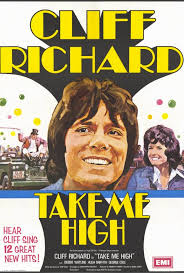
TAKE ME HIGH
UK, 1973, 91 minutes, Colour.
Cliff Richard, Debbie Watling, Hugh Griffith, George Cole, Anthony Andrews, Richard Wattis.
Directed by David Askey.
Not exactly a 21st century entertainment! Rather, of interest for more historical reasons.
This was the last main feature film for popular singer, Cliff Richard, emerging at the age of 19-20 as a singer, and actor in such films as espresso bongo, but then moving to some popular musicals. After Take Me High, his main screen presence was a long list of music videos.
Rather surprisingly in this film, he plays a merchant banker, in Birmingham, working with Anthony Andrews, surprising to see him so early, soon to be in The Scarlet Pimpernel and his key role in Brideshead Revisited. Cliff Richard is not entirely persuasive as this kind of banker, especially when the script asks him to be something of a mastermind in financial deals, one up and ship towards his partner. The deals are between Hugh Griffith, highly overacting at first, then agreeably punctures, remembering his Oscar for Ben Hur as well is his presence in Tom Jones. He is conservative, a Birmingham family traditions, contrast with George Cole as a more left-wing representative.
Debbie Watling plays a manager a restaurant who has financial problems with the company, links up with Cliff Richard, inventing the new hamburger, the Bromberg. Longtime comedian, Richard Wattis, has a role as the head of the banks in one of his final performances.
Filmed on location in Birmingham, the city, the canals, the streets and parades… It has a listed soundtrack of 15 songs. The credits focused close-up of Cliff Richard singing but many of the songs, most of them, directly son as background to the action.
A belated attempt to have Cliff Richard as a film star – but, he continued his long career, is a popular singer.
