Displaying items by tag: Stanley Holloway
Champagne Charlie
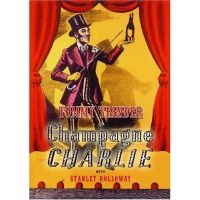
CHAMPAGNE CHARLIE
A, 1944, 75 minutes, Black-and-white.
Tommy Trinder, Stanley Holloway, Betty Warren, Jean Kent, Robert Wyndham, Guy Middleton, Austin Trevor.
Directed by Cavalcanti/Albert Cavalcanti.
Tommy Trinder was a popular entertainer, singer, especially on stage, radio and some films. Here he stars as a musical singer of the 1860s, George Leybourne, composer of a number of popular songs of the time, especially Champagne Charlie and The Daring Young Man on the Flying Trapeze.
This film appeared in 1944, during World War II, appealing to public spirit, the popular songs of the 19th century, the music halls – some morale boosting during the war. It was directed by the Brazilian born director, Albert Cavalcantiy, who moved to Europe, to England, working on documentaries and then a number of feature films including Dead of Night.
Featuring alongside Tommy Trinder is veteran singer Stanley Holloway (20 years before he immortalised Alfred Dolittle in My Fair Lady).
Trinder plays a miner coming to London with his brother who wants to become a fighter but whose lungs have prevented this because of his work in the mines. His brother, however, is a success as a singer, catching the eye of the manager of the theatre, Bessie, played by Betty Warren, who has an attractive young daughter, dancer, played by Jean Kent. She is being courted by a young upper-class gentleman.
The singer is persuaded to change his name to George Leybourne, success, Trinder bringing alive the songs (some of which written by screenwriters for the film, a range of songs emphasising different kinds of alcohol). He comes to the attention of a rival singer, well-established, played by Stanley Holloway. There is rivalry between them, especially in the range of songs on alcohol, each trying to better the other in performance and popular response. Ultimately, one challenges the other to a duel, neither prepared for it, doing some training with pistols, and a farcical encounter.
At the time, it would seem that the musicals were under threat from the theatres, complaints about drawing audiences away from theatre. The father of the young gentleman courting Bessie’s daughter is in charge of the commission – and, it is revealed that he was courting Bessie back in the past, his father intervening against lower class wedding, his now repeating it for his son. There are hearings about musicals with the two singers and Bessie giving evidence. Ultimately, the Lord comes to visit the theatre music hlal and is welcomed by everyone – and, happy ending all round.
George Leybourne’s song, Champagne Charlie was so popular that he was nicknamed with it.
A film from England’s past, the war years – but, for those interested in old-fashioned rollicking stories and, especially, the musical songs and the invitation to join in, a pleasing entertainment.
Up the Front

UP THE FRONT
UK, 1972, 89 minutes, Colour.
Frankie Howerd, Bill Fraser, William Mervyn, Linda Gray, Jonathan Cecil, Dora Bryan, Stanley Holloway, Bob Hoskins, Peter Bull, Vernon Dobtcheff..
Directed by Bob Kellett.
Frankie Howerd had a long career in comedy, especially in television and films. During the 1960s and early 1970s he appeared in The Chastity Belt and, especially, the comedy television series Up Pompeii. He also appeared in several Carry on films.
Frankie Howerd characteristically broke the fourth wall, looking at the audience, looking straight to camera, confiding all his thoughts and feelings, his jokes, his mischief, and the touch of the affected disapproval at times to the audience.
This film, playing with the Pompeii title, is set in World War I, Up the Front, starting in an aristocratic mansion, Frankie Howerd is Lurk, a servant, hypnotised during a show, then volunteering for the war – and all kinds of adventures and misadventures in France at the front.
Once again, a considerable number of British character actors are there in support. But, Frankie Howerd is an acquired taste, popular in his time, but not so lasting. Which means that this is a film for his fans and for those studying the style of popular British film comedy in the 1960s and 1970s.
On the Fiddle
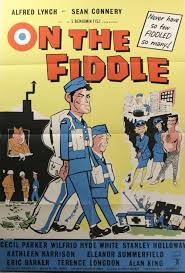
ON THE FIDDLE
UK, 1961, 89 minutes, Black-and-white.
Alfred Lynch, Sean Connery, Victor Madden, Eric Barker, Cecil Parker, Wilfrid Hyde White, John Le Mesurier, Graham Stark, Patsy Rowlands, Eleanor Summerfield, Miriam Karlin, Bill Owen, Barbara Windsor, Beatrix Lehmann.
Directed by Cyril Frankel.
The title indicates the activities of something of a rogue. And that is certainly the case here with the character and performance by comedian Alfred Lynch.
This film has a war setting, looking something like those war films from the 1940s and 1950s – but then veering into comedy, touches of parody and satire, very much the type of English comedy for the broad audience at the end of the 1950s, the early 1960s – especially remembering that this was the period of the emerging of the Carry On series.
The first part of the film shows Lynch as Horace, hanging around with all kinds of scams, and using all kind of patter to insinuate himself into the various situations – but, arrested, pretending that he was lining up for enlisting, means that his patter has landed him in the RAF.
Most of the film is a series of cons, with the supremely confident Horace, able to take charge of all kinds of situations. But, he immediately makes a friend, Peddlar, played by comparative newcomer, Sean Connery, a year before he was to be James Bond in Dr No. Peddlar is not the brightest, admires Horace, plays along with all kinds of situations, but does question Horace’s moral stances.
There is a lot of sending up of RAF officers, especially allowing themselves to be tripped so often. And, there is an interesting episode with a butcher, the meat for the RAF, attach a romantic interlude, the butcher and his wife played by Stanley Holloway and Kathleen Harrison, comedy veterans, an appearance by Wilfrid Hyde White is a quietly muttering innkeeper. And the young Barbara Windsor turns up at the end of the film.
And, while Cecil Parker has top billing, he does not appear as the flustered commander until almost the end of the film.
The Royal Navy provided cooperation, allowing the producers to film in Chatham Dockyard, and aboard HMS Jaguar and HMS Chaplet.
Perhaps this war film was a little dated by 1960 and its perspective on remembering World War II. Which means then that the targets of satire are not fresh in the cinema audience’s mind in the 21st-century but, allowing for these aspects, it is a chance to see several British comedians in action – and, course, the young Sean Connery.
