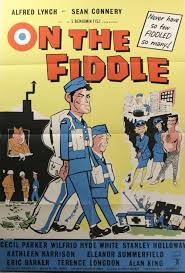
ON THE FIDDLE
UK, 1961, 89 minutes, Black-and-white.
Alfred Lynch, Sean Connery, Victor Madden, Eric Barker, Cecil Parker, Wilfrid Hyde White, John Le Mesurier, Graham Stark, Patsy Rowlands, Eleanor Summerfield, Miriam Karlin, Bill Owen, Barbara Windsor, Beatrix Lehmann.
Directed by Cyril Frankel.
The title indicates the activities of something of a rogue. And that is certainly the case here with the character and performance by comedian Alfred Lynch.
This film has a war setting, looking something like those war films from the 1940s and 1950s – but then veering into comedy, touches of parody and satire, very much the type of English comedy for the broad audience at the end of the 1950s, the early 1960s – especially remembering that this was the period of the emerging of the Carry On series.
The first part of the film shows Lynch as Horace, hanging around with all kinds of scams, and using all kind of patter to insinuate himself into the various situations – but, arrested, pretending that he was lining up for enlisting, means that his patter has landed him in the RAF.
Most of the film is a series of cons, with the supremely confident Horace, able to take charge of all kinds of situations. But, he immediately makes a friend, Peddlar, played by comparative newcomer, Sean Connery, a year before he was to be James Bond in Dr No. Peddlar is not the brightest, admires Horace, plays along with all kinds of situations, but does question Horace’s moral stances.
There is a lot of sending up of RAF officers, especially allowing themselves to be tripped so often. And, there is an interesting episode with a butcher, the meat for the RAF, attach a romantic interlude, the butcher and his wife played by Stanley Holloway and Kathleen Harrison, comedy veterans, an appearance by Wilfrid Hyde White is a quietly muttering innkeeper. And the young Barbara Windsor turns up at the end of the film.
And, while Cecil Parker has top billing, he does not appear as the flustered commander until almost the end of the film.
The Royal Navy provided cooperation, allowing the producers to film in Chatham Dockyard, and aboard HMS Jaguar and HMS Chaplet.
Perhaps this war film was a little dated by 1960 and its perspective on remembering World War II. Which means then that the targets of satire are not fresh in the cinema audience’s mind in the 21st-century but, allowing for these aspects, it is a chance to see several British comedians in action – and, course, the young Sean Connery.
