Displaying items by tag: Jeremy Allen White
Mandalorian and Grogu, The
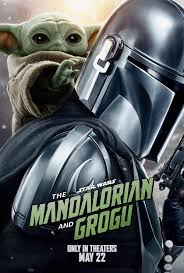
THE MANDALORIAN AND GROGU
US, 2026, 132 minutes, Colour.
Pedro Pascal, Brendan Wayne, Sigourney Weaver, Steve Blum, voices of: Jeremy Allen White, Stephen McKinley Henderson, Shirley Henderson, Martin Scorsese.
Directed by Jon Favreau.
It is 50 years since Star Wars surprised the world, delighted audiences, created a whole new perspective on Galaxy fantasies, some wonderful sequels, characters, laser action, the Force, and John Williams majestic score. The 21st century, some films, but the more recent emphasis has been the television series, the Mandalorian.
One of the creators of The Mandalorian was actor-director, Jon Favreau. Instead of the fourth in the series, he has opted for the big screen. For audiences who have enjoyed the series, familiar characters and material, action, and an opportunity to see it in a cinema atmosphere.
For audiences not familiar with the series, who hark back to the old days of the trilogies, it is something of a surprise. No opening with the galaxy far far away. No John Williams score. And, there is a rather more serious tone compared with the past, 3 CPO and R2D2, a range of strange characters and creatures, Jabba the Hut, Yoda, and we got to know Luke Skywalker, Princess Leia, Han Solo, Obi Wan Kenobi.
The Mandalorian is played by Pedro Pascal, seen in so many films and television series in recent years. But, he wears armour, is masked. This is something of a barrier to communicating his personality, having to rely on his voice and body language and action (and, in fact, it is Brendan Wayne, John Wayne’s grandson, who is actually in the armour). So no strong personal connection as we used to have with Han Solo.
But, there is Grogu, a diminutive Yoda-like creature, American-cute, but also able to participate in all the action (after he learns to press the right buttons).
But, there is plenty of action, the somewhat brutal introduction to the Mandalorian as a mercenary and his elimination of enemies and the Startroopers. He is employed by Colonel Ward, played by Sigourney Weaver. He has a mission to find the son of Jabba the Hut which leads to a kind of gladiatorial arena fight against monstrous creatures and robots. And, in space, attacks, fights, explosions…
For 21st-century audiences and series fans, a continuation of what they know. For older 20th century audiences, not quite what they might have been expecting.
- 50 years after the beginning of the Star Wars franchise? Through many films, through the Mandalorioan and television series? Continued popularity?
- The Star Wars Galaxy, the Empire, the Republic, the storm troopers, rebellion, mercenaries and battles? The weaponry, the starships?
- The continuation of the Mandala and television series? The changes from the original, the different opening, no John Williams score, the more serious tone, the intermittent light touches with Grogu and the small creatures?
- The hero, armour and masked, the less personalised character, the removal of his mask in the middle of the film, some sense of his humanity?
- The situation, the Mandalorian and his missions, reputation, for hire, seeing him in action, the fights, the enemy, the board meeting, the pressure of the leader, the subservience of the members, his shooting one of them? The attack by the Mandalorian, the pursuit, the deaths? His return?
- The importance of Grogu, the foundling, small, American cuteness, Yoda influence? Companion, presence, participating in the action, limited, liked by the audience?
- Colonel Ward, her control, the mission? The tradition of Jabba the Hut, his son, the twins and their hostility?
- The Mandalorian and, his mission, wanting the son, the hostility, the situation, the twins, the sinister role of Lord January, his betrayals?
- The gladiator sequence, creatures, the fights, the Mandalorian and his surrender, the response of the crowds, of Lord Janu?
- The rescue of the son, the small creatures and their technical skills, chatter, activities?
- The final flight, the dangers, the attack, explosions, survival?
- The return, Colonel Ward, her attitudes, to the final mission, Jabba the Hut;s son, final decisions?
- And the continuity of the story, the characters, the series?
Springsteen: Deliver Me from Nowhere
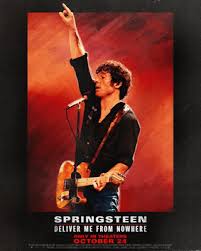
SPRINGSTEEN: DELIVER ME FROM NOWHERE
US, 2025, 120 minutes, Colour.
Jeremy Alan White, Jeremy Strong, Stephen Graham, Odessa Young, Gaby Hoffman, David Krumholz, Paul Walter Hauser, Harrison Sloan Gilbertson, Grace Gummer, Mark Maron, Matthew Anthony Pellicano Jr.
Directed by Scott Cooper.
Bruce Springsteen is a significant figure in American and world music, 20th century, 21st-century. This is a portrait of Springsteen in 1981-1982 rather than a biography, rather than an exuberant immersion in his music. That is the tone of the title, Deliver Me from Nowhere. And, in one sequence where a car salesman says to Springsteen, “I know who you are”, Springsteen replies “at least that’s one of us”.
Some background on Springsteen himself for those unfamiliar or less familiar with his life and career, courtesy of Wikipedia:
Springsteen has released 21 studio albums spanning six decades; most of his albums feature the E Street Band, his backing band since 1972. Springsteen is a pioneer of heartland rock, combining commercially successful rock with poetic, socially conscious lyrics that reflect working class American life.
And there is some Catholic background:
Springsteen attended the St. Rose of Lima Catholic School in Freehold, where he was at odds with the nuns and rebelled against the strictures imposed upon him, though some of his later music reflected a Catholic ethos and included Irish Catholic hymns with a rock music twist. In 2012, Springsteen said that it was his Catholic upbringing rather than his political ideology that most influenced his music. He said his faith gave him a "very active spiritual life" but joked that this "made it very difficult sexually" and added "once a Catholic, always a Catholic… I don't participate in my religion but I know somewhere... deep inside... I'm still on the team.”
This is very serious portrait and becomes more serious as it continues. There are black and white flashbacks to Springsteen’s childhood, a protective mother, a seriously alcoholic father, sometimes violent, demanding his son to be a man. Gaby Hoffman plays the mother and British actor, Stephen Graham (significant this year for his contribution to the series, Adolescence) is his father. But, Springsteen has the opportunity for some reconciliation with his father.
In 1981-1982, Springsteen worked in his bedroom, moved by watching the film, Badlands (1978) with Martin Sheen. It led to his reflections and a series of songs, just acoustic guitar, with very serious themes, Nebraska. And, at the same time, he composed what became something of an anthem, Born in the USA. (He is shown watching, several times, Robert Mitchum in the 1955 The Night of the Hunter, taken by his father to see it, the scenes of menace on the little boy.)
Springsteen is played effectively by Jeremy Alan White, award winner for his television series The Bear. Some have remarked that he does not look like Springsteen but, in his performance, he is able to communicate much of what drives the loner as well as the hyper-vigorous concert performances.
Supported strongly by his manager, Jon Landau, another fine performance from Jeremy Strong (Succession and frightening as Roy Cohn in The Apprentice), and by sympathetic waitress, Faye, Odessa Young, all kinds of opportunities offered to him by record companies and fans, Springsteen is often a recluse, feeling haunted many times, and an eventual acknowledgement of depression.
Which means that this film is a piece of Americana, on 20th century popular culture, an opportunity to appreciate Springsteen’s imagination and creativity, some insights into his perceptions of the US, the performance of some songs and songs in process, the American response (despite recent public condemnations of Springsteen by President Trump) rather than a concert musical.
- The title, the focus on Springsteen as a loner, depression? The experience of his loan composition of the album, Nebraska?
- Audience response to Springsteen, six decades of music, performance, public figure? Reputation, honest, medal from President Biden, criticism from President Trump?
- The film not as a concert experience although songs and performance included? The film is a portrait, flashbacks to childhood, 1981-1982, tours, composition, Nebraska, Born in the USA? Collaboration with Jon Landau? Record companies and agents, the recordings and the complications?
- Bruce Springsteen as a singer, performer, poet, creator, lyricist? And the performance by Jeremy Alan White?
- A picture of Bruce Springsteen, the New Jersey background, home life, his protective mother, going to the bar to ask his father to come home, the violence towards his mother, a to spy with his father, his father hitting him, the drinking, taking him to see The Night of the Hunter, Bruce with the baseball bat? The placing of these memories throughout the film?
- The opening concert, the energy, the performance, the exhaustion, the fans and interviews? His relationship with Jon Landau, over the years, friendship? Landau serious, knowing Springsteen’s genius, listening, advising, at home with his wife and testing ideas? Connections with the record companies, promotion, especially concerning Nebraska and the response of A whole Teller? The issue of Nebraska, the recording, the orchestra, Springsteen’s dissatisfaction, perfectionism? The mental health issues and Jon Landau’s support?
- The creation of Nebraska, watching Martin Sheen in Badlands, researching the story, the issues, resentment against society, the murders, the motivations and reactions? Is visualised? Impact, the suggestion of stories, the suggestion of songs? And the significance of the many sequences with the composing of the songs, their being played? Different from his other songs?
- At home, alone on the guitar, friendship with Mike, bringing the equipment, listening, the cassette, the limitations, the echo, Springsteen wanting this exact replication, the extent of the technicians in reproducing the sand? Then the album to be issued without name, press, promotion, tour? The scepticism of the industry?
- The episode with born in the USA, film, Paul Schrader? The composition, possessed in the performance? The promoters wanting it out there? It is being held until after Nebraska?
- Springsteen and his personal life, loner, awkward relationships, meeting the friend from school, Faye, the conversation, her being a fan, going to house, meeting her daughter, the outings, the play, his ability at being a father figure for the daughter? The merry-go-round is and all kinds of entertainment? The sexual relationship with Faye? Then his absence, not answering the phone, the conversations with Faye, leading up to her confronting him, and his leaving, her accusing him of always running away from himself?
- The issue of knowing himself or not, the quote from Flannery O’Connor about going back to the past which was not there? The car salesman and Springsteen’s response? The eventual admission of depression, going out to California, the encounter with his father, age, drink, losing his job, his mother’s concern, taking his father to hospital?
- Going to therapy, his weeping? 10 months, some recovery?
- The concert, performance, John and his support, his mother present, his father, going to see his father, the invitation to sit on his lap, the reconciliation?
- The final information, the success of Nebraska, Born in the USA, his later career – and the film over 40 years later?
Fremont
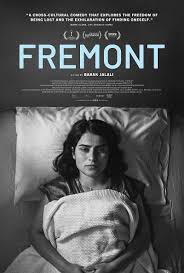
FREMONT
US, 2023, 91 minutes, Black-and-white.
Anaita Wali Zada, Greg Turkington, Jeremy Allen White, Hilda Schmelling, Siddique Ahmed.
Directed by Babajk Jalili.
Anyone who has visited San Francisco may remember the BART, Bay Area Rapid Transit, and the name, Fremont, to the south of the city. And this is where this film is located.
In fact, most of the film stays within the confines of Fremont but, at the end, it ventures out into the California deserts. And the filmmakers have opted for black-and-white photography.
A lot of the action takes place in a Fortune Cookie factory, handmade cookies, the staff inventing the wise sayings inside. This is where Donya (Anaita Wali Zada) works, a good friend in her co-worker, on good terms with the cheerful manager (but not so much with his wife), going home to her apartment, but stopping on the way for a diner meal, friendly with the manager as they watch television together. A quiet life.
But, Donya is a refugee from Afghanistan, a translator working with the Americans, getting out of the country, her family still there, something of a lonely figure but a strong figure. Which means that she is a challenge to Americans (and to citizens of any country where Afghans have fled to escape the Taleban), trying to find a new place to settle, memories of the past, the challenge to her identity. And she finds it very difficult to sleep.
She wants some sleeping pills and has a consultation visit with the psychologist. We find it very interesting to see her approach, her determination, the personality of the psychologist, his ways of dealing with his clients – and his promotion of Jack London’s White Dog as a symbol for their situations.
When the elderly writer of the sayings collapses at work, Donya is given the job. And she decides to include a phone number in one of the fortune cookie’s and to wait and see what happens.
She does get a reply and she decides to go out to visit the person who replied who tells her about a deer for her. There are some unexpectedly comic touches when she arrives – and receives a literal statue of a deer. But she stops at a garage on the way, her car needing some attention. She meets the quiet mechanic (Jeremy Allen White), goes to a diner and he follows, some conversation, and she then drives on.
But, she returns. He is very quiet. As an intense look. It affects her. And we are left with Donya out there in the desert, the weight of her life in Afghanistan, the months in the United States, her wondering and our wondering what her future will be.
- The value of small budget-independent films? Quality filmmaking? Opportunities for filmmakers and performers? Exploration of social issues? Distribution and challenge?
- The title, the Bay Area of San Francisco, the suburb, the confined view, the factory, apartments, the travel into the California countryside, the small towns, diner, garage? A particular world? In black and white?
- The background of Afghanistan, from the 19th century and occupations, Russia in the 20th century, the Taliban, 9/11, the Americans, international troops, occupation, progress, the retreat of American forces, the coming of the Taliban, rigid rule, suppression of women, sharia law, many fleeing, the deaths?
- The reality and symbolism of the Fortune Cookie factory, the texts being composed in the factory, the personal wrapping?
- Donya and her story, the initial impact, seeing her at work with the fortune cookies, conversations with Joanna, the Chinese owners, the old lady and her death, a cheery husband, the severe wife? A context for looking at Donya, her apartment, unable to sleep, conversations with the neighbour, taking his appointment at the psychiatrist, the receptionist, the doctor, her insistence?
- The revelation of her story, family, as a translator for the Americans, a desk job, supplying information and technical translations? Her family thinking her a traitor? Her being able to escape from Afghanistan, other translators and their deaths?
- Her finding herself in Fremont, eight months, the memories of the past, unable to sleep? Friends with her neighbours? Conversations with Joanna, her promotion to writing the fortune cookie sayings? Her skills, putting the message and a phone number, Joanna phoning her, the reply, seeming authentic, the signature with the Deer? Donya and her deciding to go to meet the man, a literal deer statue for the shop? Her reaction?
- The meals, at the diner, the owner, the conversations, watching the television together?
- The sessions with the psychiatrist, his initial reluctance, his explanations, her return, laconic, giving the information, filling in her background? His responses? Her wanting sleeping pills? His use of the novel, White Dog, reading of the passage, his being moved, the parallels of the part wolf, outsider, finding a place? The effects of the therapy?
- The drive, the oil in the car, the mechanic, his offering to help, a loner, his explanation himself, being alone, wanting to talk, the diner, offering the coffee, her return, the cup of coffee, the quiet attraction? Her leaving, getting the deer, the return, giving the mechanic the deer, the next cup of coffee? And Donya’s future?
- An opportunity in the 2020s to reflect on the plight of Afghanistan, the rule of the Taliban, the many migrants fleeing Afghanistan, the countries receiving them, welcome or not, adapting, future?
Iron Claw, The
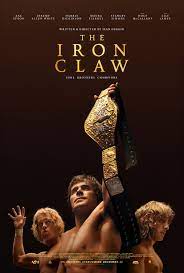
THE IRON CLAW
US, 2023, 132 minutes, Colour.
Holt McCallany, Maura Tierney, Zac Efron, Harris Dickinson, Jeremy Allen White, Stanley Simons, Lily James, Michael J.Harney, Kevin Anton.
Directed by Sean Durkin.
A strong, tough title. And a reference to a wrestling technique, the strengthening of a hand, the shape of a claw, and descending, claw-like, on the head of an opponent. The signature of the wrestling family, the Von Erichs, but also a metaphor for the control of a father over his sons.
While this is a wrestling film with many wrestling sequences (someone remarking that they were not “fake” but “pre-arranged”, vividly bringing to life the moves, the tactics, the brutality, the theatricality, and the often wild enthusiasm of the cheering crowds.
This will appeal to wrestling fans. But, for non-wrestling fans, this is also a strong family drama. It is based on an actual family, the father a one-time champion but never receiving the final accolades, his surviving four sons and his domination of them, not only to follow his career path, but to be acknowledged, recognised as champions. (For audiences caught up in the family story, there is a lot of background information on the Internet.)
There is a black-and-white prologue, the success of Fritz Von Erich, a convincing performance by Holt McCallany, and his encouraging his little boys. Then a transition to 1979, memories of the death of a very young son, the four remaining brothers, strongly bonding, huge sense of family, devotion and loyalty to their tough mother, Maura Tierney, but relying on a sense of family support. Wrestling championship is expected of each of them.
The oldest of the four is Kevin, played by Zac Efron (a long way from High School Musical days). We see him train, devote himself to rigorous regimes, and success in the ring, and he is enjoying this way of life, almost a vocation. The next son, Kerry (Jeremy Allen White from The Bear) is away from home, training in football. After him comes David, Harris Dickinson, who is emerging with championship potential, is smarter than Kevin, more articulate, and favoured by his father to go on to greater things. The contrast is in Michael, Stanley Symons, who lacks the physical build of the others and is much more interested in music, playing in a band. But, he too will be caught up in the aura of wrestling.
This is not just a story of fame and fortune. The family is said to be “cursed” and, the drama focuses on the effect of the wrestling on each of the sons, pressures, health issues, suicidal episodes, injury and coma. And, always in the foreground, the relentless father, the demands on his sons, and in certain ways, he is the one who is cursed but does not recognise it.
At the end, as with films based on true stories, there is further information about the family and some photos. As a counterbalance to the wrestling, the training, the hard physicality, there is a rather ingenuous love story, Kevin encountering a fan, played by Lily James, who takes all the initiatives to break through his wrestling preoccupations that they might make a happy couple, happy family (and the end information tells us that they have been married for almost 40 years, happy children and grandchildren living with them).
So, for some audiences, the wrestling. For other audiences, the family story and the impact of a dominating and ambitious father.
- The title, the hand, formation, iron, on the head of the opponent, blood? Symbol of the hold of the father over his sons?
- True story, the popularity of wrestling in the US, professional wrestling, techniques, training, physical progress, moves, theatricality, not fake but prearranged, the commentaries, the media and television, the fans?
- The 1970s, wrestling, the political background, scenes of Jimmy Carter, into the Reagan era?
- The prologue, black-and-white, the father, his career, success, not winning the belt, encouraging his little boys?
- The transition to 1979, the death of the young boy, his memories? The other sons, expectations? The father, his coaching, arranging bouts, contacts? Expectations of his sons, favouring one then the other? Fritz, his age, his relationship with Dottie, the long marriage, memories of their courtship, the bond between them, life at home, his personality? Dottie and her personality, restraint, keeping the house together? Meal sequences?
- The focus of the film on Kevin, Zac Efron is physical presence, build, training, running, gymnasium, pushing himself? His ambitions? Loving wrestling, love for the family and the bonding? His performances? Success? His father’s ambition for him to win the award? His not winning it? Age? His bonding with David, David emerging as favoured by his father? Kevin’s reactions?
- David, younger, taller, his physique, his determination, taking the microphone and speaking for Kevin? Training, success? The plans for Japan? His bringing up blood, the conversations with Kevin? The news of his death? The funeral? The response of the family?
- Kerry, next in line, the football training, personality, his return, training, determination, the bouts, his successes, show bouts, exhilaration, the driving, the injury, the amputation, recuperation, trying the boots, practising with Kevin, failures and falls, depression, suicide?
- Talk of the family curse, the deaths of the three boys, the curse effect on their father?
- Michael, younger, his place in the family, different build, music, the band, their all escaping through the windows after their mothers forbidding them to go? Success with the band? His being brought in for wrestling, training, the bouts, the injury, coma, slow recovery, the meal table, mental limitations? Taking the pills, writing the note, wanting to go to a better place, his death?
- The contrast with the romantic subplot, Pam as a fan, forward, talking to Kevin, bring him out of himself, his enjoying her company, her work as a vet, welcomed by the family, the wedding, her being pregnant?
- The portrait of wrestlers, their personalities, names, press conferences, boasting, self-promotion?
- The role of the media, promoters, Bill Mercer, working with Fritz, promotions, commentary, friendship?
- The deaths in the family, the boasting of the champions on media, Kevin and his determination, to win, the years, the fight, his anger, the iron claw, being disqualified?
- The final information, Kevin and Pam, almost 40 years married, the large family?
- The contribution of the family to American professional wrestling?
