Displaying items by tag: Wilfrid HydeWhite
Carry on Nurse
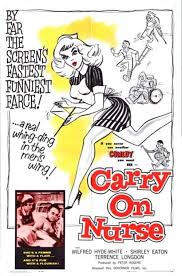
CARRY ON NURSE
UK, 1959, 86 minutes, Black-and-white.
Kenneth Connor, Kenneth Williams, Charles Hawtrey, Hattie Jacques, Joan Sims, Wilfrid Hyde White, Shirley Eaton, Terrence Longden, Bill Owen, Leslie Phillips, Susan Stephen, Susan Beaumont, Ann Firbank, Joan Hickson, Michael Medwin, Rosalind Knight, Norman Rossington, Jill Ireland, June Whitfield, Ed Devereaux, Susan Shaw, Irene Handl.
Directed by Gerald Thomas.
In retrospect, very much a film of its time, British comedy in the late 1950s, beginning the transition to explicit comedy, still a lot of innuendo but also a great number of ogling male characters.
This is the second of the Carry on series, beginning with Carry on Sergeant. Sid James, a staple of so many of the later films, had not yet joined the cast. However, a great number of the continuing cast appear here, most of the men spending their time as patients in the hospital ward. The women are nurses or visiting their husbands and boyfriends.
Hattie Jacques begins her several appearances as matron, Joan Hickson as a rather strict numbers (anticipating Miss Marple), Shirley Eaton, five years before Goldfinger, leads the nursing staff, and Joan Sims, the most regular of Carry on characters appears for the first time. There are some guest appearances by Wilfrid Hyde White and Michael Medwin. And there are some amusing cameos by various British character actors including Bill Owen, a myopic Rosalind Knight, Irene Handl and an early appearance by Jill Ireland.
While Kenneth Williams is more subdued, less facial idiosyncrasies, he plays the superior patient, interested in studying, until, at the end, the men in the ward, with drink and laughing gas, trying to remove a bunion on Leslie Phillips‘ foot, Kenneth Williams in charge of surgery. Kenneth Connor, always plays quite a different role in each film and here he is a boxer.
A lot of the verbal humour, a lot of expected hospitals shenanigans in the ward, innuendo, the 1950s British male gaze – and seeming very much more slight and innocent the later developments in the Carry on series.
- Carry on Nurse movie
- Gerald Thomas
- Joan Sims
- Hattie Jacques
- Kenneth Williams
- Kenneth Connor
- Charles Hawtrey
- Leslie Phillips
- Norman Rossington
- Wilfrid HydeWhite
- Peter Malone's Movie Reviews
- Susan Stephen
- Jill Ireland
- Rosalind Knight
- Irene Handl
- Shirley Eaton
- Bill Owen
- Ed Devereaux
- Susan Shaw
- Joan Hickson
- Michael Medwin
Murder by Rope
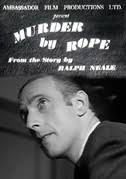
MURDER BY ROPE
UK, 1936, 64 minutes, Black-and-white.
D.A.Clark-Smith, Wilfrid Hyde-White, Sunday Wilson, Dorothy Hamilton, Guy Bellmore, Donald Reed, Albert Conway.
Directed by Geoffrey Pearson.
One of the many brief supporting features from the 1930s, murder mysteries, detection, black-and-white photography… But, while so many of them were American, this one is English, very British in style and manner.
It has the advantage of several subplots throughout the film, opening with a mad killer in the dock and condemned to death, the meetings of the jury and discussions, the condemnation by the judge.
Then, there are anonymous notes pieces of rope sent to the executioner, to the judge, warning of revenge. There is a British government concerned, and their calling in an expert on writing. There is also a novelist who was written about the case and seems to have a cheerfully morbid approach to crime (and he is played by Wilfrid Hyde-white in jovial form, but 28 years before he was to achieve immortality singing The Rain in Spain with Rex Harrison in My Fair Lady).
Then there is a gathering at a stately mansion, a judge invited, a popular actress, the judges nephew and his wife, a suspicious other guest, as well as the Butler and the maid – which leads into a crime subplot and the theft of a necklace.
And, then the expert goes to the mansion, the playwright suggesting a scenario that they re-enact, lights going out, lights coming on and the judge did. The expert then takes over the investigation, interrogating everyone.
All kinds of suspicions, the judges nephew with a money problem, suspicions on the playwright, phones cut, cast disabled, miles from the police and a phone…
And, the solution which most people would never have guessed and Agatha Christie and her fans would be very pleased.
On the Fiddle
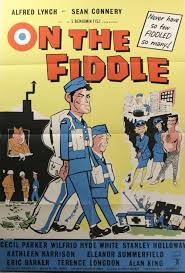
ON THE FIDDLE
UK, 1961, 89 minutes, Black-and-white.
Alfred Lynch, Sean Connery, Victor Madden, Eric Barker, Cecil Parker, Wilfrid Hyde White, John Le Mesurier, Graham Stark, Patsy Rowlands, Eleanor Summerfield, Miriam Karlin, Bill Owen, Barbara Windsor, Beatrix Lehmann.
Directed by Cyril Frankel.
The title indicates the activities of something of a rogue. And that is certainly the case here with the character and performance by comedian Alfred Lynch.
This film has a war setting, looking something like those war films from the 1940s and 1950s – but then veering into comedy, touches of parody and satire, very much the type of English comedy for the broad audience at the end of the 1950s, the early 1960s – especially remembering that this was the period of the emerging of the Carry On series.
The first part of the film shows Lynch as Horace, hanging around with all kinds of scams, and using all kind of patter to insinuate himself into the various situations – but, arrested, pretending that he was lining up for enlisting, means that his patter has landed him in the RAF.
Most of the film is a series of cons, with the supremely confident Horace, able to take charge of all kinds of situations. But, he immediately makes a friend, Peddlar, played by comparative newcomer, Sean Connery, a year before he was to be James Bond in Dr No. Peddlar is not the brightest, admires Horace, plays along with all kinds of situations, but does question Horace’s moral stances.
There is a lot of sending up of RAF officers, especially allowing themselves to be tripped so often. And, there is an interesting episode with a butcher, the meat for the RAF, attach a romantic interlude, the butcher and his wife played by Stanley Holloway and Kathleen Harrison, comedy veterans, an appearance by Wilfrid Hyde White is a quietly muttering innkeeper. And the young Barbara Windsor turns up at the end of the film.
And, while Cecil Parker has top billing, he does not appear as the flustered commander until almost the end of the film.
The Royal Navy provided cooperation, allowing the producers to film in Chatham Dockyard, and aboard HMS Jaguar and HMS Chaplet.
Perhaps this war film was a little dated by 1960 and its perspective on remembering World War II. Which means then that the targets of satire are not fresh in the cinema audience’s mind in the 21st-century but, allowing for these aspects, it is a chance to see several British comedians in action – and, course, the young Sean Connery.
Story of Gilbert and Sullivan, The
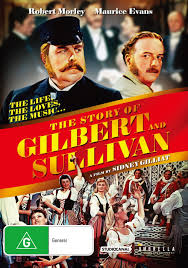
THE STORY OF GILBERT AND SULLIVAN
UK, 1953, 109 minutes, Colour.
Robert Morley, Maurice Evans, Eileen Herlieh, Peter Finch, Martyn Green, Dina Sheridan, Isabel Dean, Wilfred Hyde-White, Muriel Aked, Michael Ripper.
Directed by Sidney Gilliat.
From a 21st-century perspective, it is surprising to discover that this film was not successful at the box office on its release in the early 1950s. Yet, the operettas of Gilbert and Sullivan continued to be very, very popular.
This is quite a lavish production, sets and costumes, theatrical design, English society in the latter part of the 19th century.
For audiences interested in Gilbert and Sullivan, Robert Morley gives a variation on his enjoyably pompous performances as the self-confident Gilbert, master of words and witty lines, yet dreading opening nights, avoiding them, returning to hear applause and go happily on stage. Maurice Evans is Sullivan, classical composer of oratorios, eventually an Opera, teaming up with Gilbert, challenged by friends and a potential fiancee played by Dinah Sheridan, to honour his talent for high art. However, he is carried away and has composed many wonderful melodies, songs to accompany Gilbert’s words, but the music having a stand alone and entertainment value.
The screenplay follows the various productions, reproducing scenes from some of the most famous and well known. The film starts with an extensive excerpt from Trial By Jury, then moves into such favourites as HMS Pinafore, the Pirates of Penzance, The Mikado, The Gondoliers and Yeomen of the Guard, Iolanthe. And references to other creations like The Sorcerer.
Peter Finch appears as D’Oyley Carte, the manager of the company, the builder of the Savoy Theatre, involved in the building of the Opera house. There are quite a number of British character actors in support, Eileen Herlie as Helen D’Oyley Carte, a successful business partner with her husband, Isabel Dean as Gilbert’s wife and an entertaining cameo from Wilfred Hyde-who is to who enjoys the performances unlike his snobbish daughter.
There is some pathos at the end after Gilbert and Sullivan’s falling out, not speaking for some years, a possible reconciliation, the turn-of-the-century performance of the Yeomen of the Guard and the news of Sullivan’s death. Gilbert continued and was knighted by Queen Victoria, the culmination of the film.
In 1999, writer-director, Mike Leigh, did more than justice to Gilbert and Sullivan and their creations in his lavish and engaging film, Topsy Turvey.
