Displaying items by tag: Glynis Johns
Josephine and Men
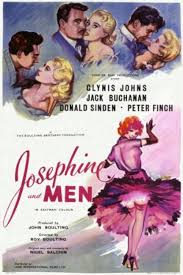
JOSEPHINE AND MEN
UK, 1955, 95 minutes, Colour.
Glynis Johns, Donald Sinden, Jack Buchanan, Peter Finch, Heather Thatcher, Ronald Squire, William Hartnell, Gerald Sim, Victor Maddern, Thorley Walters, Laurence Naismith, John Le Mesurier, Lisa Gastoni.
Directed by Roy Boulting.
This is an all-stops-out comedy drama of the mid-1950s. It has a strong leading cast but it is also a film with many well-known British character actors in supporting roles.
The Josephine of the title is played by Glynis Johns, busy, organised, intervening, engaged to Donnell Sinden, an upcoming businessman. Also around is her playboy uncle who narrates the story into a bartender, played by veteran Jack Buchanan, in films since 1917, Broadway since 1924, very well known for his starring role in The Bandwagon. And, then there is the emerging Peter Finch as a playwright.
The film should have worked better than it does. Perhaps Nigel Balchn, creator of thriller novels and screenplays is not the best choice for writing this kind of comedy drama. And, Roy Boulting had great success with films like Brighton Rock.
The actors give their all but the treatment seems, at least in retrospect, somewhat laboured. Josephine with a compulsion to help needy men, encountering the disorganised playwright, breaking the engagement to the businessman, marrying the playwright and, over the years, supporting him, urging him, and his having great success. On the other hand, the businessman has resigned, successful but suddenly turning up on their doorstep with the police after him because of allegations of fraud.
And, at the same time, the wandering, uncle also turns up.
So, Josephine with her compulsion needs to be helping the businessman on the run and so neglecting her husband. All kinds of complications, misunderstandings, the police in pursuit and interrogations, some amusing supporting characters with their roles.
But, many decades later, does not have the impact it may have had in its day.
Loser Takes All
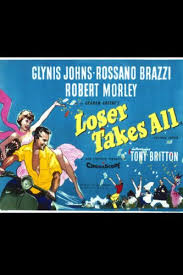
LOSER TAKES ALL
UK, 1956, 88 minutes, Colour.
Glynis Johns, Rossano Brazzi, Robert Morley, Tony Britton, Felix Aylmer, Joyce Carey, Geoffrey Keane, Albert Lieven, A.E.Matthews.
Directed by Ken Annakin.
In retrospect, the biggest surprise about this film is that it is based on a Graham Greene short story and the screenplay has, in fact, been written by Graham Greene. (He is said not to have been so happy about the finished product – he would not have given it a good review in the days when he was a film reviewer!).
It has lavish treatment, a strong cast and Monte Carlo locations and fashions. But, it has a brief running time, a type of British screwball comedy. Characters are not meant to be consistent and, here, they definitely are not. And they are slightly sketched overall.
Rossano Brazzi is a meticulous accountant, wins the favour of businessmen, Robert Morley, who invites him to Monte Carlo for a holiday where he is to marry his fiancee, Glynis Johns. The wealthy man does not turn up and the couple have very limited resources. However, they do get married. A stranger offers a gambling system to the husband and he becomes absorbed, winning a great deal of money and enabling the couple to live something of a high life. But, the husband gets so involved that he neglects his wife and she has caught the eye of a British gambler, played by Tony Britton in his first film.
The plotline is somewhat predictable but the credibility of the characters following the predictable plotline is very doubtful. Perhaps the actors are doing their best, but Rossano Brazzi becomes too serious and avaricious and Glynis Johns more flighty.
There are several character actors in support, a surprising turn by Joyce Carey who has her own schemes in the casinos, Geoffrey Keane as a manager being very superior to the customers.
The film is an early film directed by Ken Annakin who was to have a successful career in the UK and the US, dramas as well is blockbusters.
Spider's Web, The/ 1960
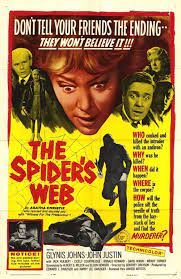
THE SPIDER'S WEB
UK, 1960, 89 minutes, Colour.
Glynis Johns, John Justin, Jack Hulbert, Cicely Courtneidge, Ronald Howard, David Nixon, Wendy Turner, Basil Dignam, Ferdy Mayne, Peter Butterworth, Anton Rodgers.
Directed by Godfrey Grayson.
Based on a play by Agatha Christie. However, it is very slight, even lighthearted in comparison with The Mousetrap and, especially, Witness for the Prosecution.
The action all takes place in a mansion, over a couple of hours. The running time is brief – the remake in 1982 with Penelope Keith is 15 minutes longer.
The first 20 minutes or so establish the characters, especially Glynis Johns as the new wife of diplomat, John Justin, prone to speculating and imagination, influencing her stepdaughter in the same vein. There are mysterious servants. And there is a mysterious gardener, Mrs Peake, played by Cicely Courtney. The mansion was previously owned by an antiques dealer – and there is a secret object which the murder is after.
The action develops when a sinister visitor arrives, who has married John Justin’s ex-wife. He claims to come to get the daughter back. However, he returns, searches a mysterious desk, and is found murdered. While the stepdaughter has played with some voodoo dolls and is upset that she killed the visitor, her stepmother decides to take the blame, calls back her friends who are at the club to help her move the body.
Many will remember The Trouble with Harry or Weekend at Bernie’s and disappearing corpses. Fortunately, this old mansion has secret doors and a secret hiding place!
While there is the question of who done it, there is the big question of where to hide the body. Peter Butterworth, in unusual casting, is the police inspector. The friends of the family include a neighbour, a magistrate, a former member of the Secret Service.
The whole thing seems rather dated, 1960s style, rather stage bound, and a somewhat flighty performance, which many have found charming, from Glynis Johns.
Ronald Howard (son of celebrated actor Leslie Howard) with his glasses and build seems to be anticipating Colin Firth!
And, there is the satisfaction of finding out, eventually, whodunnit.
