Displaying items by tag: Roy Boulting
Josephine and Men
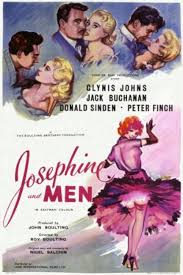
JOSEPHINE AND MEN
UK, 1955, 95 minutes, Colour.
Glynis Johns, Donald Sinden, Jack Buchanan, Peter Finch, Heather Thatcher, Ronald Squire, William Hartnell, Gerald Sim, Victor Maddern, Thorley Walters, Laurence Naismith, John Le Mesurier, Lisa Gastoni.
Directed by Roy Boulting.
This is an all-stops-out comedy drama of the mid-1950s. It has a strong leading cast but it is also a film with many well-known British character actors in supporting roles.
The Josephine of the title is played by Glynis Johns, busy, organised, intervening, engaged to Donnell Sinden, an upcoming businessman. Also around is her playboy uncle who narrates the story into a bartender, played by veteran Jack Buchanan, in films since 1917, Broadway since 1924, very well known for his starring role in The Bandwagon. And, then there is the emerging Peter Finch as a playwright.
The film should have worked better than it does. Perhaps Nigel Balchn, creator of thriller novels and screenplays is not the best choice for writing this kind of comedy drama. And, Roy Boulting had great success with films like Brighton Rock.
The actors give their all but the treatment seems, at least in retrospect, somewhat laboured. Josephine with a compulsion to help needy men, encountering the disorganised playwright, breaking the engagement to the businessman, marrying the playwright and, over the years, supporting him, urging him, and his having great success. On the other hand, the businessman has resigned, successful but suddenly turning up on their doorstep with the police after him because of allegations of fraud.
And, at the same time, the wandering, uncle also turns up.
So, Josephine with her compulsion needs to be helping the businessman on the run and so neglecting her husband. All kinds of complications, misunderstandings, the police in pursuit and interrogations, some amusing supporting characters with their roles.
But, many decades later, does not have the impact it may have had in its day.
Suspect/ The Risk
SUSPECT/THE RISK
UK, 1960, 81 minutes, Black-and-white.
Tony Britton, Virginia Maskell, Peter Cushing, Ian Bannen, Raymond Huntley, Thorley Walters, Donald Pleasence, Spike Milligan, Kenneth Griffith, Robert Bruce, Anthony Booth, Basil Dignam, Sam Kydd, Murray Melvin.
Directed by John Boulting, Roy Boulting.
British Nigel Balchin wrote thrillers and wrote the screenplay for this brief film. The Boulting brothers had a strong presence in British cinema from the 1940s. Their intention with this film was to enhance the quality of British supporting features, small budget, filmed in 17 days, brief running time. Critics at the time were harsh on the film, American critics more sympathetic.
With the writing, the Boulting Brothers’ direction, and the considerable quality of the supporting cast, serious issues of scientific experimentation, wartime security, espionage and stealing secrets, there is quite a lot of material in 81 minutes. The locations are confined, home, laboratory, restaurants, espionage. With the supporting cast so articulate, the dialogue makes a strong impression.
In fact, Tony Britton and Virginia Maskell as the stars are not as strong as the character actors, some veterans like Raymond Huntley as the politician, Peter Cushing as the professor, Kenneth Griffith as his assistant, Donald Pleasence, always sinister, Thorley Walters as an eccentric investigator, Ian Bannen as the cynical war invalid, all bring quality to the performances. And there are quite a number of interesting cameos from actors like Spike Milligan, serious and comic at the end, Sam Kydd, Murray Melvin, Anthony Booth.
A curiosity item of the period but an interesting and entertaining 80 minutes.
- Small-budget supporting feature, a television filming style?
- Nigel Balchin thriller, his writing the screenplay, nation, science, politics, espionage, romance? Popular ingredients?
- The cast, the range of British character actors, the focus on dialogue, interactions, intensity, themes articulated in the British style?
- The focus on scientific experimentation, the professor, years of experience, Peter Cushing’s style, the staff, summoned by the government, closure on his experiments, his reactions, the staff, the situation with the dedication of the statue? His discovery of Marriott with the documents, his reaction, the police, covering for Marriott?
- Bob Marriott and Lucy Byrne, colleagues, skills, the date to the pictures, Lucy and her reticence, the situation with Alan, losing his arms in war, her caring for him, past fiancee, his manner, cynical? His meeting with Marriott, charming exterior, undermining him, the connection with Brown, the situation about the government ban, the documents, saving the experiments, handing them over?
- Lucy, her work, with Marriott, the attraction, her helping with Alan, the meeting with Brown, her ignorance, her being interrogated?
- Marriott, his character, dedicated to his work, the experiment with his arm, his reaction to the ban, led on by Alan, the meeting with Brown, taking the documents, the meeting with the spies?
- Dr Shole, collaboration, personality, Mr Prince making the contact, with his assistant, the suspicions, summoning him, the information? The scenes with the professor?
- Mr Prince, his role in the investigations, sometimes doddery, absent-minded, his office a mess, the meetings with Dr Shole, relying on his assistant, the interviews, his hypotheses?
- Brown, his background, sinister, Donald Pleasence’s style, his eyes, the arrangements, the meeting, being the documents, the person in charge, the police, gunshots?
- The politics, the Minister, calling in the professor, good mannered but intense, forbidding the experiments, danger for enemies getting hold of them, the dedication of the statue, his assistant, his visit to the laboratory in meeting the staff?
- The assistant at the office, Spike Milligan, more serious – the final comedy with the monkey?
- British politics in world politics in the late 1950s? This film seen in retrospect?
Run for the Sun
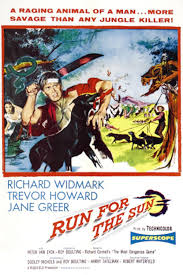
RUN FOR THE SUN
US, 1956, 99 minutes, Colour.
Richard Widmark, Jane Greer, Trevor Howard, Peter van Eyck..
Directed by Roy Boulting.
Jungle adventure set in Mexico. Richard Widmark plays a celebrated writer who served in World War II as a journalist but has disappeared. Jane Greer plays a journalist from a popular magazine, try to track down the author, flying to Mexico and discovering him.
Widmark flies his plane and crashes in the Mexican jungle. However, Widmark and Greer are quickly rescued by Trevor Howard and his associates, allegedly doing archaeological work in the jungle, especially Peter van Eyck.
But, Widmark recognises Trevor Howards voice, remembers that he was a kind of flawed Haw-Haw broadcasting from Berlin during the war, then that van Eyck is a ruthless assess officer. In a scene outlining his novel to Howard, he voices his hold history from dissatisfied but English upper-class to traitor and then fugitive.
The latter part of the film is a pursuit through the jungle, the former Nazis with their dogs, a variation on the Most Dangerous Game scenario.
It looks rather dated in decades later, but at the time it was quite popular. The film was cowritten by director, Roy bolting of the bolting brothers, and veteran Dudley Nichols.
- The title, the final chase, running east, to the sun?
- The Mexican settings, the village, the water and fishing, the bar, flight through the jungle, the crash, finding the settlement, the covert operations, the pursuit through the jungle? The musical score?
- Katie, New York journalist, arriving in Mexico, the taxi, the hotel, the encounter with Mike, his novels, pretending not to know him, her quest to find him, for the magazine? The attraction, the conversations?
- Mike, author, disappearing, background, journalism, D-Day, Berlin, his writing, Africa, disappearing?
- The interaction between Katie and Mike, his discovery of the truth, her phone call from New York, his disdain, her giving him the address – and later finding it and apologising for his suspicions?
- Taking her to Mexico City, the plane, petrol, the crash? Brown and his associates rescuing them? The local Indians and their village? The disappearance of the plane? The welcome, suspicions? Archaeologists, Mike searching the basement, discovering the lies?
- Brown, welcoming, the Dutch archaeologist, suspicions, the dogs and their barking and threats?
- Mike unmasking the group, his narrating the story for his novel, Brown’s story? Katie and Mike walking, Brown’s plane?
- The escape, the pursuit, the Indian family, the puma and is warding off the dogs? Through the jungle, brown in pursuit, setting up the trap? The dog is passing through the River, Brown and the group? Mike doubling back, to get the plane, exhausted, trapped, the set up with the bullet, killing Brown?
- The final escape, to the plane, the happy ending?
Moving Finger, The/ 1984
THE MOVING FINGER
UK, 1984, 102 minutes, Colour.
Joan Hickson, Michael Culver, Deborah Appleby, Andrew Bicknell, Sabina Franklin, Richard Pearson, Douglas Hamlet, John Barnett, Penelope Lee, Juliet Whaley.
Directed by Roy Boulting.
The Moving Finger is a second of Agatha Christie’s Miss Marple stories to be adapted for television starring Joan Hickson. Joan Hickson does seem to be the embodiment of Agatha Christie’s interpretation of Miss Marple (very different from Margaret Rutherford and Angela Lansbury) and several of the Joan Hickson stories being remade with either Julia Mackenzie or Geraldine McEwan.
The atmosphere of the 1950s is very strong, the small town, touch of isolation, the minister and his wife and life centred on the church, the local doctor, the local lawyer, the local gossip. At the centre of this story is the brother and sister, he wounded and crashing his plane, she caring for him.
The title refers to the poison pen letters which have been circulating in the town, attacking people and their characters, revealing this behaviour, the mystery of their being typed on the typewriter at the church charity.
There are various aspects, different relationships in the town, the lawyer’s daughter acting erratically but finally key to Miss Marple’s revealing the murderer – and the issue whether poison pen letters are written by women or men.
The film was directed by Roy Boulting, one of the Boulting brothers, very prominent in film direction in production in the British industry in the 1940s, 50s and 60s – and, for Roy Boulting, into the 80s.
- The popularity of Agatha Christie mysteries? Miss Marple? Joan Hickson as Miss Marple?
- The settings, the 1950s, the rural villages, homes, doctors offices, solicitors offices, the church, charities? Costumes, decor, cars…? Authentic atmosphere? The musical theme?
- The title, poison pen letters?
- The introduction to Gerry and Joanna, the war background, recuperation, settling in, the aunt, the home, friends, at the church, the noting of the various characters in the village?
- The situation with the letters, the pages, from the book, the typewriter, at the charity? The targets, the accusations, vilification? The effect on various people? Gerry receiving one?
- Mr Pye, gossip, at the church, his comments? A possible suspect?
- The range of people, suspects, Symington, law firm, his secretary, his wife at home, the troubles with Megan, the two boys? The doctor, from Wales, his sister as receptionist? At the house, Partridge, the dismissal of Beatrice, her boyfriend, the minister and his wife?
- The invitation for Miss Marple, Joan Hickson’s portrayal, age, intelligence, noticing, and the interactions with the chief inspector?
- The death of Mrs Symington, the note, the poison? The death of Beatrice, concealed?
- The inquest, the testimony, the verdict of suicide? Miss Marple dissenting?
- The complications, Gerry and his interest in Megan, the trip to London, the Pygmalion transformation, the return home, her being poisoned – and this being revealed as a ploy by Miss Marple?
- The doctor, and Joanna, the attraction, Joanna receiving a letter?
- The work at the charity, the typewriter, the donation?
- The resolving of the situation, Miss Marple trapping Symington, his motivations, Miss Holland and her looking after his boys, his motivations, the letters, a male writer rather than female, Beatrice realising what it happened after her fight with her boyfriend?
- Miss Marple and the explanations, satisfactory mystery, and solution?
