Displaying items by tag: Simon Russell Beale
Magic Faraway Tree, The
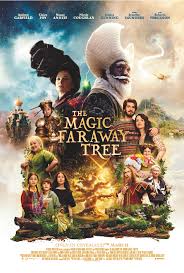
THE MAGIC FARAWAY TREE
UK, 2026, 105 minutes, Colour.
Andrew Garfield, Claire Foy, Delilah Bennett-Cardy, Billie Gadsdon, Nonzo Anozie, Rebecca Ferguson, Jennifer Saunders, Nicola Coughlin, Jessica Gunning, Michael Palin, Mark Heap, Dustin Demri-Burns, Simon Russell Beale, Lenny Henry, Tim Plester, Phoenix LaRouche.
Directed by Ben Gregor.
Enid Blyton, along with Lewis Carroll and Beatrix Potter, is a significant name in speaking about British children’s and family literature. And some of them have been transformed into films and ballets. This film is based on three Enid Blyton stories of the Magic Tree.
Here is a fantasy about children, about families, about imagination. In fact, the Thompson family, Tim and Polly (Andrew Garfield and Claire Foy) have three children. Falling on very hard times, they have to move to the country, where Tim grew up. They find an old barn, no electricity, let alone Wi-Fi! Two of the children are not very pleased, finding the isolation away from friends and technology, hard to bear. They are Beth and Joe. However, Fran, not given to talking much, has a sense of the magic, discovers the Magic Tree, encounters the fairy, Silkie, the giant Moonface, the man who cannot remember his name, and Mrs Washalot. She has a dial to spin, able to pick one of a range of worlds to visit. Fran does, returns home, a challenge to the family, a test for her brother and sister.
While watching, one wonders who the target audience for this film is. A way of understanding is to look at the response of the three children which might correspond to responses of children watching the film. Fran, young girl, is delighted with her discoveries. Joe, even younger, avid games player, does not understand this magic world at all – but, accompanying Fran, he becomes open to its delights. The trouble is with Beth, assertive teenager, described by her upset father as a “spoiled brat”. She isolates herself in the room upstairs, observes with disdain upper window, pines for her phone, her friends, dismissing Fran’s discoveries as nonsense. (And, maybe, some of her fellow teenagers watching the film may have the same reaction!)
But, in our heart of hearts, we know that she will undergo a conversion experience, highly reluctant, condescendingly agreeing – rather nasty with Silky, at one stage wishing her parents tomato and sauce business venture to fail, and then carried away with the experience and definitely on side.
Which means then that there are all kinds of imaginative delights, a world where sweets and lollies are unlimited, a world of knowing a lot, a world of spells – and, of course, a villain, Madame Slap (Rebecca Ferguson), her classroom and, detention, and some rude joke defiance! But, there are the themes of the family unity, the family song, working together, and, happy ending (even convincing Polly’s haughtily severe Germanic mother, played by Jennifer Saunders!).
- Traditional British storytelling for the children’s readership? Families? The film tradition?
- Enid Blyton, her stories, audiences, the trilogy of the Magic faraway Tree? Cinema adaptation? Narrative, characters, imaginative worlds, family themes? Fantasy and imagination?
- The locations, filmed in Malta, forest, the town, the dilapidated barn, the Magic Tree, the variety of worlds, creativity and imagination, costumes and decor, eccentric characters, make, voices? The greenhouse, dilapidated, re-created? The village and the launch? The musical score?
- The family, the financial situation, Tim and Polly, his Italian background, spaghetti and sauces, tomatoes, speaking Italian? Polly, her Germanic mother and demands, her mother disappointed in her? Jobs, finance, having to move, packing up, driving, the lone station, walking, discovering the barn? Tim and Polly and their optimism, creativity? Beth and Joe, spoilt children, demands, losses friends, Wi-Fi issues, computer games…? Fran, more sympathetic, the purse, Silkie and her presence, the sense of the fairies?
- The picture of family life, adapting, Polly and her abilities, planning and design, achievements? Tim, optimism, a steady hand, the tractor, the buildings, the greenhouse? The transformation? The happy parents?
- Beth, sulking, in her room, her complaints, her age? Joe, wanting electricity, not knowing how to play outside? The contrast with Fran, going out, discovering the magic, Silkie, Moonface, Mrs Washalot, the man who could not remember his name? Sharing, delight, discovering the world, going up the ladder, the range of sweets and delights, the supervisor against greed? Happy collecting, the marshmallows, Fran and being tempted, the rescue? Her going home, beginning to talk, with her parents?
- Polly’s mother, her assistant, in town, Jennifer Saunders’ comedy, demanding, and Beth writing the letter, posting it, the arrival by helicopter, demands, disappointment with her daughter, coming back for the launch of the source, naming Beth and her letter? The pressure on Beth?
- The situation, the tomatoes, the source, the family eating, Fran and Joe in competition, but the difficult situation?
- Beth, her agreeing to accompany Fran, the scepticism, the tree, repeating the magic words, opening up, her initial encounters, the washing water falling on her, the shrinking jacket, the familiar characters, Silkie and her enthusiasm, interactions with Beth, friends, sisters, antagonism? Agreeing to go up the ladder?
- The dial, the many possible worlds, the World of Knowing A Lot, the British character actors in the combined presence? Arguments? The way to the World of Spells, going to the hardhearted world, the wishes, Silkie becoming a fairy, Fran and the deep voice, Joe and the head from the computer games, unable to eat pizza? Beth and her wish that the project would fail? Silkie willing to sacrifice her wish so that the others could go back to being themselves?
- The plane, flying to the Castle, the background of Madame Slap, her Castle, the confrontation, the plane, going to sleep, Joe and his piloting the plane, the others on the trip, the confrontation with Madame, the classroom, her severity, and sitting back, detention people being cheeky, going to detention, then the various farts, escape, playing, waking up, her cries and waking the plane, her roar and giving it impetus?
- The discovery of the greenhouse and the failure of the crop, maggots? Tim and Polly trying to cancel the launch?
- At home, the launch, the people gathering, happy atmosphere, enthusiasm, Tim and Polly, going to the greenhouse, opening the door, the ripe tomatoes, the children, even Polly’s mother amazed, the selling of product, the bright future?
- Beth, contacting her friends, their arrival, collecting their phones, dancing and enjoying the launch? Everybody dancing, wishes fulfilled?
Choral, The
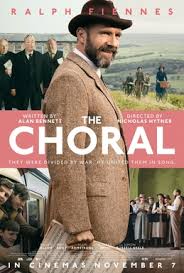
THE CHORAL
UK, 2025, 114 minutes, Colour.
Ralph Fiennes, Roger Allam, Mark Addy, Alun Armstrong, Ron Cook, Simon Russell Beale, Jacob Gudman, Emily Fairn, Taylor Uttley,
Directed by Nicholas Hytner.
There have been many perspectives on World War I and inspect on Britain, on young men and conscription. This is definitely to the fore in this film. But, the focus is on music, the choral.
This is the fictional town of Ramsden, like many Yorkshire towns, recreated in quite some detail, the vast mills which dominate everyone, the streets, the lanes, the houses, the pubs, the Grand Hotel, the railway station and the surrounding hilly countryside. The film immerses us in Ramsden.
And there is a wide range of characters, so many that, at times, the audience might lose touch with who’s who, suggestions of character but leaving it to the audience to fill in. There is the postman with a sad letters knocking on doors and the grieving mothers and wives, and his cheeky young offsider who sees grief as an opportunity for making come kind of sexual advance. There is Mary, the young Salvation Army singer, member of a black family. There is Bella, her boyfriend at war, missing, her taking up with someone else. There are the rather haughty ladies, the contraltos of the choir, snobbish. There is Mrs Bishop whose ordinary home serves as a brothel.
But, the focus is on the choral, the committee led by the mill owner, aided by the photographers and the vicar – characteristically good performances from veterans Roger Allam, Alun Armstrong, Mark Addy, Ron Cook. The choir master in lists.
The proposal for the new choirmaster is Mr Guthrie, talented conductor, living a lot of time in Germany, under suspicion for this, and the quiet indication that he might be homosexual. He is played by Ralph Fiennes, another excellent performance.
So a great deal of the film focuses on the motley choir, the recruiting of any of the young men around the town willing to sing, the auditions, serious and comic, music from popular songs to Gilbert and Sullivan, arias. The intention is Bach’s St Matthew’s Passion but the suggestion by Mr Guthrie of Edward Elgar’s oratorio, The Dream of Gerontius, from the poem by Cardinal Newman (and some anti-Catholic bigotry expressed).
A lot of rehearsal sequences, the return of Bella’s boyfriend, Clyde, Jacob Dudman, despite an arm lost, disappointment with Bella, Mr Guthrie persuading him that his sadness can be the basis for developing his gift and his being offered the role of Gerontius. Some fine scenes where Mr Guthrie talks intensely with Clyde about his fate, and a speech by Clyde indicating that purgatory exists, and that it was there in the no man’s land between the trenches.
An episode with Elgar himself, a jaunty Simon Russell Beale, agreeable, then taken aback by the plans for the interpretation of his oratorio.
Perhaps it’s the old story of putting on a show, but, ultimately, it is a moving success. But, then more reality, conscription, young men reaching that age, and the farewell at Ramsden Station.
It would be hoped that the film would encourage those who like to sing to join a choir – but, there is something strange about seeing the jaunty young men of that period singing serious music, not dreaming that rock and roll and heavy metal were to come and take over. The screenplay was written by celebrated playwright, Alan Bennett, in his late 80s.
- Expectations, music, the Yorkshire town, World War I, conscription, battle and deaths?
- The Yorkshire setting, the town of Ramsden, the detail of the town, streets, lanes, homes, shops, pub, the hotel, the Hall, the surrounding countryside, the Hills?
- The importance of music, the wide range, the Dream of capturing tears, Bach and St Matthew’s Passion, popular songs of the period, Gilbert and Sullivan, late 19th century and early 20th century music?
- The background of the war, 1916, the young men called up, the postman delivering the letters, the grieving wives and mothers? The issue of conscription, the young men reaching the age to go to war, the diminishing number of young men?
- The factories and mills, the dependence on the mills, Duxbury and his owning the mills, his position with the choral, his associates, the photographer and the photos of the young men, his associate, the vicar, the committee for the Choral, the range of auditions, good and bad, the boys urged to go including the postman and his friend, the women, the contraltos and their snobbery, the pianist and his going to war, motives, photo? The need for the choirmaster?
- Suggestion of Mr Guthrie, reactions, living in Germany, success in Germany, indications quietly of his homosexuality? His return because of the war, the music of the Grand Hotel, the approach, the discussions, his quoting Goethe, their wanting him to be quiet about Germany? Bach as German, the other composers, his having met Brahms? His agreement?
- Meeting the choir, the new auditions, his reactions, Duxbury and his love of singing? The other men? Mary, black, Salvation Army, earnest, her voice? Bella, the popular songs, but part of the choir? The need for men, going around the town, the pub, eyeing of the girls, the man from the pastry shop?
- The practice, the discussions, the characters of the various members of the choir, the boys, age, no school because of lack of teachers, issues of sex, girlfriends, sex talk, insensitive? The range of the girls, Bella and the boys, her reticent friend, Mary? The older women, snobbish? Mrs Bishop, her house being a brothel? Duxbury’s visit?
- The discussions about Bach, the suggestion of Elgar, the story of The Dream of Gerontius, Cardinal Newman and anti-Catholic prejudice? Guthrie and his letter to Elgar? The return acceptance? Elgar and his doctorate at Manchester, Mary and the invitation?
- War spirit, the choir and the news of the victory, singing God save the King, Guthrie quiet, the death of German friends?
- Robert, accompanist, devotion to Guthrie, hit critique of him? Piano, support? The call up, his decision to be conscientious objector, Guthrie’s arguments, for the sake of the choir, the hearing, the jingoistic woman, the presumptuous canon knowing God’s mind about war, stiff military man and his contempt of Robert’s motivations?, Duxbury and his trying to mediate? Guthrie present, his argument, the extension because of the concert?
- Bella, Ellis and the flirtation, her memories of Clyde, his return, loss of his arm, going to meet her, his disappointment? Leaving her free? Sitting on Hill, his sexual request, her acquiescence motivation? His grief? Love of singing, the audition, Guthrie’s response, Duxbury as Gerontius, buildup to it, Clyde stepping in, Mary as the Angel? The limitations of the choir, no orchestra that the three-piece group, the change of perspective, younger Gerontius, the war situation?
- Conscription, the young men going to be examined, the man from the bakery and epilepsy? The others preparing to go? Feeling that they had not lived? Sexual experience? The young man attracted to Mary, encouraged by her enthusiastic mother, the time alone, the proposal, Mary’s reaction, his stripping, her turning away, her loneliness? The postman going to Mrs Bishop, the sexual encounter, the formalities, no payment?
- The arrival of Elgar, the academic down, his initial enthusiasm, Mary singing, discovery that Clyde was Gerontius, looking at the score, his upset, the tantrum, offering Mary a tutor? Leaving in a huff? The discussions, the suggestion of no payment so it would be an amateur performance, no fees for Elgar?
- Letting everyone know, the audience gathering, the strength of the performance, the World War I setting, Gerontius wounded and dying, Clyde and his explanation about purgatory against the Vicar’s Anglicanism, the powerful explanation that than no man’s land was a purgatory for survival? And the background of Guthrie’s talk with Clyde agreeing that he was at his lowest, but that it was the time to sing, to make the most of it?
- The success of the performance, everybody happy? The applause? Duxbury and his reclusive wife? Her response and reconciliation?
- The young men going off on the train, the farewell at the station, Robert being taken in by the military as conscientious objector? Guthrie and his achievement?
- A perspective on Britain and World War I, the small Yorkshire town, the young men, the war across the channel, wounds and deaths, return?
Frankenstein/ 2025
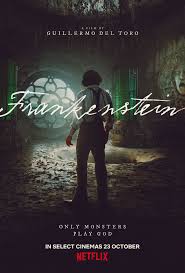
FRANKENSTEIN
US, 2025, 150 minutes, Colour.
Oscar Isaac, Jacob Elordi, Christophe Waltz, Mia Goth, Felix Kammerer, Charles Dance, David Bradley, Lars Mikkelson, Christian Convery, Burn Gorman, Ralph Ineson.
Directed by Gullermo del Toro.
Mexican director, Guillermo del Toro, has had a long fascination with imagination and fantasy, the celebrated Pan’s Labyrinth, and popular action with Blade, Hellboy, Pinocchio. So, what will he choose to do with Frankenstein?
This is very much an all stops out interpretation of Mary Shelley’s classic novel, its narrative, its characters, its explorations of themes of life and death, human arrogance, playing God, playing the devil. Since Boris Karloff played the creature in the 1930s, there have been very many Frankenstein films, and Hammer Studios thrillers, Kenneth Branagh’s 1994 spectacle…
Here is an epic treatment, the Gothic traditions, running for 2 ½ hours.
The familiar elements are all here, the opening in the Arctic with Frankenstein and the monster stranded, the rescue, Victor Frankenstein narrating his story wanting some kind of healing and forgiveness, the background of the Frankenstein family, demanding father, Victor and his scientific interest, experiments with reviving some kind of life, his laboratory, hunting the dead bodies, the creation of the creature, the lightning, the aftermath, the wandering creature and the confrontation with its maker. And all presented with heightened atmosphere.
In all the treatments, the question is how sympathetic Victor Frankenstein should be. Oscar Isaac here is not sympathetic at all – oppressed by his demanding father (Charles Dance), relying for help on his younger brother, William (Felix Kamerer all) and the link with Elizabeth (Mia Goth) and her tender affection for the Creature. There is an interesting new character, the wealthy man, Harlander, Elizabeth’s uncle, who wants to bankroll Frankenstein and his experiments with some sinister intentions, played with his usual relish by Christophe Waltz.
But, significant in this film is that the Creature, not called monster, though made up of many body parts, neatly put together, is, for the most part, the most sympathetic character. And Jacob Elordi plays him with a great deal of pathos, but with dignity, gradually coming to consciousness, words, ideas, out in the countryside learning compassion, to read, but also discover the truth about his origins and that he was doomed not to die.
This is a film which gives great attention to atmosphere, sets and decor, costumes, atmospheric score, enabling audiences to appreciate why the Frankenstein story has continued to be entertaining but much more, a questioning of human power, human arrogance, and the need for forgiveness.
- Lasting popularity of the story, Mary Shelley’s novel and treatment, issues of life, creativity, death, playing God, playing the devil? The many versions, from the 1930s, Hammer Studios, Kenneth Branagh, 1994, the cinema tradition?
- The lavish treatment, sets and decor, costumes, atmosphere? Atmospheric score? The Arctic sequences in the snow and ice, the University sequences, the laboratories, the castles, 19th-century society? The countryside sequences, bleak, wolves, winter?
- The opening in the Arctic, the presence of Frankenstein and the Creature, the ship, the expedition, the Capt, the crew, the confrontation with the Creature, saving Frankenstein, the threats from the Creature, Frankenstein telling his story, his confession, his fate?
- The introduction to the Creature, initial horror, strength, menace, threat to Frankenstein, the interaction with the sailors, violence, deaths?
- Frankenstein telling his story, his background, the sequences with his father, his father’s demands on the cruelty? Treatment of his wife? The birth of his brother? The two brothers grow growing up? The father, the doctor, unable to save his wife, his demands on Victor, testing him as regards medicine, science? His death?
- Victor, relationship with his brother, growing up, his brother’s life, Elizabeth, her relationship with William? Her visits? Her family background? Expectations? Harlander and Elizabeth as his niece?
- Victor, his experiments, his machines, theories, the skeletons, the body parts, his demonstration to the professors in Edinburgh, electric charge, movement and life? Then denouncing him?
- Harlander and his ambitions, personality, state of health, finance, collaboration with Victor, finding the Castle and location? William and his helping his brother build up the laboratory in the Castle?
- Victor, access to bodies, the executioner, the choices, the background of war, injuries, examining the bodies, transporting them to the Castle, the various limbs? Putting them together, sewing, a composite Creature rather than a monster?
- The pressure from Harlander, the confrontation with him, syphilis, wanting to be transferred into the creature, Victor not wanting him because of contamination for his brain, his falling to his death? Concealing his body?
- The storm, the lightning, the drama of his setting up the situation, the Creature, lightning, the movement, coming to life?
- The nature of the creature, tall, presentable, clothing and cloak, able to say only Victor, the humanity, the inhumanity?
- Victor’s reaction, amazed, fearful, presumptuous, the treatment of the Creature, imprisoning him? The effect on Victor’s consciousness, conscience? More than he expected? Not anticipating the consequences?
- The effect on the creature, lonely, exploring the Castle, the relationship with Victor? His ability to heal quickly?
- Elizabeth, her visit, the discovery of the Creature, the bonding, talking, his saying her name? Her response to Victor?
- Victor and his impatience with the creature, lack of development, explaining Harlander’s death to William, the decision to set fire to the Castle, the elaborate preparations, setting the fire, the creatures call, Victor’s change of heart, entering, the explosion, breaking his leg?
- The creature surviving, wandering the countryside, the wolves, the community, his hiding, surviving, the family and their life, hunting the walls, leaving the old blind man, the Creature, listening, understanding, sympathy for the old man, hearing the family’s needs, building, chopping the wood, all kinds of service? The happy life and friendship? The family thinking him the Spirit of the Forest? The old man to Jim to read, speak, think, reflect? Growing understanding? The walls, the return of the family, the Creature fleeing?
- The decision to find Victor, the return to the Castle, the notes, reading them, knowing that he would live for eternity, getting Victor’s address, travelling to Vienna, the buildup to the confrontation, Victor regretting creating him? The Creature wanting a companion? The celebration, society, lavish? Elizabeth, shielding the Creature from the shot, William dying, fearing his brother, the Creature helping Elizabeth that she dies?
- The situation in the Arctic, the response of the captain, encouraging Victor to tell his story, sympathy and understanding, the help of the doctors, the creature coming on board, the explanations, Victor’s repentance, the Creature for giving him? The response of the crew? The captain changing his ambition to reach the North Pole and to return home, the response of the crew?
- The Creature pushing the ship out of the ice, and looking towards the sun, reaching out and beginning his life without death?
Downton Abbey: The Grand Finale
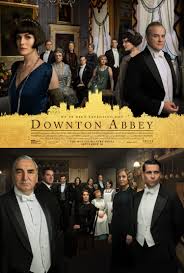
DOWNTON ABBEY: THE GRAND FINALE
UK, 2025, 125 minutes, Colour.
Michelle Dockery, Hugh Bonneville, Elizabeth McGovern, Joanne Froggatt, Paul Giamatti, Dominic West, Laura Carmichael, Phyllis Logan, Alessandro Nivola, Jim Carter, Penelope Wilton, Joely Richardson, Alan Leech, Robert James-Collier, Simon Russell Beale.
Directed by Simon Curtis.
The title says it all: Downton Abbey: The Grand Finale. But, Julian Fellowes, creator and writer of the series and the movies, invites us to watch it all. And, it is probably all that Downton Abbey audiences are hoping for.
It is 1930. The Great Depression as hit the United States and, because of Cora, Lady Grantham, American, there are repercussions of the Depression for Downton Abbey itself in the upstairs aristocracy that we have come to know as well as the downstairs servants whom we have also got to know very well. And, although divorce statistics have increased, they are not acceptable in the English upper-class. Lady Mary has filed for divorce, unacceptable, she is shunned, but her family and some of the shocked servants, as well as ourselves, are there to support her.
We are introduced to all the familiar characters, so many of them most getting older, especially Lord Grantham, some retiring. And, with the first part of the film set during the season in London, especially with buildings and billboards in Piccadilly Circus, the theatre season as well, we are immersed in the London experience, especially a visit to Bitter Sweet, Noel Coward’s play, and an introduction to Coward himself, many of his songs and lyrics throughout the film and, the presence of the playwright in London and a visit to Downton along with his star, played by Dominic West. In fact, Noel Coward is going to save the day several times throughout this drama - rehabilitating is Mary (and a wry joke about his play, Private Lives) and his brainwave for his play Cavalcade, seen as a potential investment!.
But, back to Downton, beautiful, sumptuous, the beautiful grounds, limbs and decor, grand dinners… As well as all the familiar faces downstairs and the bonds between those upstairs and downstairs, though, dining separately!
And there is the annual affair, the haughty president, quite misogynistic, what meetings, and the challenge from the new cook at Downton, spurred on by a defiant Lady Merton.
The main drama concerns Cora’s brother, Harry, played by Paul Giamatti, arriving at Downton to sort out their mother’s estate, and the revelation that he has lost money, but is accompanied by his grinning American financial adviser, played by Alessandro Nivola. Lady Mary is taken in by him – but we aren’t. And it takes a very striking sequence by Mary’s sister, Edith, talking very straight at him and unmasking him – all at the seasons races Ascot!
With the financial difficulties, Lady Mary is to take over Downton, her parents move aside, and of an era – and, we should mention, the portrait of Violet, glimpsed many times through the film and some footage from the past of Maggie Smith at her imperious best. This film is dedicated to her.
And, at the end, with the various farewells, and the focus on Lady Mary, she treats us to a whole range of her memories, the events of the past, vignettes of the various characters, meaning that this is a very nostalgic farewell.
The grandeur of Downton Abbey and the memories of its aristocratic and comfortable life are very seductive. Most of us surrender as we watch – but, it is seduction because most of us would be very uncomfortable were we invited in real life to Downton, our reaction to the manner and manners of the aristocratic class, the fact that most of us are quite egailitarian in our attitude to society.
At the end, it is almost as if we should start singing There’ll Always be an England. But history and reality reminds us that while this Downton life still continues, it is diminishing, but are still part of the dreams and fantasies of the 21st-century audience. So, the film was right in the final credits’ song is Noel Coward’s I’ll See You Again from Bitter Sweet.
(And for trivial pursuit aficionados, the link between director, Simon Curtis, and star, Elizabeth McGovern, is that they were married in 1993 and have two children.)
- The popularity of the television series and the various films over such a long period? And popular internationally?
- The settings, the Abbey, exteriors, the grounds, the lavish interiors, upstairs and downstairs? The contrast with the London sequences, flats in the city, the season in London in the late 1920s, early 1930s? And the American connections? The overriding presence of Maggie Smith, references, portraits?
- Audience familiarity with the main characters, the generations of characters, marriages? And American connections?
- The downstairs characters, butler, cook, various maids, companions, the details of life downstairs, the etiquette, the cooking, serving, the meals together downstairs? The accepted status quo?
- The establishing of the characters, the London sequences, the generation getting older, the next generation, financial issues, moves to London, selling properties? The reality of divorce, acceptable or not in British society, attitudes towards Lady Mary? At popular functions, criticisms, denunciations, her having to leave?
- Back at Downton Abbey, the financial situation, Robert and Cora, reluctance, decisions, the divorce situation, interactions with Mary? The possibility for moving? To London?
- Mary, the divorce, memories of her husband, working with her sister, the various connections and in-laws, discussions, support?
- Cora, her brother arriving, memories, funerals, financial issues? Harold bringing Gus, Gus and his American charm, the racing connections, his behaviour with Mary, the affair, Ascot, his horse, the revelations about his being a conman, taking in Harold, his being unmasked and ousted? Background of the Depression in the US and its consequences worldwide?
- The various complications with the downstairs characters, changes, retirements, audiences identifying with the range of characters?
- The local stories, Sir Hector and his hold over the socialising and organisations in the district, Isabel Merton, antagonism, the committee, her friendship with the cook, inviting her to be on the committee, the drama at the various meetings, the cook assertive? And the day itself, at the fair, the various competitions, rides and enjoyment, the crowds, and a comeuppance for Sir Hector?
- The theatre background, Noel Coward, the musical themes, his celebrity, playwright and his film connection, Noel Coward and his companion, the connection with Downton, all the organisation and secrecy to bring Noel Coward to Downton?
- Noel Coward, his arrival, downstairs, upstairs, his companion, able to move from upstairs to downstairs, the invitation to the staff to come upstairs, the symbolic changing of society in the 1930s? Howard and his influence, financial investment, and ideas for future plays?
- The farewell to Downton Abbey, Robert and Cora, Mary and her new responsibilities?
- The wide popularity of these characters and their situations – and, yet, audiences enjoying the fiction but critical of the class differences and realities?
Firebrand, The
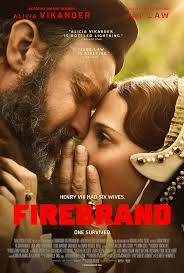
FIREBRAND
UK, 2023, 121 minutes, Colour.
Alicia Vikander, Jude Law, Simon Russell Beale, Eddie Marsan, Sam Riley, Erin Doherty, Junia Rees, Patsy Ferran.
Directed by Karim Ainouz.
There is always something interesting and arresting in any story about Henry VIII. And, this is the case here, Henry VIII at the end of his life, returning from battles, throwing his (heavy) weight around, acting on whims, up and down relationship with his wife, Katherine Parr, and caught up in political machinations, especially with the Seymours, the brothers of his late wife, Jane Seymour, uncles of his heir, the boy to be Edward VI. And, there are ecclesiastical intrigues, strong-minded promoters of Protestant theology, ambiguous Catholic prelates like Stephen Gardiner, and, especially the death of Henry VIII.
While this film is supposed to be a history of Katherine Parr, it is a fiction based on a successful series of novels by Elizabeth Fremantle. At this point, it is worth recommending another series of novels, those of the barrister, Matthew Shardlake, long but engrossing books by C.J.Sansom bringing this period vividly to life.
There is a difficulty with the title here, Firebrand. This is not exactly firebrand storytelling. There are some sparks but, rather, this is a somewhat dark and claustrophobic story, mainly confined within the palace. Nevertheless, it reminds us that Katherine Parr was a strong woman even if in the various stories of Henry VIII, she comes at the end of his succession of six wives. And she survived him (though, with a touch of fiction, Henry VIII in this film does not survive her.)
Katherine Parr is played by Alicia Vikander, an intelligent woman, a writer, collector of prayers, committed to the Protestant cause, in contact with a strong female evangelist who experiences the ire of the King. Katherine has served as regent while Henry has been away at the wars. She has been successful, also a strong stepmother young Elizabeth and the young Edward. At this stage, Mary, with her fiery Spanish background from her mother, Katherine of Aragon, is a young adult at the court.
But, while the film shows Katherine as strong, the performance is not quite as attention commanding as intended. Jude Law is pompous, vulgar, festering leg injury, callous in terms of his lustful roving eye, a monarch of whims, Law certainly holding audience attention. As does Simon Russell Beale as Stephen Gardner, reminding audiences of the complexities of the break from Rome, of the role of the Catholics, of the role of the emerging Church of England. Gardiner machinations, intrigues, has the ear of the king, is hostile to Katherine Parr, the scenes of the film concerning him the most active.
While Katherine Parr survived and married Thomas Seymour, the last part of the film highlights the Tudor history to come in drawing attention to the young Elizabeth, her character, her emerging self-assertion.
Firebrand does not stand out amongst the film is about Henry VIII but, the subject matter is always interesting and intriguing.
- The title? As applied to Katherine Parr, the historical role, author, promoter of the Protestant cause, relationship with the Seymours, the last wife of Henry VIII? Not so much of a firebrand in this version?
- Elizabeth Fremantle and her Tudor novels? Adapted, historical interpretations, inventions, the film’s screenplay and further interventions and interpretations?
- The period, the last year of Henry VIII’s life? His return from the wars? His reputation, Katherine of Aragon and the divorce, the clash with Rome, wanting the male heir, execution of Anne Boleyn, Elizabeth, Jane Seymour and her death, Prince Edward? The marriage to Katherine Parr, her being Regent during his absence, stepmother to his children?
- The portrait of Katherine Parr, her age, her past, marriages and widow, relationship with the Seymours, the political implications? Her concern about her books, her prayers and compositions, publishing? Her skills, as Regent, the relationship with Elizabeth, good stepmother? The marriage to Henry VIII, a loving relationship, tolerating the relationship, personal, sexual, political? His ability to turn against those closest to him? The execution of two of his previous wives?
- Katherine Parr, the connection with Anne Askew, the scenes with Anne Askew, her preaching, her beliefs, the Bible, strong Protestantism? Katherine Parr’s support? The gift of the heirloom and its later been used against her?
- Jude Law’s interpretation of Henry VIII, big, ageing, jovial, hedonistic, whims, narcissistic, back from the war, his past, his children, his hold over them, trusting Katherine Parr, his relationship with her, his vigorous and violent sexuality? Food? His health, the infection on his leg, the doctors treating him, in close-up? The sores, the smell?
- The King’s behaviour, his whims, erratic, the banquet, his eyeing of the young woman and interviewing her, getting her to sing, all in the presence of his wife? The expectations of the time for the king and women? His relationship with the Seymours? His relationship with Stephen Gardiner, Gardiner’s advice, machinations, against Anne Askew, against the Queen?
- The Seymours, Katherine’s relationship with Thomas, the planning of Edward, the era of the king, the king suspicions about Thomas, the accession of Prince Edward, Edward and advising Thomas to betray Katherine for their political safety?
- Stephen Gardiner, Catholic background, in the service of Henry VIII, the fluidity of Catholic prelates and Protestant prelates, the absence of Thomas Cranmer from this film, Gardiner, Catholic attitudes, against Anne Askew, interrogating the Queen, his visits, interviews, his political and religious names?
- The portrait of Mary, speaking Spanish, memories of her mother, her age, attitude towards Elizabeth, in the presence of the king, the banquets, her relationship to Katherine?
- The portrait of Elizabeth, strong minded, her age, coping in the court, her attitude towards her father, the memories of her mother’s death? Reliance on Katherine Parr?
- Prince Edward, his age, heir to the throne, the Seymour’s? His role in the court, his father’s attitude?
- Katherine Parr, the pregnancy, and invention for this story, the experience of the pregnancy, the king’s reaction, the miscarriage, the blood, the consequences?
- Katherine, the arrest, in prison, the release, her going to visit Henry, invented aspect of her responsibility for his death? Fiction?
- The enclosed nature of this story, within the walls of the Castle, some views of the building from outside, but the claustrophobic effect? And in the confines of this Tudor world?
