Displaying items by tag: Charles Dance
Ladies First
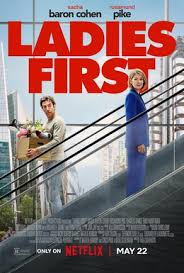
LADIES FIRST
US, 2026, 93 minutes, Colour.
Sacha Baron Cohen, Rosamund Pike, Tom Davis, Emily Mortimer, Werucha Opia, Charles Dance, Fiona Shaw, Richard E.Grant, Kathryn Hunter, Bill Paterson, Ron Cook.
Directed by Thea Sharrock.
There has been a constant popularity in films of role reversals, parents becoming children, children parents, and, sometimes, the role reversals of men and women, being transported into an alternate universe. And that is the case here – but, it is a remake of the 2018 French comedy,. I am not the Easiest of Men which was released at the time of the #Me Too emergence.
Perhaps 2026 is a bit late for Ladies First as some reviewers have suggested. However, as we watch it, the comedy of the men behaving in a female way, was to be subservient, accepting this, exasperated, finding ways to overcome it as well as the comedy of the women behaving in insensitive macho attitudes and manner, it does make its points for a wide audience.
And, this version has many advantages. Who better than Sasha Baron Cohen, memories of Borat and his other films and satires, playing the misogynistic, obnoxiously insensitive male, paying lip service to female executives and ignoring them at meetings, seeing himself as a contemporary Lothario, but remaining male throughout the story, forced to face the macho-women mirror images of his objectifying behaviour. Many tangles, many humorous moments, many satiric barbs – and his finally getting the message.
The other advantage is having Rosamund Pike as the co-star, her two previous films, Now You See Him, Now You Don’t and In the Grey, saw her cast as rather ruthless business women and she draws on this when, after being introduced as a 20 year employee at the firm, receiving a token promotion but ignored at meetings, and then transformed into the hard-hearted executive dramatising and exercising all the ambitious, unscrupulously dominating mirror of male behaviour.
And, there is a strong cast character actors in supporting roles. The usually urbane Charles Dance has become a rather simpering assistant. Kathryn Hunter, rather tiny, a cleaner in the office, always getting in the executive’s way, transforms into a hard-drinking, dominating CEO. Richard E.Grant, is a pigeon-man vagrant who understands the situation, trying to give advice to Sasha Baron Cohen.
Also a plus is the director, Thea Sharrock, who has made the sensitive, The Beautiful Game, as well as the sharp satire of Wicked Little Letters.
So, a whole lot of reversal situations, most of them very funny, but always the consciousness/conscience check that male chauvinism is being sent up as exercised by the women and that the men are experiencing as women, the continued putdowns, targeted male superiority, male exploitation and harassment.
And, for those who enjoy words and play on words, there are all kinds of funny moments and quick quips, Queens Cross instead of King’s Cross, the end of the prayer as a-woman, a variation on frequently used swear word. And, on a broadcast, Pope Beatrice IV.
Sad to say, this kind of comic role reversal, perhaps required somewhat less than in times past, is still very relevant.
Frankenstein/ 2025
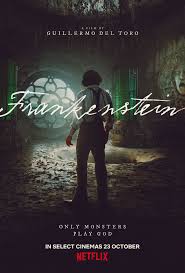
FRANKENSTEIN
US, 2025, 150 minutes, Colour.
Oscar Isaac, Jacob Elordi, Christophe Waltz, Mia Goth, Felix Kammerer, Charles Dance, David Bradley, Lars Mikkelson, Christian Convery, Burn Gorman, Ralph Ineson.
Directed by Gullermo del Toro.
Mexican director, Guillermo del Toro, has had a long fascination with imagination and fantasy, the celebrated Pan’s Labyrinth, and popular action with Blade, Hellboy, Pinocchio. So, what will he choose to do with Frankenstein?
This is very much an all stops out interpretation of Mary Shelley’s classic novel, its narrative, its characters, its explorations of themes of life and death, human arrogance, playing God, playing the devil. Since Boris Karloff played the creature in the 1930s, there have been very many Frankenstein films, and Hammer Studios thrillers, Kenneth Branagh’s 1994 spectacle…
Here is an epic treatment, the Gothic traditions, running for 2 ½ hours.
The familiar elements are all here, the opening in the Arctic with Frankenstein and the monster stranded, the rescue, Victor Frankenstein narrating his story wanting some kind of healing and forgiveness, the background of the Frankenstein family, demanding father, Victor and his scientific interest, experiments with reviving some kind of life, his laboratory, hunting the dead bodies, the creation of the creature, the lightning, the aftermath, the wandering creature and the confrontation with its maker. And all presented with heightened atmosphere.
In all the treatments, the question is how sympathetic Victor Frankenstein should be. Oscar Isaac here is not sympathetic at all – oppressed by his demanding father (Charles Dance), relying for help on his younger brother, William (Felix Kamerer all) and the link with Elizabeth (Mia Goth) and her tender affection for the Creature. There is an interesting new character, the wealthy man, Harlander, Elizabeth’s uncle, who wants to bankroll Frankenstein and his experiments with some sinister intentions, played with his usual relish by Christophe Waltz.
But, significant in this film is that the Creature, not called monster, though made up of many body parts, neatly put together, is, for the most part, the most sympathetic character. And Jacob Elordi plays him with a great deal of pathos, but with dignity, gradually coming to consciousness, words, ideas, out in the countryside learning compassion, to read, but also discover the truth about his origins and that he was doomed not to die.
This is a film which gives great attention to atmosphere, sets and decor, costumes, atmospheric score, enabling audiences to appreciate why the Frankenstein story has continued to be entertaining but much more, a questioning of human power, human arrogance, and the need for forgiveness.
- Lasting popularity of the story, Mary Shelley’s novel and treatment, issues of life, creativity, death, playing God, playing the devil? The many versions, from the 1930s, Hammer Studios, Kenneth Branagh, 1994, the cinema tradition?
- The lavish treatment, sets and decor, costumes, atmosphere? Atmospheric score? The Arctic sequences in the snow and ice, the University sequences, the laboratories, the castles, 19th-century society? The countryside sequences, bleak, wolves, winter?
- The opening in the Arctic, the presence of Frankenstein and the Creature, the ship, the expedition, the Capt, the crew, the confrontation with the Creature, saving Frankenstein, the threats from the Creature, Frankenstein telling his story, his confession, his fate?
- The introduction to the Creature, initial horror, strength, menace, threat to Frankenstein, the interaction with the sailors, violence, deaths?
- Frankenstein telling his story, his background, the sequences with his father, his father’s demands on the cruelty? Treatment of his wife? The birth of his brother? The two brothers grow growing up? The father, the doctor, unable to save his wife, his demands on Victor, testing him as regards medicine, science? His death?
- Victor, relationship with his brother, growing up, his brother’s life, Elizabeth, her relationship with William? Her visits? Her family background? Expectations? Harlander and Elizabeth as his niece?
- Victor, his experiments, his machines, theories, the skeletons, the body parts, his demonstration to the professors in Edinburgh, electric charge, movement and life? Then denouncing him?
- Harlander and his ambitions, personality, state of health, finance, collaboration with Victor, finding the Castle and location? William and his helping his brother build up the laboratory in the Castle?
- Victor, access to bodies, the executioner, the choices, the background of war, injuries, examining the bodies, transporting them to the Castle, the various limbs? Putting them together, sewing, a composite Creature rather than a monster?
- The pressure from Harlander, the confrontation with him, syphilis, wanting to be transferred into the creature, Victor not wanting him because of contamination for his brain, his falling to his death? Concealing his body?
- The storm, the lightning, the drama of his setting up the situation, the Creature, lightning, the movement, coming to life?
- The nature of the creature, tall, presentable, clothing and cloak, able to say only Victor, the humanity, the inhumanity?
- Victor’s reaction, amazed, fearful, presumptuous, the treatment of the Creature, imprisoning him? The effect on Victor’s consciousness, conscience? More than he expected? Not anticipating the consequences?
- The effect on the creature, lonely, exploring the Castle, the relationship with Victor? His ability to heal quickly?
- Elizabeth, her visit, the discovery of the Creature, the bonding, talking, his saying her name? Her response to Victor?
- Victor and his impatience with the creature, lack of development, explaining Harlander’s death to William, the decision to set fire to the Castle, the elaborate preparations, setting the fire, the creatures call, Victor’s change of heart, entering, the explosion, breaking his leg?
- The creature surviving, wandering the countryside, the wolves, the community, his hiding, surviving, the family and their life, hunting the walls, leaving the old blind man, the Creature, listening, understanding, sympathy for the old man, hearing the family’s needs, building, chopping the wood, all kinds of service? The happy life and friendship? The family thinking him the Spirit of the Forest? The old man to Jim to read, speak, think, reflect? Growing understanding? The walls, the return of the family, the Creature fleeing?
- The decision to find Victor, the return to the Castle, the notes, reading them, knowing that he would live for eternity, getting Victor’s address, travelling to Vienna, the buildup to the confrontation, Victor regretting creating him? The Creature wanting a companion? The celebration, society, lavish? Elizabeth, shielding the Creature from the shot, William dying, fearing his brother, the Creature helping Elizabeth that she dies?
- The situation in the Arctic, the response of the captain, encouraging Victor to tell his story, sympathy and understanding, the help of the doctors, the creature coming on board, the explanations, Victor’s repentance, the Creature for giving him? The response of the crew? The captain changing his ambition to reach the North Pole and to return home, the response of the crew?
- The Creature pushing the ship out of the ice, and looking towards the sun, reaching out and beginning his life without death?
Rumours
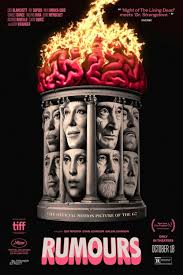
RUMOURS
Canada, 2024. 118 minures, Colour.
Cate Blanchett, Rolando Ravallo, Charles Dance, Nikki Amuka-Bird, Roy Dupuis, Dennis Menochet, Alicia Vikander.
Directed by Evan Johnson, Galen Johnson, Guy Maddin.
Esoteric and exotic are two words that come to mind while watching films by a Canadian rector, Guy Maddin. While he does have narrative and character development, his interest seems to be on the different kinds of impact films can have. His work is praised by critics. But, the average audience is bewildered.
While Rumours is probably the most accessible of his films, it still seems to have bewildered many of the public. To many, this seems so absurd a narrative, that they give up on it.
The basic plot outline, however, seems fairly direct. A meeting of leaders of the G7 takes place in ta castle in a German forest. The seven leaders meet for lunch, served in a pleasant gazebo, discussions, personal interactions, conflicts, and then their being stranded, lost in the forest at night. But, what happens to them in the forest, exposing of the limitations of their characters, the threats of impending apocalyptic doom, certainly takes them and the audience on unexpected paths.
The film does have the advantage of having Cate Blanchett in the central role as the German Chancellor, accented English and all. The other central character is the Canadian, Roy Dupuis, the most complex character of them all and he is given the final rhetorical declarations. The rest of the cast are strong character actors, including Charles Dance, of all people, as the ageing, prone to nod off, American President (and, just as it was a to explain his very proper British accent, he is cut off and we never know). Dennis Menochet dominates his scenes, a large man, -the intellectual, the French president. And Nikki Amuka-Bird, is a black prime minister from the UK.
The film might be seen as a political drama. However, the expose of the limitations of each of the leaders, leads to a satiric approach. The task for the leaders that we watch is their preparing for the communiqué, something like a school project amongst them, small groups, stating the obvious, truisms, platitudes. And then there are many farcical situations, some comedy. And, the three directors have though had an interest in conventions of horror films – so, excavations of 2000-year-old corpses, zombies, sex-obsessed, cavorting in the forest, and an AI program that is a perverse controller, and an overlarge-sized brain out their amongst the trees.
When asked to indicate approach to appreciating Rumours and its satire, a review suggests itself. What if the leaders of the G7, meeting there at the gazebo, all nodded off like the American President and had a communal nightmare. This would be the nightmare, cut off, lost, the very human limitations made all the more manifest, their being manipulated as the world seems to be going to its doom – and, rhetorically, standing there on the balcony, proclaiming some kind of hopeful G7 statement that might transcend the doom. Which means that both the leaders and we ourselves as the audience are often bewildered.
- The work of the directors? Exotic and esoteric? Ironic comedy? Drama? Touches of horror?
- The title, rumours, rumours of war…?
- The basic premise, the meeting of the G7, the world leaders, economic situation, the official statement, reassurance? The screenplay and the presentation of the leaders, strengths, and expose of weaknesses, personal incompetencies, self-importance, relationships, affairs? Their characteristics representing their nations? The meeting, lunch, the gazebo, discussions, the small groups, preparation of the statement?
- The German setting, the forest, the Castle, the gazebo, the forest? The events in the night, the darkness? The trees, the zombie-like creatures, the excavation of the bodies, Sylvain falling in, the sexual behaviour of the zombies, the ferry, the crossing of the water? The final scenes in this castle? The musical score?
- The German leader, memories of Angela Merkel, Cate Blanchet, the accent, in charge, hosting, her concerns, the attraction to Maxine, going to search for him, the sexual encounter, the aftermath? Her support, guidance? The encounter with Celestine, her being able to understand and translate?
- Maxime, Canada, the crises at home, the past affair with the British Prime Minister, his Celestine, the present with the German, his personality, his wife, deceptions? His crises and running away, the drinking, the clash with the British Prime Minister, the sexual encounter with the German leader, wandering in the forest, the discovery of the giant brain, discovering Celestine, the interactions with her? His carrying Sylvain after his collapse?
- The French Prime Minister, pomposity, large, history, his book on graves, the excavations, his literary quotes, historical quotes, relationship with the other members, especially with the Italian Prime Minister, his notes blowing away, his pursuing them, in the forest, falling into the grave, the struggle with the body, his collapse, Maxine carrying him, the wheelbarrow, the ferry?
- The Japanese Prime Minister, quiet, participating in the activities?
- The Italian Prime Minister, small, friendly, quiet, the cured meat in his pocket, helping everyone, is a special concern about the French Prime Minister, the wheelbarrow?
- The British Prime Minister, black, businesslike, the past relationship with Maxime, f ending him off, the participation in the activities?
- The American president, as played by Charles Dance, the British accent, the almost explanation but not given? Age, superiority, leader of the free world, yet his falling asleep, his wanting to sleep, the Italian Prime Minister saving him?
- The satire, the discussions for the statement, like small school groups discussing, the obvious, the platitudes…? The expose of the foibles? Lost in the forest, the zombies, the crises?
- Celestine, the past, the talk about a new world order, her language, her documents, past with Maxime, the translation, rescuing her? Talk about Astrid?
- The phone, the messages, Astrid, the little girl, asking for rescue, the group making their way to the Castle, entry, finding the Pres, the AI control, the accusations of sexual abuse, manipulation of characters? The death of the president?
- The finale, the world up in flames, the rhetorical speech, the seven on the balcony? How much satiric? How much some kind of hope despite everything?
Despite the Falling Snow
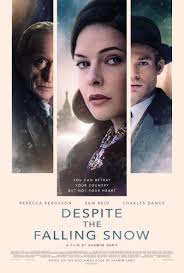
DESPITE THE FALLING SNOW
Canada/UK, 2017, 93 minutes, Colour.
Rebecca Ferguson, Sam Reid, Charles Dance, Oliver Jackson-Cohen, Anthony Head, Antje Traue.
Directed by Shamim Sarif.
Despite the Falling Snow is a film about the Soviet Union, the collapse of the Soviet Union, transitions, espionage. The director, Shamim Sarif, adapted the screenplay from her own novel.
The film has two time eras, the late 1950s in Russia, the early 1960s in the United States. This establishes the main characters, especially the Russian, played by Australian Sam Reid (Interview with a Vampire, The Newsreaders). Then there is Russia in the early 1990s, after the collapse of the Soviet Union, as will the sequences at this time in the United States. The Russian displayed this time by Charles Dance.
There are complexities in relationships, seeming betrayals, efforts to make atonement. The leading character in the later period is played by Rebecca Ferguson (Mission Impossible, Dune).
The film was made in Serbia standing in from Moscow. At the time of this film’s release, even the 1990s was becoming part of Soviet and American history.
- The title? Moscow and snow? Moscow and espionage? Moscow and romance?
- The work of the director, novel, screenplay, production, direction?
- A cold war story? The USSR in the Christian era? The US in the Kennedy era? The transition to 1992, election year for Bill Clinton, the collapse of the Soviet Union, Boris Yeltsin?
- The filming in Serbia, the Moscow sequences, the winter, the streets, the river, the Kremlin, official offices, apartments, schools? The contrast with the US, receptions in the 1960s, apartments in the 1990s? The musical score?
- The introduction, the US reception, 1961, meeting between Soviet officials and Americans? Sasha and his presence, nervy, accompanied, meeting the US contact, his making a run for it, pursued, the car, the photo of his life, the contact had been lost?
- 1959, Sasha, is political career, his parents, friendship with Misha, his boss, severe protocols in secrecy? The meeting with Katia? The attraction? His being used, her getting the documents, her falling in love, mission and his influence, the preparation for the wedding, her hesitancy, her commitment, life together? The romance with Katia? Meal with his parents? His going to the US, the on, security? His boss, the revelation of espionage? Katie telling him the truth, the effect on him, wanting to save her, going to America?
- The film has cut his story, her background, the flashbacks to the brutality against her family, work at school, connections with Misha, the contacts, the documents, passing them on? The relationship with Misha? The relationship with Sasha, using him, his attraction, her attraction, the decision for the wedding, life with Sasha, the revelation of the truth, the dangers?
- Misha, his political affiliations, espionage, photographing documents, passing them to County, his friendship with Sasha? The complications, the discovery?
- 1992, the older Sasha, his war with the documentation, the loss of cut here? With his niece, her artwork? Going to Moscow? His being unwilling to go?
- Laura, artwork, going to Moscow, the Moscow connection, the artwork of cut here, the exhibition? The impact of the art of cardio on visitors, on the audience? Is trying to make connection with Misha?, Personality, reserved? Pretending to make the contact? Lauren, lesbian, her approach to mania? Millions resistance? Telling the truth, the conflict between the two?
- The visit to measure, old age, invented, staying in Moscow? His hostility, drinking? His going to the exhibition, getting the suitcase? Seeing the artwork? Meeting with Sasha? The clash, leaving the suitcase?
- Sasha, going to Moscow, the exhibition, the encounter with Misha, the suitcase, the letter and his reading it?
- The audience seeing the flashback, Misha and the torture, the soldiers, his meeting with Katia, the confrontation, her running, her being shot?
- An espionage story? The Cold War? 30 years later and consequences? But, principally, a romance story?
