Displaying items by tag: Hugh Bonneville
Shanghai
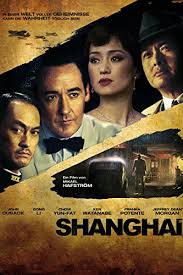
SHANGHAI
China/US/Thailand, 2010, 105 minutes, Colour.
John Cusack, Gong Li, Chow Yun-Fat, David Morse, Ken Watanabe, Franka Potente, Jeffrey Dean Morgan, Hugh Bonneville, Benedict Wong, Christopher Buchholz.
Directed by Mikael Halfstrom.
Shanghai was not so well reviewed on its release – however, it does have something of a more favourable following now (as instanced by comments on the IMDb).
Production was prepared for filming in Shanghai but permission withdrawn after complaints about presentation of sexual matters in Ang Lee’s Lust: Caution. The production was moved to Thailand – and the sets to recreate Shanghai in 1941 are quite elaborate, blocks of city streets of the time, buildings, facades, lights, as well as elaborate interiors, especially in a casino with the gambling, the stage entertainment, the crowds. And, the film is filled with extras, quite a number of strong crowd sequences, Japanese troops killing people in the streets and subsequent panic, panic at a railway station, and crowds at the end trying to get away on ships leaving Shanghai.
And the audience needs to pay attention to the complexities of the plot. The focus is on the journalist coming from Nazi Berlin, some considering him favourable to the Nazis, but is now collaborating with the Americans present and finding himself in complex situations with the Chinese resistance to the Japanese. He is played, rather sternly, by John Cusack.
The film has a strong supporting cast, led by celebrated Chinese actress (especially in the 1990s in ang Yimou films), Gong Li. She is married to Anthony, a power in the crime community of Shanghai, and played also by veteran Chinese actor, Chow Yun-Fat (famous at the time for his appearance in John Woo films). There is also the military chief played by Ken Watanabe.
The plot involves John Cusack searching for the killer of his journalist friend, played by Jeffrey Dean Morgan, leading him to the crime chief as well as the military chief. But the important thing is the role of the wife and her involvement with the resistance, and especially at the end, trying to get a young woman who has been mistress both to the military chief and the American journalist who has been killed out of Shanghai.
The film has been directed by Swedish director, Mikael Halfstrom.
- The title and focused, 1941, Shanghai’s place in China at the time, International Centre, the war with Japan, the year of Pearl Harbor?
- The production values, the elaborate sets for Shanghai, streets and buildings, interiors, casinos, offices, apartments? The large cast, the many crowd scenes, war, action, railway stations, wharfs? The musical score, songs and performance? International atmosphere?
- International intrigue, the background of Germany during the 30s, the outbreak of the war? The situation of Japan and its attack on China, the 30s? Japan preparing for the world war? The effect on Chinese citizens? The resistance? International presence, the dividing of the city into zones, the British, American, French, the Germans?
- The focus on Paul Soames, the American, undercover, agent, journalist, his work in Berlin, reputation, coming to Shanghai, his friendship with Connor? Meeting him, Sumi, his work, information, his death? wanting to find out the truth?
- The opening with Tanaka, the arrest, the interrogation, the threats? Going back two months?
- Paul, his friendship with Richard Astor, commissions, the American presence, international intrigue?
- Paul and his work as a journalist, the British editor, hostility, suspicions of his political stances?
- His getting the background information, travelling through Shanghai, observing, the people, the politics, the Japanese presence, the resistance, the shootings in the street…?
- The encounter with Anna, the attraction, questions, her relationship with her husband, his criminal background, power, at the casino? The revelations about Anna, the resistance, at the casino, passing on messages, but her relationship with her husband? The secrecy? The continued encounters with Paul, his following her and her knowing it? The issue of his friend and his death, the girl who is his mistress, the revelation of her relationship with Tanaka, her role as an agent? Her drug addiction, her being shielded and hidden? The plan to get her out of Shanghai?
- Social life in Shanghai, the German Embassy, the Consul, his wife, relationship with Paul, from the past?
- Tanaka, his presence, suspicions, authority, the relationship with Anthony, with Anna? The arrest of Paul, the brutality, the interrogation? Watching the execution of the Chinese agent?
- The complexities of getting the mistress out of Shanghai, the intrigue, all watching, Anna and her friends with the girl, the railway station, Japanese suspicions, the creating of the diversion, the shooting, the crowd and confusion? Tanaka, with the young girl, his love for her, the final injection?
- The final complications, Anthony and his giving infomration to Tanaka, the confrontation at the house, the bodyguard, the driver, the shootings, Anthony taking a stance, his death, can occur wounded, Paul and Anna escaping? Going to the wharf, the passport, Paul saying and it was his wife, there seem Tanaka, or having spent his life, their being allowed on the ship? Indications of returning later?
- Espionage, journalism, war atmosphere, in an exotic location?
Christmas Karma
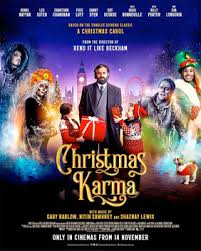
CHRISTMAS KARMA
UK, 2025, 113 minutes, Colour.
Kunal Nayyar, Leo Suter, Charithra Chandran, Pixie Lott, Danny Dyer, Boy George, Rufus Jones, Billal Hasna, Allan Corduner, Billy Porter, Eva Longoria, Hugh Bonneville, Trudie Styler.
Directed by Gurinda Chadha.
The critics who dislike this film complained that it had a week plot! What would Charles Dickens have to say about that!
There have been many, many versions of Charles Dickens popular novel of 1843 A Christmas Carol. And, there have been many variations on the plot, especially with a focus on Scrooge. There have been a number of dramas, there have been musicals, there have been ghost stories…
Gurinda Chadha (Bend it Like Beckham) draws on her Indian cultural background, especially as it has taken root in the United Kingdom, in London. She has chosen to use Dickens’ story and characters, in quite some detail, especially her version of Ebenezer Scrooge, called here Eshaan Sood, the ghosts of Jacob Marley and other Christmases, Bob Cratchit and his family. But they are firmly set in the multi-ethnic, multicultural, communities in and beyond London.
Which means a move from the Christian tradition of Christmas to its being celebrated as a Festival for all cultures, the time of joy, of generosity.
And, the film tries on all kinds of entertainment and movie conventions. First of all, it should be considered as the equivalent of a cinema pantomime, not a straightforward telling of the story, but rather a heightened atmosphere, eccentric characters with exaggerated performances designed to delight and for laughter. And, this version is also a musical drawing on all kinds of music and songs, breakdance, rap, ballads, choral recitals, comic lyrics, and some enjoyment of Bollywood musical styles, and the interweaving of the traditional Christmas songs and carols into the background score. And a reminder of the Christian tradition with a sequence in a church.
With the Scrooge character, played by Kunal Nayaar (popular with his 279 episodes of The Big Bang Theory), a bit younger than usual, but dramatising all of Dickens’ imagining of his meanness, in his company, with his staff celebrating Christmas, no bonuses, exact accounts, even with his assistant, Bob Cratchit (a sympathetic Leo Suter).
The film spends quite a deal of time with the ghosts. According to the credits, Hugh Bonneville is the ghost of his partner, Jacob Marley (though unrecognisable). And the pantomime atmosphere continues in the highly exaggerated presence of the three ghosts, their clothes, their appearances, their mannerisms, Eva Longoria dressed as for the Mexican Day of the Dead for Christmas past, Billy Porter in a very mannered style as Christmas present and, rather briefly compared with the others, Boy George made up as the ghost of Christmas to come.
There are several relatives, his nephew and his wife inviting him to Christmas celebration, and his friends at the shop, their hardships, trying to sell Christmas decorations and gifts.
All the Dickens ingredients are there – and then some, especially Eshaad Sood’s back story of an Indian in Uganda, the Idi Amin era, his coming to England, a poor boy, struggling to make his way, in love, the possibility of happiness in marriage but his fulfilling the expectations of his in-laws to make something of himself, sacrificing everything to build up his fortune, losing his fiancee, devoting himself completely to becoming a millionaire. Ghost of Christmas Present opens Sood’s eyes to the realities of Christmas which he shuns, the Cratchit family and their needs, touching his heart. And the future is grim – his funeral, all alone.
Sood experiences a wonderful conversion, his joy that it is still Christmas morning, and, doing a Warren Buffet with his fortune, distributed to all and sundry, to the charities, to his staff, and, of course, to the Cratchit family and Tiny Tim (who doesn’t get the opportunity to say God bless us all).
The film that Gurinder Chandra is offering to a wide audience who want joy at Christmas, is a happy story, happy songs, comic characters, hard hearts softened. Obviously, this will not appeal to everyone – but it has the potential.
On its release in the UK, several prominent British reviewers offered scathing reviews, one giving it no stars, deriding it as one of the worst Christmas films ever. But, the target audience was not these reviewers, but rather a general public who are open to some light entertainment, even if not perfect, which brings some joy and merriment. (But there is the question concerning these reviewers and why they chose to use such vitriolic language in their condemnatory reviews of what is rather innocent and harmless entertainment.)
- The popularity of Charles Dickens A Christmas Carol. The many versions? The various imaginings?
- The London Christmas Carol, but in the multi-ethnic communities? The target audience? Christmas as a Festival celebration rather than emphasising the Christian tradition? Taking the universal “spirit of Christmas”?
- The work of the director, Indian background, Karma in the title and in the life of Eshaan Sood? Her knowledge of the Indian community in London, UK? Traditions, celebrations, costumes, performance, singing and dancing? Hollywood/Bollywood? The film as a musical, breakdance, rap, choral, ballads, an exuberant Bollywood style?
- Use of Dickens’ narrative, the Scrooge character, a bit younger than might have been expected, his meanness, demands in his office, a millionaire, complaints about taxes, refusing to help charities, in his office, the staff celebrating Christmas and his putting a damper, the assistance of Bob Cratchit? His being alone, no interest or compassion?
- The use of Dickens’ ghosts, Jacob Marley, his partner, warning? Christmas past, the costume of the Day of the Dead, personality of the ghost, her singing, commentary, accompanying Sood, the narrative of Uganda, Indians, migrating? The lonely boy, his experiences, hardships, fiancee, in love, meeting her parents, their expectations, his determination to make something of himself, completely dedicated, alienating his fiancee and her leaving, his loneliness, continued work, becoming a millionaire, his company, the narrowness of his life?
- The presentation of the Cratchit family, husband and wife, the children, Tiny Tim and his weakness, the outing, the joyful songs, Bob singing his ballads?
- The ghost of Christmas present, Billy Porter and his experience, manner, clothes, hair, commentary, singing? Taking Sood on his tour, to see how the other half lived, the hardships, the sacrifices? Tiny Tim, his illness, touching Sood, his own memories? A conversion experience?
- The ghost of Christmas to come, Boy George, not a long performance, singing, presence? Sood taken into the future, the coffin, his funeral, people absent, Bob Cratchit in the church and leaving? Loneliness, nothing personal achieved?
- Waking up, still Christmas morning, the choir, the gifts, their singing, change of clothes, coming down, in the streets, distributing his wealth, the encounters with everyone, going to his nephew’s party and everyone surprised, his reactions and joy? Going to the shop, paying for everything in the shop and the family’s amazement?
- Going to see Bob Cratchit, the family, Mrs Cratchit suspicious, is one Tim, the gifts, the celebration?
- Sood and the experience of Christmas spirit, change of heart, generosity and joy, distributing wealth to make others happy, and the postscript of his return to Uganda, seeing his friend after so many years, remembering his past, happiness – and future joy?
Downton Abbey: The Grand Finale
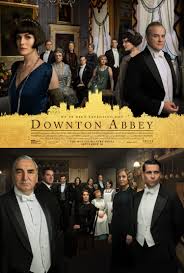
DOWNTON ABBEY: THE GRAND FINALE
UK, 2025, 125 minutes, Colour.
Michelle Dockery, Hugh Bonneville, Elizabeth McGovern, Joanne Froggatt, Paul Giamatti, Dominic West, Laura Carmichael, Phyllis Logan, Alessandro Nivola, Jim Carter, Penelope Wilton, Joely Richardson, Alan Leech, Robert James-Collier, Simon Russell Beale.
Directed by Simon Curtis.
The title says it all: Downton Abbey: The Grand Finale. But, Julian Fellowes, creator and writer of the series and the movies, invites us to watch it all. And, it is probably all that Downton Abbey audiences are hoping for.
It is 1930. The Great Depression as hit the United States and, because of Cora, Lady Grantham, American, there are repercussions of the Depression for Downton Abbey itself in the upstairs aristocracy that we have come to know as well as the downstairs servants whom we have also got to know very well. And, although divorce statistics have increased, they are not acceptable in the English upper-class. Lady Mary has filed for divorce, unacceptable, she is shunned, but her family and some of the shocked servants, as well as ourselves, are there to support her.
We are introduced to all the familiar characters, so many of them most getting older, especially Lord Grantham, some retiring. And, with the first part of the film set during the season in London, especially with buildings and billboards in Piccadilly Circus, the theatre season as well, we are immersed in the London experience, especially a visit to Bitter Sweet, Noel Coward’s play, and an introduction to Coward himself, many of his songs and lyrics throughout the film and, the presence of the playwright in London and a visit to Downton along with his star, played by Dominic West. In fact, Noel Coward is going to save the day several times throughout this drama - rehabilitating is Mary (and a wry joke about his play, Private Lives) and his brainwave for his play Cavalcade, seen as a potential investment!.
But, back to Downton, beautiful, sumptuous, the beautiful grounds, limbs and decor, grand dinners… As well as all the familiar faces downstairs and the bonds between those upstairs and downstairs, though, dining separately!
And there is the annual affair, the haughty president, quite misogynistic, what meetings, and the challenge from the new cook at Downton, spurred on by a defiant Lady Merton.
The main drama concerns Cora’s brother, Harry, played by Paul Giamatti, arriving at Downton to sort out their mother’s estate, and the revelation that he has lost money, but is accompanied by his grinning American financial adviser, played by Alessandro Nivola. Lady Mary is taken in by him – but we aren’t. And it takes a very striking sequence by Mary’s sister, Edith, talking very straight at him and unmasking him – all at the seasons races Ascot!
With the financial difficulties, Lady Mary is to take over Downton, her parents move aside, and of an era – and, we should mention, the portrait of Violet, glimpsed many times through the film and some footage from the past of Maggie Smith at her imperious best. This film is dedicated to her.
And, at the end, with the various farewells, and the focus on Lady Mary, she treats us to a whole range of her memories, the events of the past, vignettes of the various characters, meaning that this is a very nostalgic farewell.
The grandeur of Downton Abbey and the memories of its aristocratic and comfortable life are very seductive. Most of us surrender as we watch – but, it is seduction because most of us would be very uncomfortable were we invited in real life to Downton, our reaction to the manner and manners of the aristocratic class, the fact that most of us are quite egailitarian in our attitude to society.
At the end, it is almost as if we should start singing There’ll Always be an England. But history and reality reminds us that while this Downton life still continues, it is diminishing, but are still part of the dreams and fantasies of the 21st-century audience. So, the film was right in the final credits’ song is Noel Coward’s I’ll See You Again from Bitter Sweet.
(And for trivial pursuit aficionados, the link between director, Simon Curtis, and star, Elizabeth McGovern, is that they were married in 1993 and have two children.)
- The popularity of the television series and the various films over such a long period? And popular internationally?
- The settings, the Abbey, exteriors, the grounds, the lavish interiors, upstairs and downstairs? The contrast with the London sequences, flats in the city, the season in London in the late 1920s, early 1930s? And the American connections? The overriding presence of Maggie Smith, references, portraits?
- Audience familiarity with the main characters, the generations of characters, marriages? And American connections?
- The downstairs characters, butler, cook, various maids, companions, the details of life downstairs, the etiquette, the cooking, serving, the meals together downstairs? The accepted status quo?
- The establishing of the characters, the London sequences, the generation getting older, the next generation, financial issues, moves to London, selling properties? The reality of divorce, acceptable or not in British society, attitudes towards Lady Mary? At popular functions, criticisms, denunciations, her having to leave?
- Back at Downton Abbey, the financial situation, Robert and Cora, reluctance, decisions, the divorce situation, interactions with Mary? The possibility for moving? To London?
- Mary, the divorce, memories of her husband, working with her sister, the various connections and in-laws, discussions, support?
- Cora, her brother arriving, memories, funerals, financial issues? Harold bringing Gus, Gus and his American charm, the racing connections, his behaviour with Mary, the affair, Ascot, his horse, the revelations about his being a conman, taking in Harold, his being unmasked and ousted? Background of the Depression in the US and its consequences worldwide?
- The various complications with the downstairs characters, changes, retirements, audiences identifying with the range of characters?
- The local stories, Sir Hector and his hold over the socialising and organisations in the district, Isabel Merton, antagonism, the committee, her friendship with the cook, inviting her to be on the committee, the drama at the various meetings, the cook assertive? And the day itself, at the fair, the various competitions, rides and enjoyment, the crowds, and a comeuppance for Sir Hector?
- The theatre background, Noel Coward, the musical themes, his celebrity, playwright and his film connection, Noel Coward and his companion, the connection with Downton, all the organisation and secrecy to bring Noel Coward to Downton?
- Noel Coward, his arrival, downstairs, upstairs, his companion, able to move from upstairs to downstairs, the invitation to the staff to come upstairs, the symbolic changing of society in the 1930s? Howard and his influence, financial investment, and ideas for future plays?
- The farewell to Downton Abbey, Robert and Cora, Mary and her new responsibilities?
- The wide popularity of these characters and their situations – and, yet, audiences enjoying the fiction but critical of the class differences and realities?
Bank of Dave 2, The
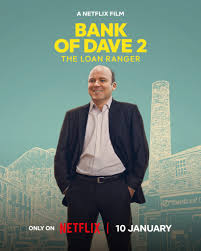
BANK OF DAVE 2
UK, 2025, 104 minutes, Colour.
Rory Kinnear, Joe Hartley, Chrissy Metz, Amit Shah, Rob Delaney, Leila Farzad, Hugh Bonneville.
Directed by Chris Foggin.
A response to the original film, Bank of Dave, could be “If only…!”.
And, it could be a response to Bank of Dave 2.
Which means that their stories about Dave Fishwick and establishing the Bank of Dave, his personality, life in Burnley, Lancashire, his concern about ordinary people needing loans and asking for small interest payments, giving profits to charity, made for a rather heartwarming true/truish story.
So, what could happen with Bank of Dave 2? The subtitle is an enjoyable play on words, with Dave as something of a Loan Ranger, but with his discovery of the exorbitant rates charged by upstart companies, controlled by US interests, freely operating with poor legislation in the UK, the threats to ordinary people and getting them into situations impossible to repay the loan let alone the interest, here was a possible crusade for Dave.
And, he takes it up, becomes involved, takes risks, runs the danger of gangster manoeuvres from the US, has the backing of his local parliamentarian, even the backing and help from his rival from the previous film, Sir Charles, played by Hugh Bonneville.
Rory Kinnear was very engaging in the first film as Dave and continues his charm and exuberance. And, supported very well by Joe Hartley as his wife Nikki, full of common sense but also shrewdness. And, this time, he is helped by the rather awkwardly reticent Oliver (Amit Shah) who works as an accountant for Citizens Advice, recommended to Dave and becoming enthusiastic in helping Dave seek out particular cases, especially for possible court cases against the companies.
Dave has also read an article by American Jessica (singer and television star of over 100 episodes of This is Us, Chrissy Metz). He Is persuaded to come to Burnley, is almost knocked over in the street by Oliver whom she then meets officially, but is eager to collaborate, finally being able to draw on a past friend in New Jersey for a confrontation with the gangster.
The screenplay is often very broad, comic touches rather than subtlety, the romance very early signalled, but the road to confrontation with the exploitative business is actually quite complex, interestingly so.
Which means that most people who enjoyed the first one will enjoy the second – though there are quite a number of bloggers who seem to resent sequels and want to bad mouthe them. And, it seems a pity that there are many bloggers also who seem to become allergic and condemnatory when they go and see what might be described as a nice and entertaining film.
- The popularity of the original film? The work of Dave Fishwick? The movement towards the Bank of Dave? The next step in Dave Fishwick’s campaigns, the loan companies?
- Back to Burnley, Lancashire? The pictures of the town, homes, workplaces, buildings? The scenes in New York, the editorial rooms? New Jersey, the restaurants, the gangster’s home? The musical score, the finale concert, def leopard, and the finale in the pub, Stand by Me?
- Presupposing knowledge of Dave, his personality, his concern and commitment, the bank, charity work, the support of his wife, her shrewdness?
- The television interviews, the question on the radio interview, his concern about loans, finding out more, reading Jessica’s article, phoning her, inviting her to Burnley? His meeting with Oliver, Oliver and is Citizens Advice work? His interest in working with Dave?
- Jessica, her articles, personality, cerebral, invitation to write person-oriented articles, phoning Dave, coming to Burnley, Dave’s explanation of the town, the situations, the loans? Her standing in the street, almost knocked down by Oliver, the discussions, his awkwardness, their meeting in Dave’s bank? Their friendship, working together, telling stories, reticence, the bonding between them?
- Oliver, the various stories, Zoe singing at the pub, her mother and debt? The other stories? Jessica and Oliver going to the various interviews, the sad stories of the loans, the exorbitant interest rates? Oliver and Jessica with the idea of filming, the episodes, David his involvement? Online, the number of viewers?
- Dave and his involvement, the discovery of the various companies, their exorbitant rates, the decision to buy back some of the debts, going to pay, empty offices, the confrontation with the official and the big building, security, confirming Dave is commitment?
- Mancini, gangster, reputation, in New Jersey, the contact with Margot, his supporting her, demands, her plans, wanting payments, court cases, buying off, the confrontations with Dave?
- The MP and his support, Sir Charles and the previous antagonism, his coming to support Dave, recommending the lawyer?
- The court case, Dave and Nikki and the rehearsals, the actual case, Margot and the threats, the whole truth and nothing but, Tom Cruise joke, Dave and his speech, the documentation, the information from the lawyer, Dave and co and their research into payments, the attempts at paying back and no contact with the companies, everything online? The judge, the adjournment, Margot and dropping the case?
- The emotional side, Oliver and Jessica, discussions, their lives, his divorce, boring job, her contact with the police and detective? The phone call, her successful articles, returning to the US? Oliver’s reaction?
- The issue of the papers served on Mancini, the help of the detective, Dave, Nikki and Oliver going to the US, Jessica and her help, going to the restaurant, the next day, the detective turning up, the serving of the papers, the gangsters tracking Dave through his phone, to the concert, the device of getting him back to England?
- Success, Jessica going to Burnley, the pub, Zoe and her mother on stage, the arrival of Def Lepard and co-, Stand by Me?
- The truth behind the film, truish – and the inventiveness of the gangster connection for the drama?
Paddington in Peru

PADDINGTON IN PERU
UK, 2024, 106 minutes, Colour.
Hugh Bonneville, Emily Mortimer, Samuel Joslin, Madaleine Harris, Julie Walters, Olivia Coleman, Jim Broadbent, Hayley Atwell, Voices of: Ben Whishaw, Imelda Staunton. Cameos by Hugh Grant, Joel Fry, Robbie Gee, Sanjeev Baskhar, Ben Miller, Jessica Hynes.
Directed by Dougal Wilson.
Who cannot like Paddington! His stories are always bearable!
We have enjoyed the first two films very much. There was an element of surprise about them, the introduction to Paddington himself, the wonderful voice provided by Ben Whishaw, the members of the Brown family and their ability to welcome Paddington. And, there were various adventures and, who can forget, the villainous Hugh Grant?
It does mean that here we accept Paddington straightaway, the glimpse of his early years in Peru reaching out to pick a beautiful orange, falling into the River – and landing in London. Now, a letter from his Aunt Lucy (voiced by Imelda Staunton) encouraging him to come for a visit (and that humour is awkward episode getting his passport photographs).
But there is a bit of background about Mr Brown, somewhat British stick-in-the Mode, challenged at work about risks. In the brainwave! Why don’t they all go with Paddington to Peru, including the kindly Mrs Bird (Julie Walters). Hugh Bonneville is once again Mr Brown but, this time, Emily Mortimer is Mrs Brown.
Once they will arrive in Peru, now met by Reverend Mother at the local home for retired bears! Suddenly, and exuberantly, we have Sister Act meets The Sound of Music. But, bad news, aunt Lucy has disappeared and Paddington is determined to find her. And, Olivia Coleman, in recent years showing a variety of talent (Wonka, Little Wicked Letters), is here as the exuberant Reverend Mother.
With the action adventure that follows, more than a touch of Indiana Jones here, the action is geared more to the young audience, the touch of caricature with the boat captain (Antonio Banderas), farcical and slapstick situations high dangers and minutes, especially as Paddington and the family get lost in the Andes jungle, double dealings and some sinister flashbacks…
But, there are some secrets to be revealed, and a variation on the search for El Dorado and that fabled gold. This, everybody benefits from the adventure, and Mr Brown becomes extraordinarily daring. And Paddington has to make a decision, finding his tribe there in Peru, and whether he will go back home with the Browns.
Adult audiences, especially, please don’t rush for the exit when the credits begin to appear because there is a very enjoyable special guest interlude during the credits. And, as always, possibilities for more.
- The popularity of Paddington, the films? And in himself, from Peru, landing in London, the Brown family, part of the family, his adventures, memories of Aunt Lucy in Peru, the possibility of his returning to visit Peru and Aunt Lucy? The effectiveness of Ben Wishaw’s voice?
- Expectations from the previous film and their popularity and acclaim? The intentions of the filmmakers here, a film for younger audiences, style, treatment, humour, adventures, the touch of the absurd for enjoyment? The impact for older audiences, the adult characters, the adventure, the mayhem? And the postscript with Hugh Grant?
- The scenes of Paddington’s origins, little bear, the oranges, on the branch, falling, to England, with the family? The memories of Aunt Lucy? The correspondence with her? His receiving the letter from her, inviting him to Peru, his eagerness?
- The Brown family, the children growing older, University entrance, computer games and inventions, not wanting to play Scrabble with the mother, Mr Brown, the firm, Risk-taking, the American executive, her demands, the challenge to him? His very proper reticent British way of style of life?
- The suggestion to go to Peru, the reaction of the family, Mr Brown and the decision to take a risk? Mrs Bird and her presence, decision to go? The farewell in the street with all the British film and television celebrities’ cameos? The flight, landing, Peru?
- The visuals of Peru, the mountains, the river, waterfalls, locations in Peru and Colombia? The settlement? The boat
- the convent, Reverend Mother, her cheery attitude, the staging of the musical, Sister Act meets The Sound of Music? The family settling in? The disappearance of Aunt Lucy, the nuns? The retired bears and their lifestyle, bingo…? Reverend Mother and her explanations, her eagerness for them to go searching, but her remaining at home?
- The expedition, Paddington and his eagerness, the family, hiring the boat, the captain and his daughter, his manner and mannerisms? On the voyage, the comedy, the dangers, the rapids?
- The background of El Dorado, the captain and his ancestors and their appearing behind him, his relationship with his daughter, the search for gold, Paddington and his arm band, the translation and interpretation? The captain disappearing and his search?
- The family on the boat, the dangers, capsizing, stranded? Through the jungle? Mr Brown and his being more daring? Paddington’s memories of the Inca image, his arrival at the tower, the rock? The family arriving?
- The Machu Picchu kind of location, the confrontation with the captain, pursuing more Paddington, the fights, the bolder, the dangers…? The reappearance of the daughter, her helping the family?
- Mrs Bird, back at the convent, curious, suspicious, finding the radio room, the confrontation, the truth about Reverend Mother? The plane, flying, the crash landing, the confrontation, Reverend Mother from the El Dorado-seeking family, the flashbacks to their disasters? The confrontation with the captain? Her being overcome?
- Finding Aunt Lucy, going beyond the barrier, finding El Dorado, the gold being the oranges, the scenes of collecting, squeezing, Paddington and his predilection for marmalade?
- Paddington finding his tribe, his being welcomed, his speech, the family ready for him to stay, his decision to return with them, finding his tribe but going home with his family?
- Happy ending – and the epilogue with Phoenix Buchanan and Hugh Grant’s style? Future prospects?
Never Forget Tibet
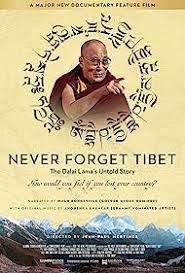
NEVER FORGET TIBET
UK, 2022, 94 minutes, Colour.
Narrated by Hugh Bonneville.
Directed by Jean-Paul Mertinez.
This is a very worthy project. It cannot be condemned by those who dislike straightforward narratives, chronicled from beginning to end. Rather, this documentary has a whole lot of themes, all mixed together, sometimes reappearing unexpectedly (and without immediate reason).
There are many reasons for watching the film. One of the main reasons is to go back to the Dalai Lama’s history, the complex relationship with the Chinese government in 1950 and then his escape from Lhasa in March 1958.
There is some initial background about the Dalai Lama himself, his being a reincarnation of previous Dalai Lamas, interviews with members of his family, especially with his younger brother, very articulate, remembering the past, the escape, his own life, studies, hippy days, serious days and study, as well as the Dalai Lama’s sister who reestablished the Buddhist nuns, fostering their training, academic education, contempt of life in exile in India.
The film introduces us to an Indian journalist, niece of the Indian official who guided and received the Dalai Lama and his entourage at the time of their escape. There is a sequence where he meets the Dalai Lama, embraces him, and they reminisce, as well as noting how each of them has got older. The journalist has been able to arrange time with the Dalai Lama.
Over the decades, the Dalai Lama has been an engaging personality, not always clear when speaking English, but always willing to do so, and there is his perennial humour and laugh. Here we have an opportunity to spend quite some time with the Dalai Lama, his comments about his experiences when young, his training, the episode with China in 1950, spending time in Beijing, interested in Marxism and Socialism, a relationship with Mao Tse Tung. However, he does spend quite a lot of time, giving quite some vivid detail of his memories of the escape, the timing, the dangers, the harsh Indian countryside and mountains, illness, the welcome when received.
There is also commentary by a younger Indian journalist focusing on the past but also highlighting aspect of Tibet in the present and the relationship with China.
And, scattered throughout the film are quite a number of episodes – an interview with a Buddhist leader and his explanation of meditation and chant; a meeting with the Dalai Lamas doctor; an interview with doctor who runs the medical centre today in Lhasa. And, throughout the film, there is an interview with an expert on the Austrian traveller, Heinrich Harrer, famous for his book (and the subsequent film with Brad Pitt) Seven Years in Tibet. His being in Tibet is explained, his time there, his understanding of the Buddhist culture, the role of the Dalai Lama. And, keeping records of his experiences in Tibet, also taking advantage, sometimes with very limited photographic equipment, of taking photos, preserving them through travels and difficulties, there are eventually being able to to be developed in 1951. The film incorporates many of these photos.
So, not the most polished of documentaries, but a great deal of interesting interviews, footage, photos, and the personality and the spiritual compassion and profound Buddhist messages as expressed by the Dalai Lama.
Mummies
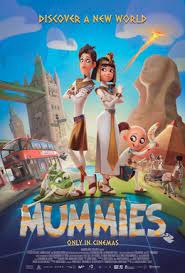
MUMMIES
Spain, 2023, 88 minutes, Colour.
Joe Thomas, Eleanor Tomlinson, Hugh Bonneville, Sean Bean, Celia Imre, Santiago Winder, Shakka, Dan Starkey.
Directed by Juan Jesus Garcia Galocho.
An unexpected and entertaining animation film, especially because it comes from Spain, Spanish writers, Spanish director, Spanish technology – but with the central part of the action taking place in contemporary London.
This is a film which young audiences may well enjoy with its characters, adventures. However, it is also a tongue-in-cheek entertainment for an adult audience, especially those with some familiarity of exploration and excavations, digging up ancient Egypt, transporting souvenirs for museums in Europe. And the popular music scene.
The original version has a Spanish voice cast but for English-speaking audiences there is an excellent cast, Joe Thomas and Eleanor Tomlinson in the central roles, Sean Bean as the Pharaoh, Hugh Bonneville is a sometimes dim-witted, ambitious and villainous Lord Carnaby. And, in support, is Celia Imre as the mother.
There is ambiguity in the title of the film. There are the Egyptian mummies but Lord Carnaby’s mother is continually phoning him, criticising him, demanding he go to the theatre, a torment in his life, and villainous mummy, so to speak.
The action opens with a Ben Hur kind of chariot race introducing us to the hero, Thurt, the charioteer, triumphant, but his wheels falling off his going into depression, wanting isolation, autographing fan cards. He has a chance encounter with the Princess, harsh in her manner, told by her father that she has to marry, and the sacred bird will indicate the correct suitor. The charioteer’s precocious younger brother throws a boomerang and it bounces off various surfaces finally hitting the charioteer. He wants to live alone. The Princess doesn’t want to marry, feels imposed on.
In the meantime, we see Lord Carnaby and his dimwitted associates excavating, finding treasure, especially a ring, which the charioteer and the Princess want to recover. And, here is the inventiveness, they have to leave the Egyptian Afterlife and go into the contemporary world, the audience looking at our world through their eyes and amazement, although the younger brother adapts very very quickly to the technology and to the slaying.
The main action then takes place in London, the charity and Princess thinking that such a big metropolis must be Rome. Their adventures take place in the theatre putting on a new musical of Aida with all its costume and Egyptian sets, the Princess seeing the ring and taking over the singing, great applause, being taken up by an enthusiastic rapper, Ed (Shakka). The Princess is applauded, makes a record, goes viral, loves the fame. But they are captured by Lord Carnaby and what follows is a struggle in the Museum, a car and bus chase through London, and a final return to the Afterlife, a couple in love, happy ever after.
An unexpectedly enjoyable experience.
- A film for children? A film for adults?
- The title, the Egyptian mummies? And Lord Carnaby’s continual phone calls and criticisms from his mother?
- The Spanish film, Spanish writers and director, the British version with British voice cast? Musical score? Songs? A musical of Aida?
- The imagination of the film, ancient Egypt, the Egyptian afterlife, 21st-century excavations, discoveries, artefacts, exhibitions? The characters from the afterlife in the 21st-century, Egypt, London? Spotlights and their appearing as skeletal?
- Introduction to Thurt, the amphitheatre, the chariot race, echoes of Ben Hur, victory, the chariot wheels, his retiring, loss of self-confidence, yet being a star, autographing all the cards? With his young brother, with the dog? The sudden discovery that he was to be married to the Princess?
- The Princess, the clash with the charioteer in the street, her haughtiness, the pharaoh, her chaperone, to be married, her wanting independence, the announcement of the charioteer, the bird and its choice (and the little brother’s boomerang)? The issue of the ring?
- Lord Carnaby, the satire on British excavators? His two dithering assistants? The excavations, the discoveries, the ring, his ambitions, transferring everything to London, his museum? The setting up of the exhibition? His relationship with his mother, her continually dominating, phoning at the wrong time, demanding he go to the theatre, the theatre performance? Her phoning him even when in the same room?
- The adventures of the charioteer, the Princess, the little brother and the dog, venturing out into the modern world, amazed, the audience looking at 21st-century through their eyes? The transport, going to London, thinking that it was Rome? The younger brother adapting to the 21st-century, all the technology, all the slaying? The dog enjoying himself?
- The tension between the charioteer and Princess, not wanting to be married, he to be a bachelor, she to be free, her ambitions? The sparring, their being forced together? The traffic and the dangers? Going to the theatre, the new musical of Aida, the sets and costumes, the stage manager pushing the men, on stage, the performance, the Princess intervening, taking over, the ring, her song, glimpsed as skeletal yet the applause?
- The encounter with, rapper, entrepreneur, praising the Princess, saving them, giving them accommodation, the charioteer and his jealousy? Going to the shops, the credit card, the display of different costumes? Going to the studio, the Princess performing its song? Its success, going viral? Her being pleased, acknowledged, applauded?
- Going to the museum, their being trapped by Lord Carnaby, drugged, the brother and dog to the rescue, Ed intervening, his being drugged, all the action, yet the two assistants and their dithering, at the drinks and sweets machine, the cardboard cutout of Lord Carnaby, the bewilderment, the escape, the drive through London, the brother driving the bus, the dog with the pedal, Lord Carnaby in pursuit, the manoeuvres, his finishing up on the barge on the Thames?
- The Princess, her decision, the return to Egypt’s, the pharaoh and his welcome, her mother, the charioteer and his proposal? Happy ending – and her singing?
- An inventive imaginative animation entertainment?
