Displaying items by tag: Mia Goth
Frankenstein/ 2025
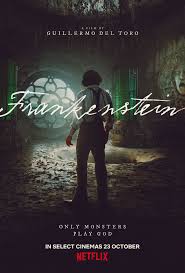
FRANKENSTEIN
US, 2025, 150 minutes, Colour.
Oscar Isaac, Jacob Elordi, Christophe Waltz, Mia Goth, Felix Kammerer, Charles Dance, David Bradley, Lars Mikkelson, Christian Convery, Burn Gorman, Ralph Ineson.
Directed by Gullermo del Toro.
Mexican director, Guillermo del Toro, has had a long fascination with imagination and fantasy, the celebrated Pan’s Labyrinth, and popular action with Blade, Hellboy, Pinocchio. So, what will he choose to do with Frankenstein?
This is very much an all stops out interpretation of Mary Shelley’s classic novel, its narrative, its characters, its explorations of themes of life and death, human arrogance, playing God, playing the devil. Since Boris Karloff played the creature in the 1930s, there have been very many Frankenstein films, and Hammer Studios thrillers, Kenneth Branagh’s 1994 spectacle…
Here is an epic treatment, the Gothic traditions, running for 2 ½ hours.
The familiar elements are all here, the opening in the Arctic with Frankenstein and the monster stranded, the rescue, Victor Frankenstein narrating his story wanting some kind of healing and forgiveness, the background of the Frankenstein family, demanding father, Victor and his scientific interest, experiments with reviving some kind of life, his laboratory, hunting the dead bodies, the creation of the creature, the lightning, the aftermath, the wandering creature and the confrontation with its maker. And all presented with heightened atmosphere.
In all the treatments, the question is how sympathetic Victor Frankenstein should be. Oscar Isaac here is not sympathetic at all – oppressed by his demanding father (Charles Dance), relying for help on his younger brother, William (Felix Kamerer all) and the link with Elizabeth (Mia Goth) and her tender affection for the Creature. There is an interesting new character, the wealthy man, Harlander, Elizabeth’s uncle, who wants to bankroll Frankenstein and his experiments with some sinister intentions, played with his usual relish by Christophe Waltz.
But, significant in this film is that the Creature, not called monster, though made up of many body parts, neatly put together, is, for the most part, the most sympathetic character. And Jacob Elordi plays him with a great deal of pathos, but with dignity, gradually coming to consciousness, words, ideas, out in the countryside learning compassion, to read, but also discover the truth about his origins and that he was doomed not to die.
This is a film which gives great attention to atmosphere, sets and decor, costumes, atmospheric score, enabling audiences to appreciate why the Frankenstein story has continued to be entertaining but much more, a questioning of human power, human arrogance, and the need for forgiveness.
- Lasting popularity of the story, Mary Shelley’s novel and treatment, issues of life, creativity, death, playing God, playing the devil? The many versions, from the 1930s, Hammer Studios, Kenneth Branagh, 1994, the cinema tradition?
- The lavish treatment, sets and decor, costumes, atmosphere? Atmospheric score? The Arctic sequences in the snow and ice, the University sequences, the laboratories, the castles, 19th-century society? The countryside sequences, bleak, wolves, winter?
- The opening in the Arctic, the presence of Frankenstein and the Creature, the ship, the expedition, the Capt, the crew, the confrontation with the Creature, saving Frankenstein, the threats from the Creature, Frankenstein telling his story, his confession, his fate?
- The introduction to the Creature, initial horror, strength, menace, threat to Frankenstein, the interaction with the sailors, violence, deaths?
- Frankenstein telling his story, his background, the sequences with his father, his father’s demands on the cruelty? Treatment of his wife? The birth of his brother? The two brothers grow growing up? The father, the doctor, unable to save his wife, his demands on Victor, testing him as regards medicine, science? His death?
- Victor, relationship with his brother, growing up, his brother’s life, Elizabeth, her relationship with William? Her visits? Her family background? Expectations? Harlander and Elizabeth as his niece?
- Victor, his experiments, his machines, theories, the skeletons, the body parts, his demonstration to the professors in Edinburgh, electric charge, movement and life? Then denouncing him?
- Harlander and his ambitions, personality, state of health, finance, collaboration with Victor, finding the Castle and location? William and his helping his brother build up the laboratory in the Castle?
- Victor, access to bodies, the executioner, the choices, the background of war, injuries, examining the bodies, transporting them to the Castle, the various limbs? Putting them together, sewing, a composite Creature rather than a monster?
- The pressure from Harlander, the confrontation with him, syphilis, wanting to be transferred into the creature, Victor not wanting him because of contamination for his brain, his falling to his death? Concealing his body?
- The storm, the lightning, the drama of his setting up the situation, the Creature, lightning, the movement, coming to life?
- The nature of the creature, tall, presentable, clothing and cloak, able to say only Victor, the humanity, the inhumanity?
- Victor’s reaction, amazed, fearful, presumptuous, the treatment of the Creature, imprisoning him? The effect on Victor’s consciousness, conscience? More than he expected? Not anticipating the consequences?
- The effect on the creature, lonely, exploring the Castle, the relationship with Victor? His ability to heal quickly?
- Elizabeth, her visit, the discovery of the Creature, the bonding, talking, his saying her name? Her response to Victor?
- Victor and his impatience with the creature, lack of development, explaining Harlander’s death to William, the decision to set fire to the Castle, the elaborate preparations, setting the fire, the creatures call, Victor’s change of heart, entering, the explosion, breaking his leg?
- The creature surviving, wandering the countryside, the wolves, the community, his hiding, surviving, the family and their life, hunting the walls, leaving the old blind man, the Creature, listening, understanding, sympathy for the old man, hearing the family’s needs, building, chopping the wood, all kinds of service? The happy life and friendship? The family thinking him the Spirit of the Forest? The old man to Jim to read, speak, think, reflect? Growing understanding? The walls, the return of the family, the Creature fleeing?
- The decision to find Victor, the return to the Castle, the notes, reading them, knowing that he would live for eternity, getting Victor’s address, travelling to Vienna, the buildup to the confrontation, Victor regretting creating him? The Creature wanting a companion? The celebration, society, lavish? Elizabeth, shielding the Creature from the shot, William dying, fearing his brother, the Creature helping Elizabeth that she dies?
- The situation in the Arctic, the response of the captain, encouraging Victor to tell his story, sympathy and understanding, the help of the doctors, the creature coming on board, the explanations, Victor’s repentance, the Creature for giving him? The response of the crew? The captain changing his ambition to reach the North Pole and to return home, the response of the crew?
- The Creature pushing the ship out of the ice, and looking towards the sun, reaching out and beginning his life without death?
Maxxxine
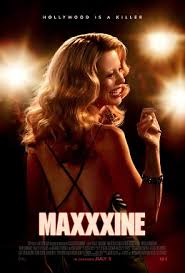
MAXXXINE
US, 2024, 104 minutes, Colour.
Mia Goth, Elizabeth Debicki, Bobby Cannavale, Michelle Monaghan, Kevin Bacon, Lily Collins, Simon Prast, Giancarlo Esposito, Moses Sumney.
Directed by Ti West.
In recent years, writer-director Ti West, has directed many television episodes. However, he made his mark around 2010 with some horror films, especially The Innkeepers. He also made a revenge Western, In a Valley of Violence, 2016, with Ethan Hawke and John Travolta. Then he made X, something of an exploitation film at a mansion out in the countryside of the Midwest. It featured Mia Goth. And it was a commercial success.
West then decided to go back in history and make a period piece, again about an ambitious actress, again played by Mia Goth, Pool. And with the same somewhat sensationalist themes and treatment.
This is the third film in his trilogy, this time set in 1985. And the audience is taken to a version of Hollywood of that period, a style of cinematography that is garish and sometimes lurid, as a symbol and as a location for part of the climax. West is enthusiastic about this portrayal of Hollywood, emphasising the seedy side, cheap apartments, video stores which were becoming popular at the time, the adult movie industry, sleazy agents in their offices. There is also the world of filmmaking, auditions, the movie lots, a visit to the Psycho motel as well as action there, sinister mansions in the Hollywood Hills. Very strong on atmosphere – and with many of the songs of the period, as was all kinds of in the occasions, billboards, almonds theatre, the stars on the walk of fame, cinemas showing St Elmo’s Fire.
Once again, this is a showcase for Mia Goth who seems to relish her performances as actresses who have more than relish and ambitions for their careers. And the supporting cast is more notable, Elizabeth Debicki as a somewhat pretentious and ambitious director, filming a sequel to The Puritan with all kinds of religious right protesters outside the studio with their placards. Kevin Bacon offers something of an absurd private eye who gets a dreadful comeuppance. Bobby Cannavale and Michelle Monaghan are the investigating police, he a would-be actor, she rather stern and critical. Lily Collins has a cameo as a British actress, Giancarlo Esposito is the agent, and Simon Prast who was a religious fanatic in X is even more terrifying here as Maxine’s avenging father.
So, a mixture of exploitative ingredients, sex, violence, ambition, religious intolerance.
- The work of the director, his trilogy, themes, moviemaking, collaboration with Mia Goth?
- The relationship of this film to the other two? Characters, themes, movies, sexuality and exploitation, violence and murder, ambitions and ruthlessness, religious fanaticism?
- The title, Maxine, from Miller to Minx, adding the Xs to her name? Her car number plate? And the way that she ruthlessly drove her car?
- The prologue, the little girl, dancing, the interview with her religious father? All of this sequence in the revelations of what was happening?
- 1985, Hollywood, the sign and symbol, the streets, the stars and Grauman’s theatre, garish look, lurid touches? The streets, the motels, the studios, legal offices, Universal lot, the motel from Psycho, exteriors and interiors? The musical score, the range of songs from the 1980s?
- Maxine, in Los Angeles, the move from Texas, ambitions, to get the life that she deserved, her intensity, the adult movies, pornography, her reputation and people recognising her at the studio? Her friends, performance? The apartment, moving from job to job, the video store, the owner, conversations, watching videos with him, enlisting his help to identify the mysterious video and its origins? His relationship with Maxine, exasperation with her? The brutality of his murder and her response to his being carried out?
- The audition, the film, The Puritan, the sequel? The director, imperious presence, height, not American accent, expectations? The interview, her being in adult movies, her body? Her getting the part? Going back to the studio, the interviews with the director, her demands? The scene of making the cast of her head, the past memories, her panic? And the later final sequence with the cast of her head in the glass? The background of the, Night Stalker the many deaths, and her friend, their discussions, the discovery of the two dead bodies, the symbolic mark?
- Mysterious video and her watching it, her panic? The address of the windscreen? The encounter with John, Kevin Bacon and the satiric performance? Confrontations, pursuit, his threats and self-confidence? Not identifying the employer? The drinks and conversation? Is appearance at the studio, the pursuit and chase, the weapon and her wound in his nose? The later encounters, the Psycho motel? Her explaining this to her agent, Ted and his personality, manner, sleazy? The confrontation with John, and the brutal crushing of the car and him?
- The police officers, the would-be actor and his performances, the tough woman in charge? Confronting Maxine, with the death of her video store friend, the continued interrogations, her refusal to answer, the threats?
- Demonstrations, against The Puritan, the religious right? Protests and placards?
- The buildup to the climax, Maxine and her fears, the decision to go to the address, the detectives deciding to follow her, her entering the house, eerie, discovering her father, his speeches, showing her the video from her childhood, the massacres in Texas, fleeing? Her father, religious fanatic, his campaign, stamping Satan out of Hollywood, his followers and the ritual, the attempt to exorcise Maxine, tying her up, close-ups of his face, the arrival of the police, the shootout? Maxine free, confronting her father, eventually shooting him? The detectives, shot, wounded, dead? The hovering helicopter?
- The aftermath,, Maxine as a celebrity, the interviews, the director and her advice? Set, her becoming respectable, the plaster cast of her head?
