Displaying items by tag: Christoph Waltz
Minions & Monsters
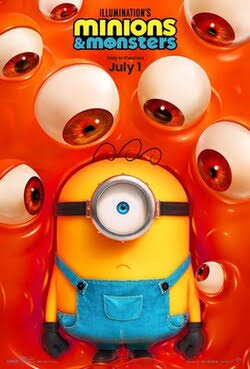
MINIONS & MONSTERS
US, 2026, 90 minutes, Colour.
Voices of: Pierre Coffin, Alison Janney, Christophe Waltz, Zoe Deutch, Bobby Moynihan, Jeff Bridges, Jesse Eisenberg, Phil LaMarr, George Lucas, Trey Parker.
Directed by Pierre Coffin, Patrick Delage.
We have been living with the Minions, enjoying their mischievous company, since Despicable Me in 2010. With their size, yellow colour, one or two eyes, their distinctive language and chatter, their willingness to serve diabolical masters like Gru, audiences now have expectations of them, enjoying when they turn up in the movies (and in a range of commercials!).
The children’s audience will enjoy all the shenanigans here, the origin story of this group of minions, setting sail, settling in different lands, the various tyrants that they served, and, of all things, their finally arriving in the American West, pursuing a bandit and a train, discovering that it actually was being filmed. They are in Hollywood in the 1920s.
For the adult audience, especially movie fans, there are all kinds of references to early movies, experiments by Edward Muybridge, the Lumiere Bros, George Belies and the moon, and jokes recreating Charlie Chaplin in the cogs sequence in Modern Times, Harold Lloyd on his ladder in Safety Last, and glimpses of Buster Keaton, references to Citizen Kane, Hooray for Hollywood, We’re in the Money… and, the contemporary Hollywood Museum which has George Lucas himself. an exhibit in a glass case, asking to be released from his contract! In fact, this Minions film is really an homage to the movies and, especially to Hollywood in the 1920s, styles of filmmaking, the studio moguls, the directors, camerawork, introduction of sound, awards.
The main characters are the artistic James and his affable friend, Henry, and the good-natured Ed. In Hollywood, they do get a chance to make a movie – but, with the book of spells and their reading them out loud, strange creatures emerge. The culmination of the film is a kind of big gooey Godzilla equivalent, destroying LA in its path. Which means some kind of heroics, the massing together of the minions (which often happens throughout the film from early rowing in prehistoric boats to crowding on vehicles in Los Angeles and, incidentally, breaking the Hollywoodland sign).
A glance at the cast list shows that there is very strong voice talent.
All’s well that ends well, everybody happy with James’s movie, screening at the Chinese theatre, applause, awards, and, at last during the final credits, some upstaging of Gru. So, where to next! And soon!!
Dracula: A Love Story
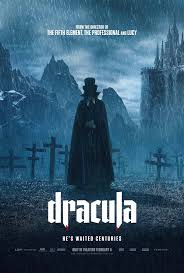
DRACULA: A LOVE TALE
France, 2025, 129 minutes, Colour.
Caleb Landry Jones, Christoph Waltz, Zoe Bleu, Guillaume de Tonquedec, Matilda De Angelis, Ewens Abid.
Directed by Luc Besson.
One wonders about the fascination with the Dracula story, vampires, in the first part of the 2020s, comedy in Redfield, the sombre Voyage of the Demeter, the elaborate Nosferatu. And now, long time action director, Luc Besson, has scripted and directed another variation on Bram Stoker’s novel.
Many of us have a great admiration for Francis Ford Coppola’s 1992, Bram Stoker’s Dracula, with Gary Oldman. It had an extraordinary eight minute opening, Vlad, summoned to war, farewelling his wife, stylised battle sequences, false reporting of his death, his wife killing herself and Vlad defying the priest who refuses her a Christian burial. And Besson has decided to open his film with a rather longer prologue in this vein, fierce battles, death of Vlad’s wife, his defiance of a Cardinal, loss of faith and condemned never to die.
That setting is 1480 then the screenplay moves forward 400 years, Dracula, with Caleb Landry Jones, who had appeared in the Australian film, the trim, is an ageing recluse in his castle, visited by Jonathan Harker, from Paris, to consult him about one of his properties. This gives the opportunity for Dracula to tell Jonathan his story and for it to be visualised, quite lavishly, as a younger Dracula searches incessantly over the world for his wife, infecting a whole range of women (and some pageantry with groups of women and stylised courtly dancing) to help him in his search.
1889, introducing the vampire hunter, not Van Helsing this time, but a priest, devoted to science, determined to find Dracula and put an end to him. And, who better to portray this kind of priest than Christopher Waltz (Oscars for Best Supporting Actor into Tarantino films, Inglourious Basterds and Django Unchained ?
Dracula then travels to Paris, and, with the help of one of his infected women, encounters Mina, sees her as the reincarnation of his wife, determined to take possession of her and return to Romania. Which means then that the priest has to pursue him back to his castle, buildup to a confrontation – and, surprisingly, a rather large scale military assault on the Castle, cannon firing, soldiers invading (and repelled by a team of gargoyles come alive!).
But, the horror emphasis, in the Christopher Lee vein, is not the style of this film. The screenplay has some sympathy for Dracula and his loss, his continued defiance, which means that the ultimate confrontation between him and the priest is not just that the vampire be destroyed but that he make a selfless gesture, enabling Mina to live her life and for him then to be willing to die for her sake, a true love for her. Not exactly what we might have been expecting from a Dracula film.
There are the elements of Bram Stoker’s novel, a strong influence from Francis Ford Coppola’s film, perhaps rather low-key in comparison, but interesting in its sympathetic portrait of the vampire and the priestly variation on Van Helsing.
- The long tradition of Dracula films? Different perspectives? The basis in Bram Stoker’s novel? The influence of Francis Ford Coppola? The several Dracula films in the first half of the 2020s?
- The film as a Luc Besson, fantasy, action?
- The settings, 1480, warfare? The castle? The 1890s, Romania, isolation, the castle and interiors? Paris, society, the hospital? The musical score?
- The prologue, Vlad, Prince, the marriage to Elisabeta, going to war, leading his troops, his guard, the battlers? The pursuit by the enemy? Elisabeta, the carriage, escaping, court, her death?
- Vlad, with the Cardinal, the interactions, his anger, the death of his wife, defying God, defying the church, killing the Cardinal, the image of Christ and the blood? His punishment, not to die? And his perpetual search for his wife?
- The 1890s, Paris, Jonathan Harker, his travels, the property in Paris, the appearance of Dracula, 400 years of age, the welcome, the meal, the cross given by the coach, Dracula drawing it into the fire? Warning Johnthan to stay in his room, Jonathan wandering, the discovery of the coffin? The appearance of the live gargoyles? Johnathan hanging, the blood, Dracula and drinking the blood of the rat? Jonathan his pleading, for Dracula to tell his story?
- The story, his quest for his wife, the decision to infect the women, to have assistants to search for his wife, the stylised dancing, through the centuries, costumes and style, the range of women, attracted, his infecting them? Failure to find this a better way?
- Living in his castle, his personality, the decision to go to Paris, Maria and her fiance, the wedding, her collapse, infected, in the hospital? The doctor, treating her? Her friendship with Nina?
- The central role of the priest, the van Helsing substitute? His talk about the church, science, superstitions? Talking about his order? Independent? His appearance, cassock, hat, his bag? Coming to the hospital, the discussions with the doctor, analysing Maria? Defying her? His researches, the visit to Maria’s room, with her fiance? The book, the image of Dracula? His wife?
- Maria, friendship with Nina, her escape from the hospital, dressed, going out, the celebration, the fair, the rides and excitement, the encounter with Dracula, his charm, the dancing, the effect on Mina?
- Dracula, charming, the love story rather than the threats and horror? His hold on Mina, taking her home, the coffin?
- Jonathan’s escape, with Maria’s fiance, with the doctor, with the priest? The travel into the castle?
- The Castle, the gargoyles of the attack, the priest, the confrontation with Dracula, the discussion, love, immortality, the role of God, God and evil?
- The the Army, the cannon, the soldiers, the invasion, the gargoyles and the destruction?
- The final confrontation between the priest Dracula, the role of Mina, as a little better, her memories, reliving the past and happiness? Pleading with Dracula? His decision, the decision to free her, to die?
- The priest, executing Dracula, the ash, the cloud flying in the sky?
- The basic Bram Stoker story but the emphasis on love story and redemption rather than horror?
Frankenstein/ 2025
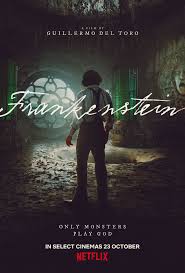
FRANKENSTEIN
US, 2025, 150 minutes, Colour.
Oscar Isaac, Jacob Elordi, Christophe Waltz, Mia Goth, Felix Kammerer, Charles Dance, David Bradley, Lars Mikkelson, Christian Convery, Burn Gorman, Ralph Ineson.
Directed by Gullermo del Toro.
Mexican director, Guillermo del Toro, has had a long fascination with imagination and fantasy, the celebrated Pan’s Labyrinth, and popular action with Blade, Hellboy, Pinocchio. So, what will he choose to do with Frankenstein?
This is very much an all stops out interpretation of Mary Shelley’s classic novel, its narrative, its characters, its explorations of themes of life and death, human arrogance, playing God, playing the devil. Since Boris Karloff played the creature in the 1930s, there have been very many Frankenstein films, and Hammer Studios thrillers, Kenneth Branagh’s 1994 spectacle…
Here is an epic treatment, the Gothic traditions, running for 2 ½ hours.
The familiar elements are all here, the opening in the Arctic with Frankenstein and the monster stranded, the rescue, Victor Frankenstein narrating his story wanting some kind of healing and forgiveness, the background of the Frankenstein family, demanding father, Victor and his scientific interest, experiments with reviving some kind of life, his laboratory, hunting the dead bodies, the creation of the creature, the lightning, the aftermath, the wandering creature and the confrontation with its maker. And all presented with heightened atmosphere.
In all the treatments, the question is how sympathetic Victor Frankenstein should be. Oscar Isaac here is not sympathetic at all – oppressed by his demanding father (Charles Dance), relying for help on his younger brother, William (Felix Kamerer all) and the link with Elizabeth (Mia Goth) and her tender affection for the Creature. There is an interesting new character, the wealthy man, Harlander, Elizabeth’s uncle, who wants to bankroll Frankenstein and his experiments with some sinister intentions, played with his usual relish by Christophe Waltz.
But, significant in this film is that the Creature, not called monster, though made up of many body parts, neatly put together, is, for the most part, the most sympathetic character. And Jacob Elordi plays him with a great deal of pathos, but with dignity, gradually coming to consciousness, words, ideas, out in the countryside learning compassion, to read, but also discover the truth about his origins and that he was doomed not to die.
This is a film which gives great attention to atmosphere, sets and decor, costumes, atmospheric score, enabling audiences to appreciate why the Frankenstein story has continued to be entertaining but much more, a questioning of human power, human arrogance, and the need for forgiveness.
- Lasting popularity of the story, Mary Shelley’s novel and treatment, issues of life, creativity, death, playing God, playing the devil? The many versions, from the 1930s, Hammer Studios, Kenneth Branagh, 1994, the cinema tradition?
- The lavish treatment, sets and decor, costumes, atmosphere? Atmospheric score? The Arctic sequences in the snow and ice, the University sequences, the laboratories, the castles, 19th-century society? The countryside sequences, bleak, wolves, winter?
- The opening in the Arctic, the presence of Frankenstein and the Creature, the ship, the expedition, the Capt, the crew, the confrontation with the Creature, saving Frankenstein, the threats from the Creature, Frankenstein telling his story, his confession, his fate?
- The introduction to the Creature, initial horror, strength, menace, threat to Frankenstein, the interaction with the sailors, violence, deaths?
- Frankenstein telling his story, his background, the sequences with his father, his father’s demands on the cruelty? Treatment of his wife? The birth of his brother? The two brothers grow growing up? The father, the doctor, unable to save his wife, his demands on Victor, testing him as regards medicine, science? His death?
- Victor, relationship with his brother, growing up, his brother’s life, Elizabeth, her relationship with William? Her visits? Her family background? Expectations? Harlander and Elizabeth as his niece?
- Victor, his experiments, his machines, theories, the skeletons, the body parts, his demonstration to the professors in Edinburgh, electric charge, movement and life? Then denouncing him?
- Harlander and his ambitions, personality, state of health, finance, collaboration with Victor, finding the Castle and location? William and his helping his brother build up the laboratory in the Castle?
- Victor, access to bodies, the executioner, the choices, the background of war, injuries, examining the bodies, transporting them to the Castle, the various limbs? Putting them together, sewing, a composite Creature rather than a monster?
- The pressure from Harlander, the confrontation with him, syphilis, wanting to be transferred into the creature, Victor not wanting him because of contamination for his brain, his falling to his death? Concealing his body?
- The storm, the lightning, the drama of his setting up the situation, the Creature, lightning, the movement, coming to life?
- The nature of the creature, tall, presentable, clothing and cloak, able to say only Victor, the humanity, the inhumanity?
- Victor’s reaction, amazed, fearful, presumptuous, the treatment of the Creature, imprisoning him? The effect on Victor’s consciousness, conscience? More than he expected? Not anticipating the consequences?
- The effect on the creature, lonely, exploring the Castle, the relationship with Victor? His ability to heal quickly?
- Elizabeth, her visit, the discovery of the Creature, the bonding, talking, his saying her name? Her response to Victor?
- Victor and his impatience with the creature, lack of development, explaining Harlander’s death to William, the decision to set fire to the Castle, the elaborate preparations, setting the fire, the creatures call, Victor’s change of heart, entering, the explosion, breaking his leg?
- The creature surviving, wandering the countryside, the wolves, the community, his hiding, surviving, the family and their life, hunting the walls, leaving the old blind man, the Creature, listening, understanding, sympathy for the old man, hearing the family’s needs, building, chopping the wood, all kinds of service? The happy life and friendship? The family thinking him the Spirit of the Forest? The old man to Jim to read, speak, think, reflect? Growing understanding? The walls, the return of the family, the Creature fleeing?
- The decision to find Victor, the return to the Castle, the notes, reading them, knowing that he would live for eternity, getting Victor’s address, travelling to Vienna, the buildup to the confrontation, Victor regretting creating him? The Creature wanting a companion? The celebration, society, lavish? Elizabeth, shielding the Creature from the shot, William dying, fearing his brother, the Creature helping Elizabeth that she dies?
- The situation in the Arctic, the response of the captain, encouraging Victor to tell his story, sympathy and understanding, the help of the doctors, the creature coming on board, the explanations, Victor’s repentance, the Creature for giving him? The response of the crew? The captain changing his ambition to reach the North Pole and to return home, the response of the crew?
- The Creature pushing the ship out of the ice, and looking towards the sun, reaching out and beginning his life without death?
