Displaying items by tag: Andrew Garfield
Magic Faraway Tree, The
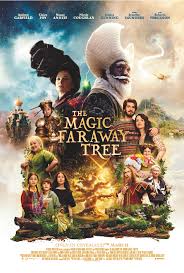
THE MAGIC FARAWAY TREE
UK, 2026, 105 minutes, Colour.
Andrew Garfield, Claire Foy, Delilah Bennett-Cardy, Billie Gadsdon, Nonzo Anozie, Rebecca Ferguson, Jennifer Saunders, Nicola Coughlin, Jessica Gunning, Michael Palin, Mark Heap, Dustin Demri-Burns, Simon Russell Beale, Lenny Henry, Tim Plester, Phoenix LaRouche.
Directed by Ben Gregor.
Enid Blyton, along with Lewis Carroll and Beatrix Potter, is a significant name in speaking about British children’s and family literature. And some of them have been transformed into films and ballets. This film is based on three Enid Blyton stories of the Magic Tree.
Here is a fantasy about children, about families, about imagination. In fact, the Thompson family, Tim and Polly (Andrew Garfield and Claire Foy) have three children. Falling on very hard times, they have to move to the country, where Tim grew up. They find an old barn, no electricity, let alone Wi-Fi! Two of the children are not very pleased, finding the isolation away from friends and technology, hard to bear. They are Beth and Joe. However, Fran, not given to talking much, has a sense of the magic, discovers the Magic Tree, encounters the fairy, Silkie, the giant Moonface, the man who cannot remember his name, and Mrs Washalot. She has a dial to spin, able to pick one of a range of worlds to visit. Fran does, returns home, a challenge to the family, a test for her brother and sister.
While watching, one wonders who the target audience for this film is. A way of understanding is to look at the response of the three children which might correspond to responses of children watching the film. Fran, young girl, is delighted with her discoveries. Joe, even younger, avid games player, does not understand this magic world at all – but, accompanying Fran, he becomes open to its delights. The trouble is with Beth, assertive teenager, described by her upset father as a “spoiled brat”. She isolates herself in the room upstairs, observes with disdain upper window, pines for her phone, her friends, dismissing Fran’s discoveries as nonsense. (And, maybe, some of her fellow teenagers watching the film may have the same reaction!)
But, in our heart of hearts, we know that she will undergo a conversion experience, highly reluctant, condescendingly agreeing – rather nasty with Silky, at one stage wishing her parents tomato and sauce business venture to fail, and then carried away with the experience and definitely on side.
Which means then that there are all kinds of imaginative delights, a world where sweets and lollies are unlimited, a world of knowing a lot, a world of spells – and, of course, a villain, Madame Slap (Rebecca Ferguson), her classroom and, detention, and some rude joke defiance! But, there are the themes of the family unity, the family song, working together, and, happy ending (even convincing Polly’s haughtily severe Germanic mother, played by Jennifer Saunders!).
- Traditional British storytelling for the children’s readership? Families? The film tradition?
- Enid Blyton, her stories, audiences, the trilogy of the Magic faraway Tree? Cinema adaptation? Narrative, characters, imaginative worlds, family themes? Fantasy and imagination?
- The locations, filmed in Malta, forest, the town, the dilapidated barn, the Magic Tree, the variety of worlds, creativity and imagination, costumes and decor, eccentric characters, make, voices? The greenhouse, dilapidated, re-created? The village and the launch? The musical score?
- The family, the financial situation, Tim and Polly, his Italian background, spaghetti and sauces, tomatoes, speaking Italian? Polly, her Germanic mother and demands, her mother disappointed in her? Jobs, finance, having to move, packing up, driving, the lone station, walking, discovering the barn? Tim and Polly and their optimism, creativity? Beth and Joe, spoilt children, demands, losses friends, Wi-Fi issues, computer games…? Fran, more sympathetic, the purse, Silkie and her presence, the sense of the fairies?
- The picture of family life, adapting, Polly and her abilities, planning and design, achievements? Tim, optimism, a steady hand, the tractor, the buildings, the greenhouse? The transformation? The happy parents?
- Beth, sulking, in her room, her complaints, her age? Joe, wanting electricity, not knowing how to play outside? The contrast with Fran, going out, discovering the magic, Silkie, Moonface, Mrs Washalot, the man who could not remember his name? Sharing, delight, discovering the world, going up the ladder, the range of sweets and delights, the supervisor against greed? Happy collecting, the marshmallows, Fran and being tempted, the rescue? Her going home, beginning to talk, with her parents?
- Polly’s mother, her assistant, in town, Jennifer Saunders’ comedy, demanding, and Beth writing the letter, posting it, the arrival by helicopter, demands, disappointment with her daughter, coming back for the launch of the source, naming Beth and her letter? The pressure on Beth?
- The situation, the tomatoes, the source, the family eating, Fran and Joe in competition, but the difficult situation?
- Beth, her agreeing to accompany Fran, the scepticism, the tree, repeating the magic words, opening up, her initial encounters, the washing water falling on her, the shrinking jacket, the familiar characters, Silkie and her enthusiasm, interactions with Beth, friends, sisters, antagonism? Agreeing to go up the ladder?
- The dial, the many possible worlds, the World of Knowing A Lot, the British character actors in the combined presence? Arguments? The way to the World of Spells, going to the hardhearted world, the wishes, Silkie becoming a fairy, Fran and the deep voice, Joe and the head from the computer games, unable to eat pizza? Beth and her wish that the project would fail? Silkie willing to sacrifice her wish so that the others could go back to being themselves?
- The plane, flying to the Castle, the background of Madame Slap, her Castle, the confrontation, the plane, going to sleep, Joe and his piloting the plane, the others on the trip, the confrontation with Madame, the classroom, her severity, and sitting back, detention people being cheeky, going to detention, then the various farts, escape, playing, waking up, her cries and waking the plane, her roar and giving it impetus?
- The discovery of the greenhouse and the failure of the crop, maggots? Tim and Polly trying to cancel the launch?
- At home, the launch, the people gathering, happy atmosphere, enthusiasm, Tim and Polly, going to the greenhouse, opening the door, the ripe tomatoes, the children, even Polly’s mother amazed, the selling of product, the bright future?
- Beth, contacting her friends, their arrival, collecting their phones, dancing and enjoying the launch? Everybody dancing, wishes fulfilled?
After the Hunt
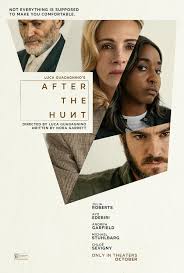
AFTER THE HUNT
US/Italy, 2025, 138 minutes, Colour.
Julia Roberts, Ayo Edebiri, Andrew Garfield, Michael Stuhlbarg, Chloe Sevigny.
Directed by Luca Guadagnino.
We can puzzle about the title. And the nature of the hunt. And the aftermath.
There are several senses and themes, honesty, integrity, issues of sexual assault in the aftermath of the #Me Too movement. And, for the aftermath, there is a very long, still scene, silent, at the end of the film, giving the audience time to think, perhaps to adjust judgements. And, there is an aftermath postscript, five years later.
To appreciate After the Hunt, it is important to ask who the target audience for the film actually is. It is certainly not the general audience looking for entertainment. Most would be bored, sometimes baffled, especially with the discussions and vocabulary – even when spoken by such a star as the popular Julia Roberts. After all, this is a drama set at the Ivy League university range of Yale. In the background is professional eagerness to achieve tenure and the academic and personal perils of losing it. There are tutorials that sound recondite and abstruse, theses on theories in the abstract.
And the cast of characters is strongly in this vein, difficult to like, let alone identify with even in a crisis of accusations of sexual assault which, if not true this time, probably true at another time, a focus on the presumptuous male. Then the victim, young, from a highly privileged generation, very self-conscious, drawing conclusions from the fact that she is black, queer, her parents huge donors to Yale, the staff feeling obliged to promote her, issues of genuine study and accusations of plagiarism. She is played by Ayo Edebiri (from television’s The Bear). The accused is a lecturer, also seeking tenure, played by Andrew Garfield.
In fact, at the centre is Alma, Julia Roberts’ character, a tough surface, brittle manner, intellectual, complex emotions in the present situation, confidante of the accuser, but also going back into her past memories and crises. Her husband is a psychoanalyst, played by Michael Stuhlbarg, provides an anchor for the audience, loving support of his wife but also critical and prone to act out this criticism, like playing booming music to upset her as she wakes each morning, or interrupting her during a serious conversation.
So, the faculty and discussions, board meetings, the student counsellor (Chloe Sevigny) and issues of confidentiality. Luca Guadagnino has directed challenging issues in films for 20 years, best known for Call Me by Your Name and Challengers. There is definitely emotional complexity (especially the revelation of hidden secrets and guilt) but couched in cerebral interchanges and arguments.
When the film was screened at the Venice film Festival, there were 50% love responses, 50% haste responses… And there is like and dislike 50% each way for this reviewer.
- The title? The actual hunt? The aftermath?
- The Yale setting, the reputation of Yale, the Ivy League, wealthy students, wealthy donors, board and management, the philosophy faculty? University sequences, home sequences, street and restaurants…? The range of the musical score? Pounding, quiet, background?
- Target audience, not the popular audience, the philosophy faculty, the philosophical discussions and issues, language and vocabulary, the tutorials and the discussions? Abstract?
- The introduction to the main cast, the University, the tutorials, Alma and the students, the discussions, their personalities? Maggie and her presence? The party, Alma and Frederic getting ready, their guests, Hank, Maggie? The immediate impressions of each, Alma, her age, Julia Roberts, more brittle personality, emotions and control? The issue of tenure? Hank, personality, lecturing, the issue of tenure? Maggie, her age, black, queer, her parents and donations, her thesis, praise, the underlying issue of plagiarism? Frederick, the host, his relationship with his wife, psychoanalysis, contribution to the discussions?
- The aftermath, Hank and drinking, escorting Maggie? Maggie approaching Alma, the accusation? Maggie’s reaction? Her relationship to Hank, memories of the past, his reputation with women? Her reaction to Maggie, the issue of plagiarism? The effect on Alma? Her relationship with Frederick, his support, the loud music in the morning, the issue of inviting Maggie to dinner? Her delay, Frederick and his reaction, Alma and Maggie talking, the loud music, his coming in and out?
- The authorities, the faculty, the discussions, with Alma, the Counsellor doctor, her presence, discussions with Alma, confidentiality? The like and dislike between them? Ultimate decisions? Hank, the issue of tenure, his being fired after the accusations? Alma and the tenuous situation?
- Alma, the discussions with Frederick, the revelation about her past, the seduction, her cooperation, age 15, the man, her devotion, the break, her accusation, his suicide? The consequences for her, immediate, over the decades?
- The encounter with Hank, his plea, the attraction, the kiss, her rejection?
- Maggie, her background, her family, the thesis, the plagiarism, sense of privilege, the issue being queer, her partner and explanations, being black? Her determination, the accusations, the case?
- Alma and the later tutorial, the students, the abuse, her responses, the silent student?
- Audience identifying or not with the characters, the issues? Judgement on Hank, judgement on Maggie? Alma and Frederic, the discussion – and the very long take, allowing the audience time to consider?
- Five years later, Maggie, still at the University, the meeting with Maggie, the discussions, Maggie and her career, her attitudes towards Alma, letting retribution go, not quite reconciliation? Alma and Frederic together? The future?
We Live in Time
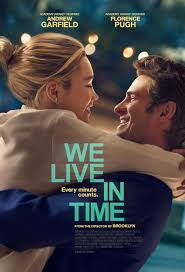
WE LIVE IN TIME
UK, 2024, 108 minutes, Colour.
Andrew Garfield, Florence Pugh, Grace Delaney, Lee Braithwaite, Adam James, Douglas Hodge, Niamh Cusack.
Directed by John Crowley.
We live in time, moment by moment, day by day, year by year, a linear progress. But, in time, we also have the capacity for moving backwards and forwards in our memories.
It is important to note this for this film because rather than the linear progress of a couple meeting, falling in love, having a child, coping with illness, the screenplay moves backwards and forwards, sometimes disconcerting, the audience having to be alert to appreciate at which period in time the action is taking place. Which means that the experience for the audience is not immersive as a linear exposition would offer, but, rather, a variety of responses as we move backwards and forwards in time for insights and comparisons.
And, with living in time meaning from birth to death, this film is very strong in an unusual and sometimes graphic (but happy) birth sequence as well as a contemplation of illness and death.
The film was directed by John Crowley (Brooklyn, The Goldfinch) and gives strong opportunities for performance by the two stars. Andrew Garfield is Tobias, working with Weetabix and its promotion, a strong presence but designed very much to be supportive of Florence Pugh as Almut who, in fact, knocks him down in her car, not the most propitious of meetings. In fact, this is very much Florence Pugh’s film, a strong screen presence as has been shown in a range of films, comedies, dramas and even Marvel Universe actioners, dominating the film, her personality, her moods, her skills as a chef, her pregnancy and the challenge of the birth, her love for her daughter, her having to face serious cancer.
With moving backwards and forwards in time, we do have the opportunity to appreciate Almut’s response to her illness in the light of her previous activities, approaches to life. And, while she is fully alive with her husband and child, her skills as a cook, a chef, are significant, propelling her, even as she is sick, to join in the UK tea, in a chef’s competition in Italy.
The film has a strong female sensibility (though written and directed by men), inviting an empathy with Almut, not always liking her, irritated sometimes with her, but also in admiration of how she deals with life and life challenging situations.
- The title, the focus on time, but not in linear time for the narrative, moving about in time, and themes of time from birth to death?
- The British film, locations, characters, issues? The London sequences, the home and interiors, the grounds? The Italian sequences, the travel, the chef competition? The musical score?
- The effect of the narrative being non-linear, audiences jolted, identifying the time situation? The role of memory, memories and interpretation, understandings of the past? Preparing for the future?
- The bond between Tobias and It? The initial encounter, Tobias and the divorce, upset, being hit by the car, in hospital, the initial encounter with Helmet? Explanations? Each personality? Tobias, the impact of the divorce? Helmet, her parents, the story, skating, family life? As a chef? Seeing her at work, the kitchen, the staff, creativity, with Jade?
- The development of the relationship, Tobias, his work, manner, the meetings with helmet, wanting to depend, time passing, falling in love, the ring in proposal? The bonding together? Families? The issue of children, the disputes?
- The backwards and forwards, the issue of helmets illness, the past, recovery, the recurrence, the effect on her, the consultations, the advice, medical treatment? Success? Failure? Her work, the decision to continue with the cooking, the effect on her, being sick, the issue of the hysterectomy?
- The pregnancy, her working, the effect? Tobias and anxiety? Held up in the traffic, the service station, the attendance, the drama and comedy of the birth? Success?
- The scenes of happy family, their daughter, the playful sequences, the outings? The effect on each of them?
- The decision to carry on with the cooking, the background of her success at the restaurant, Simon and his urging, choosing Jade? The clash with Tobias, his challenges to her, her response, wanting something that her daughter could remember her by? Change of heart, the winning of the UK session, going to Italy, Tobias and the daughter supporting her?
- The symbolic skating, her past championship, Tobias awkward?
- Her death, Tobias and his daughter returning home, the dog, the chicken coop, memories of the past, how to crack eggs?
