Displaying items by tag: Robert Donat
Young Mr Pitt, The
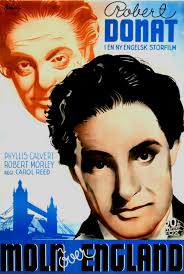
THE YOUNG MR PITT
UK, 1942, 102 minutes, Black-and-white.
Robert Donat, Robert Morley, Phyllis Calvert, John Mills, Raymond Lovell, Felix Aylmer, Max Adrian, Herbert Lom, Jean Kandel.
Directed by Carol Reed.
The film is a star vehicle for renowned British actor, Robert Donat, during World War II. (Comparisons implied between Napoleon and his aggression and the Nazi overwhelming of your about to Hitler. Comparisons between William Pitt and his stances against Napoleon and Churchill confronting Hitler.)
Donat had made a great impression on stage in London but also in the film, especially with his role in The Private Life of Henry VIII, then as the Count of Monte Cristo, a succession of prestigious roles, serious and comic in the latter part of the 1930s, culminating in his Oscar-winning role in Goodbye Mr Chips, 1939.
There was a break between Goodbye Mr Chips and The Young Mr Pitt, three years.
The film is a detailed re-creation of England, especially at the end of the 18th century and the beginning of the Napoleonic wars. Robert Donat also appears as the older Pitt, passing on his political legacy to his son, the credits noting that the speeches by both Pitts came from the actual records.
Pitt is was prime minister for several decades, falling briefly out of favour with the threat from France after the Revolution but then regaining the prime ministership and the confronting of Napoleon. Robert Morley appears as Fox, invited to collaborate with Pitt but refusing, mocking, but eventually coming onto his side.
There is a gallery of British character actors in support and, interestingly, an early John Mills appearance as William Wilberforce. Herbert Lom all yes yes is what is there and stops on’s’s offices are all there is the’s plays Napoleon – and was to do so in 1956 in War and Peace.
The film was directed by Carol Reed who had been emerging during the 1930s with such films as The Citadel. Perhaps his most famous film, from 1949, was his version of Graham Greene’s The Third Man. Reed continued directing during the 1950s and, surprisingly, won the Oscar for Best Director in 1968 for Oliver.
- Audience knowledge of William Pitt, his father, his long prime ministership, during the French Revolution, the rise of Napoleon, the war with France? Nelson?
- British filmmaking in 1942, World War II, dramatising British history, in wartime, the leadership of the Prime Minister, an enemy from the continent (Pitt and Napoleon, Churchill and Hitler)? The public supporting the war effort?
- The film as “intelligent”? The quality of the screenplay language, well articulated, period sequences yet conveying a great deal of history and character? Costumes and decor, vivid recreation of the period? The musical score?
- The introduction, the senior Pitt, his political role, verbatim speeches from history, his evening with his son, passing on the inheritance? The drinking, the respect, the family pride?
- Robert Donat’s presence and performance, credibility, deliverance of speeches, also verbatim from history? His age, his inheritance, his skills, the ridicule of the political opposition, the king, appointing him prime minister? His approach to Charles Fox, refusing? Entry to parliament, the exaggerated mockery? His speeches?
- The screenplay, moving through almost 20 years, not many indications of dates and how much time passing? Audience applying this?
- Pitt, his advisers, the relationship with William Wilberforce, Smith as his assistant and secretary? The other friends? The incident of his being mobbed, the physical training centre, the man coming to the rescue and joining the fight, indicating Pitt’s support amongst the people? The newspaper headlines, Fox losing popularity, Pitt, in Parliament?
- The overview of his social achievements? Hard work?
- Issues in France, the French Revolution, the execution of the king, Fox and his sympathy for the French? His speeches in the parliament, ridiculing of Pitt? Pitt and his stances, national pride?
- Napoleon, his signature, his rise, power, the 1790s, Toulon, the siege, British ships, Pitt and his decision to build up the navy? The collage of huge ships filled and launched? Confrontations with Napoleon? The scenes with Napoleon, building up his presence on par? The visit by Talleyrand, by the American, Pitt and his stances?
- Opposition to his approach, the ridicule and the parliament? The irony of his reading the message about the victory in Egypt? The choice of Nelson, the church sequence, the appointment, Nelson and his achievements, especially Trafalgar?
- Lord Auckland, diplomatic, his daughter, Pitt and the visits, playing games with the children, the attraction to the daughter, the conversations? Her support? The coach and nodding off and driving to the house, her waiting, Pitt turning back to his work?
- The new Prime Minister, appointed by the king, the parallels with 1938 and appeasement of Hitler, the appeasement of Napoleon, focusing on domestic issues rather than defence?
- The further dangers, the appointment by the king, Fox coming to support him, Wilberforce after an initial hesitation, support?
- Pitt and his help, the doctor’s advice, the nanny and her care, his long working hours, drinking, ignoring the medicine?
- The film and its tribute, his achievement, death at 46? And morale boosting in 1942?
Cash/ If We Were Rich
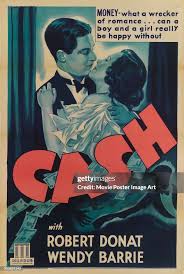
CASH (FOR LOVE OF MONEY/IF WE WERE RICH)
UK, 1933, 62 minutes, Black-and-white.
Robert Donat, Edmond Gwenn, Wendy Barrie.
Directed by Zoltan Korda.
The third film, small budget, for celebrated British actor, Robert Donat. The same year he was to appear in The Private Life of Henry VIII and quickly invited to Hollywood for The Count of Monte Cristo. Donat did not like Hollywood and returned and stayed in England for the next 25 years until his death, making a number of significant films ranging from The Ghost Goes West to The Citadel to The Winslow Boy. He won the Best Actor Oscar in 1939 for Goodbye Mr Chips.
In some ways this film is very quaint, small-budget British filmmaking of the early 1930s. The focus is on money, Edmond Gwenn playing a scheming businessman trying to play off his friends, but rather limited in his cash. The creditors are after him. Wendy Barrie plays his support daughter.
The complication comes when the assistant creditor, Donat, charming in his manner, is attracted to the daughter, finds $100,000 in cash in a bag, place there allegedly by a thief, uses the cash to charm the daughter and the old schemer who then arranges for discussions, on the visual evidence of the cash, for a huge entertainment scheme (and, in the 1930s, reference to one of the attractions as sex appeal).
The greedy colleagues all make a contract. The young man is able to get a is one from the businessman. The butler who has actually paid of the schemer’s bill for home delivery of food, without noticing, actually stokes the fire using all the cash. And, the newspapers then reveal that it was forged cash.
Not particularly startling, more historical interest, and with two Oscar winners, Robert Donst himself and Edmond Gwenn, who is probably best known as Santa Claus, Kris Kringle, Oscar winner for The Miracle on 34th Street.
