Displaying items by tag: Dinah Sheridan
Story of Gilbert and Sullivan, The
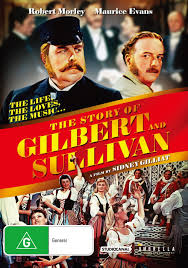
THE STORY OF GILBERT AND SULLIVAN
UK, 1953, 109 minutes, Colour.
Robert Morley, Maurice Evans, Eileen Herlieh, Peter Finch, Martyn Green, Dina Sheridan, Isabel Dean, Wilfred Hyde-White, Muriel Aked, Michael Ripper.
Directed by Sidney Gilliat.
From a 21st-century perspective, it is surprising to discover that this film was not successful at the box office on its release in the early 1950s. Yet, the operettas of Gilbert and Sullivan continued to be very, very popular.
This is quite a lavish production, sets and costumes, theatrical design, English society in the latter part of the 19th century.
For audiences interested in Gilbert and Sullivan, Robert Morley gives a variation on his enjoyably pompous performances as the self-confident Gilbert, master of words and witty lines, yet dreading opening nights, avoiding them, returning to hear applause and go happily on stage. Maurice Evans is Sullivan, classical composer of oratorios, eventually an Opera, teaming up with Gilbert, challenged by friends and a potential fiancee played by Dinah Sheridan, to honour his talent for high art. However, he is carried away and has composed many wonderful melodies, songs to accompany Gilbert’s words, but the music having a stand alone and entertainment value.
The screenplay follows the various productions, reproducing scenes from some of the most famous and well known. The film starts with an extensive excerpt from Trial By Jury, then moves into such favourites as HMS Pinafore, the Pirates of Penzance, The Mikado, The Gondoliers and Yeomen of the Guard, Iolanthe. And references to other creations like The Sorcerer.
Peter Finch appears as D’Oyley Carte, the manager of the company, the builder of the Savoy Theatre, involved in the building of the Opera house. There are quite a number of British character actors in support, Eileen Herlie as Helen D’Oyley Carte, a successful business partner with her husband, Isabel Dean as Gilbert’s wife and an entertaining cameo from Wilfred Hyde-who is to who enjoys the performances unlike his snobbish daughter.
There is some pathos at the end after Gilbert and Sullivan’s falling out, not speaking for some years, a possible reconciliation, the turn-of-the-century performance of the Yeomen of the Guard and the news of Sullivan’s death. Gilbert continued and was knighted by Queen Victoria, the culmination of the film.
In 1999, writer-director, Mike Leigh, did more than justice to Gilbert and Sullivan and their creations in his lavish and engaging film, Topsy Turvey.
Calling Paul Temple
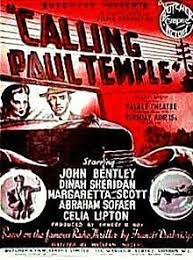
CALLING PAUL TEMPLE
UK, 1948, 92 minutes, Black-and-white.
John Bentley, Dinah Sheridan, Margaretta Scott, Abraham Sofaer, Celia Lipton, Jack Raine.
Directed by Maclean Rogers.
This is the first two films focusing on writer and detective, Paul Temple, played by John Bentley with Dinah Sheridan as his wife. The second film, 1950, was Paul Temple Triumphs.
The significant contributor to this film is the writer, Frances Durbridge, popular with his many novels, the Paul Temple series going to radio for over 30 years, later at 24 part television series with Francis Matthews as Paul Temple. John Bentley himself featured in quite a number of small-budget British supporting features in the 1950s but was very successful in the television series, 255 episodes, Crossroads, from the mid-60s to the mid-70s.
The film opens on the train, a mysterious death, a signature on the blind, REX. It appears that this is one of a series of murders, investigated by various police, and interest from Scotland Yard, calling in the the assistance of Paul temple with his writing and detective skills. And, in this story, strongly assisted by his wife in all investigations.
Surprisingly, the next sequences in a nightclub, many affluent guests, a spacious singing and dancing area, and a performance, attractively provocative, by Celia Lipton. And, then more surprisingly, another song. However, we have seen in her dressing room she has written a note for the police to give them information about the murders. During a performance, she collapses and dies.
As expected, there is quite a range of suspects, a particular focus on a dpctpr, played by Abraham Sofaer, three of his patients have been killed. Then there is a strong, sometimes mysterious presence of his assistant, played by Margaretta Scott.
For audiences who enjoy this kind of small-budget, supporting feature film, the type of story so popular in television series to come, there are plenty of suspects, moments of danger, twists, even including the Dr hypnotising his assistant and forbidding her to give information.
And, as a bonus, there are many sequences actually filmed in Canterbury, in the streets, hotels, cafes, Cathedral, ruins of friary’s…
There is a twist in the solution, the common denominator being Egypt’s prior to World War II. However, there is something of an anti-climax because audiences enjoy the unmasking of a significant murderer race here he is not such an interesting and dramatic character!
